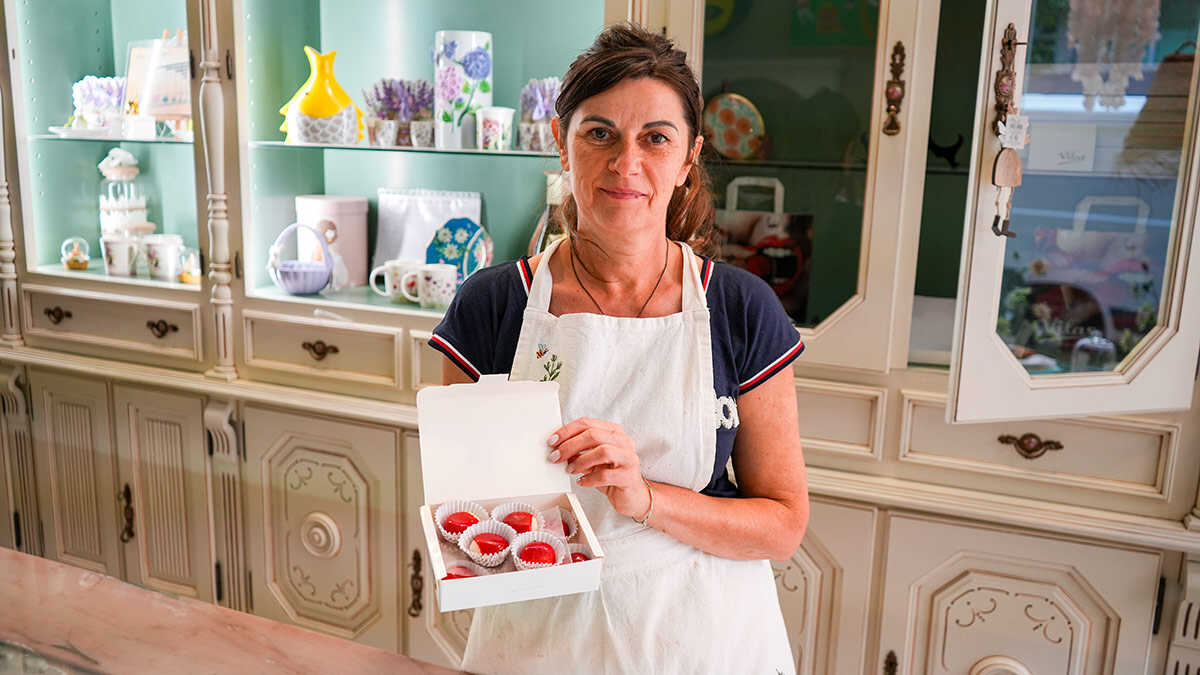
Many hands have worked in Vilas’s bakery since then. Now it is Flor Petre who is responsible for keeping alive a story that began 289 years ago. She has owned the establishment for just two years, but knows every corner of the business well because she has worked there for a decade. When the previous owners decided to retire, the future of the confectionery was left hanging in the balance: close or find someone willing to continue. The sale notice remained up for a year without anyone taking the step. Until Flor decided to do so. She had spent eight years also learning the trade in the bakery and, at 52, was facing the possibility of losing her job. She took out a loan and took the reins of Vilas. “Now I make decisions doing what I was already doing before,” she says.
Born in Romania and based in Aragon for 22 years, Flor began her career at Vilas behind the counter, working as a sales assistant. Little by little, she also became involved in the bakery, learning the shop’s recipes and working methods. When the time came to decide the future of the confectionery, more than a job opportunity was at stake: the survival of a centuries-old establishment in a city that has already seen other pastry shops disappear for lack of a new generation to take over.
THE TASTE OF ALMOST THREE CENTURIES
Vilas’s history began in 1737 with Raimundo Vilas, as a confectionery and candle shop. In those early days, the establishment produced more than just pastries: it also made candles for convents, baptisms and all kinds of celebrations. This gave rise to a close relationship with the Church that lasted for generations and left behind some unusual traditions. The former owner, Antonio Vilas, eventually left the confectionery to his accountant on one condition: every Saturday, sweets and pastries had to be taken to the church. For years, there was also a tradition of blessing products associated with important celebrations, such as Three Kings’ cakes.
The confectionery has not always occupied number 5 on Alcoraz Street, either. Its original premises were in Coso Bajo, until damp problems caused the building to collapse. Around three decades ago, the business found a new location and moved both the shop and the bakery there. The address changed, but not a way of working that still champions handmade products today.
Marzipan, nougat, saint’s bones, delicias, almond and pine nut pastries, cakes, tarts, tea pastries, chocolates, empanadas and cheesecakes currently fill its display cases. Among this wide range, Flor points to three products as being especially closely linked to the shop’s identity: the soufflé, the Loreto cake and, above all, the marzipan chestnuts, Vilas’s true signature product.
Almonds and sugar are the foundation of Vilas confectionery’s marzipan chestnuts. Photo: Diego Sanz
Marzipan chestnuts can be found at different establishments in Huesca, but Vilas’s have their own story: the shop’s original recipe was created by Antonio Vilas. Almonds and sugar are the basis of an apparently simple product that continues to be made here using traditional methods. This way of working also means rejecting industrial shortcuts. Vilas does not use additives or preservatives in its products, Flor explains. Adding them would extend the sweets’ shelf life and open the door to distributing them in large supermarkets, but it would mean changing the philosophy that has accompanied the establishment for generations.
Flor does not seem willing to do that. “It is anchored centuries in the past, for better or worse,” she says of the confectionery. A characteristic that, far from hiding, she embraces as part of its identity: “As long as I’m here, it won’t be industrialized.” In the bakery, the aim remains for the sweets to taste like what they are: almonds, sugar and raw ingredients worked by hand.
A STORY THAT REMAINS ALIVE
When Flor decided to take charge of Vilas, she had one concern. After the confectionery had been tied to the same family story for so many years, and because she was from elsewhere, she feared that some customers in Huesca might view the change with a degree of distrust. The opposite happened. “Huesca’s customers are loyal, and those who know the products trust us and place many orders,” she explains. Another new group is also joining this faithful clientele: “More and more people from outside the area are coming specifically to buy our own products.”
The confectionery is located at 5 Alcoraz Street. Photo: Diego Sanz
This loyalty makes it possible to sustain a method of production that requires time and people. Five people currently work at Vilas: three in the bakery and two in the shop. At a time when many traditional businesses are struggling to find someone to take over, the confectionery seems to have resolved that uncertainty. Flor’s son and daughter-in-law are among those working in the bakery, learning and already taking part in the establishment’s daily life.
After almost three centuries, the story Raimundo Vilas began in 1737 with candles and pastries continues among almonds, sugar and trays fresh from the bakery. Flor arrived as a sales assistant, learned the trade and, when no one seemed willing to take over, decided to go into debt so the shutters could continue to be raised every morning. Now she looks toward the next generation with one certainty: “Vilas will not cease to exist; there is a lot of life behind it.”