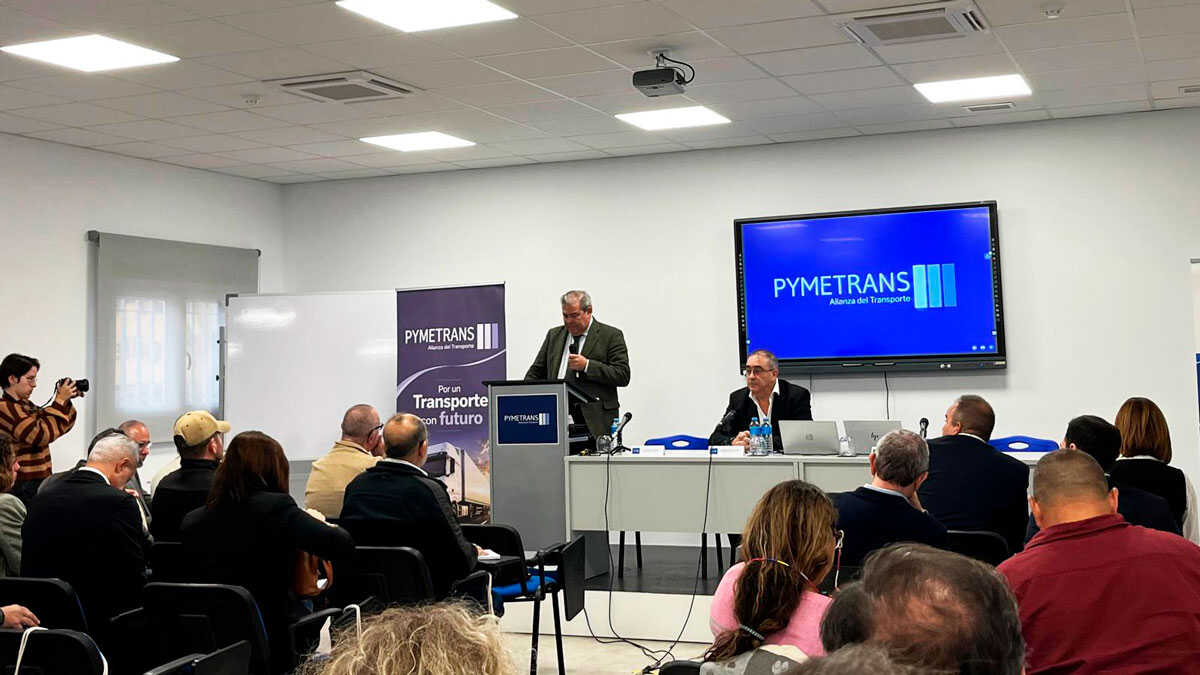
Against this backdrop, Pymetrans held a Technical Conference on Transport Digitalization, bringing together business owners, professionals and specialists at Tradime’s headquarters in Zaragoza’s Transport City to analyze the sector’s main challenges in digital transformation, vehicle modernization, regulatory compliance and access to financing.
During the opening of the conference, Pymetrans President José Antonio Moliner highlighted the need to support companies throughout this transformation process, taking into account the specific characteristics of a sector largely made up of self-employed operators and small businesses.
Business owners, professionals and specialists gathered at Tradime’s headquarters in Zaragoza’s Transport City
“Digitalization is a reality that we have to adapt to, but we cannot forget that behind every new obligation there are companies that need time, resources and training to comply with it. The same effort cannot be demanded from a self-employed operator with one truck as from a large company with specialized departments,” Moliner said.
The Pymetrans president insisted that transport modernization must translate into real benefits for companies. “We support all tools that help reduce paperwork, cut costs and improve management, but digitalization cannot become more bureaucracy or a new financial burden for small carriers. Public authorities must facilitate this transition and ensure that no one is left behind,” he added.
The conference featured four technical presentations on the present and future of road transport
NEW TECHNOLOGIES, LEGAL CERTAINTY AND DOCUMENT DIGITALIZATION
The conference featured four technical presentations focused on issues of particular importance for the present and future of road transport.
The first presentation was delivered by Sergio Manero, managing director of Motortrans–Covei, who discussed the possibilities offered by connected trucks and the incorporation of new technologies into industrial vehicles. His presentation examined advances in connectivity, telemetry to optimize fuel consumption, predictive maintenance and integrated systems that can improve fleet efficiency, safety and management.
José Manuel Hidalgo and José Loarce, lawyers at Sin Riesgo Penal, addressed the main legal risks and liabilities faced by road transport companies, stressing the importance of adopting preventive measures and ensuring regulatory compliance, particularly in the case of small and medium-sized enterprises.
One of the central topics of the meeting was the implementation of the Electronic Administrative Control Document (DeCA)
One of the central topics of the meeting was the implementation of the Electronic Administrative Control Document (DeCA) and electronic invoicing, addressed by José Luis Bueno, CEO of Plataforma de Control Digital – Grupo Davinci. His presentation examined the first days of the new digital obligation, including a practical demonstration of how the electronic control document works and the tools available to facilitate its implementation.
The implications of electronic invoicing for transport companies, adaptation deadlines and the opportunities offered by automation to reduce administrative tasks and streamline management processes were also discussed.
The final presentation was delivered by Ignacio Ezcurra, manager of Tradisna, who explained the main public grants and financing programs aimed at promoting the digitalization and modernization of transport companies. His presentation reviewed the requirements for accessing the calls for applications and the opportunities these instruments offer to facilitate the investments needed in new technologies and management tools.
With this conference, Pymetrans reaffirms its commitment to defending the interests of small and medium-sized transport companies
The conference concluded with remarks from Carlos Pascual and José Manuel Peña, members of Pymetrans’ Presidency Committee, who highlighted the achievements made by the federation since its creation. Despite its short history, Pymetrans has shown that rigor, unity and teamwork are essential to driving change. This collective effort is gradually bearing fruit and making it possible to achieve significant and necessary progress for the sector.
With this conference, Pymetrans reaffirms its commitment to defending the interests of small and medium-sized transport companies by promoting training, advice and knowledge sharing to help the sector address technological and regulatory challenges.