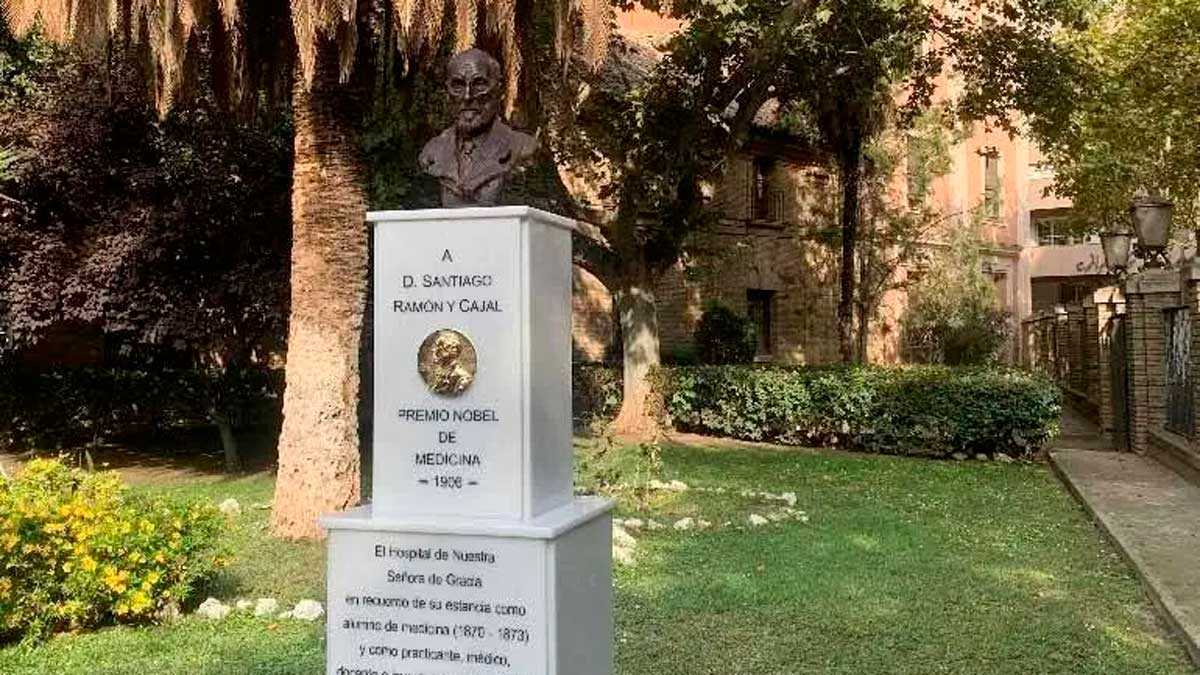
The sculpture was installed in the hospital’s entrance gardens, a particularly significant location for the Aragonese scientist. Ramón y Cajal had trained under his father at the center, where he worked in 1876. He also practiced as a rural doctor in several municipalities across Aragon and developed part of his professional and research career at the University of Zaragoza.
The unveiling had a distinctly familial character. His great-grandnephew, who shares the scientist’s name, highlighted his family’s close relationship with the hospital. “For more than 150 years, doctors from our family have worked at this hospital, specifically across five generations,” he recalled, visibly moved by the tribute.
The Aragon Government’s then-Health Minister, Sira Repollés, stressed the importance of having a visible tribute to the scientist in Zaragoza. “It was time for Aragon, and more specifically Zaragoza, which was Ramón y Cajal’s birthplace, to have an outdoor bust that everyone could see and admire,” she said.
For her part, the then-president of the Zaragoza Medical Association, Concha Ferrer, recalled a lesser-known side of the researcher: his talent for photography. She noted that he had created a collection of images from the early 20th century comparable to works recognized with major awards.
The bust thus became a tribute to Ramón y Cajal’s scientific career and his connection to medicine in Aragon. This is how we reported it in Aragón Digital five years ago, in the original story about the unveiling of his sculpture at Zaragoza Provincial Hospital.