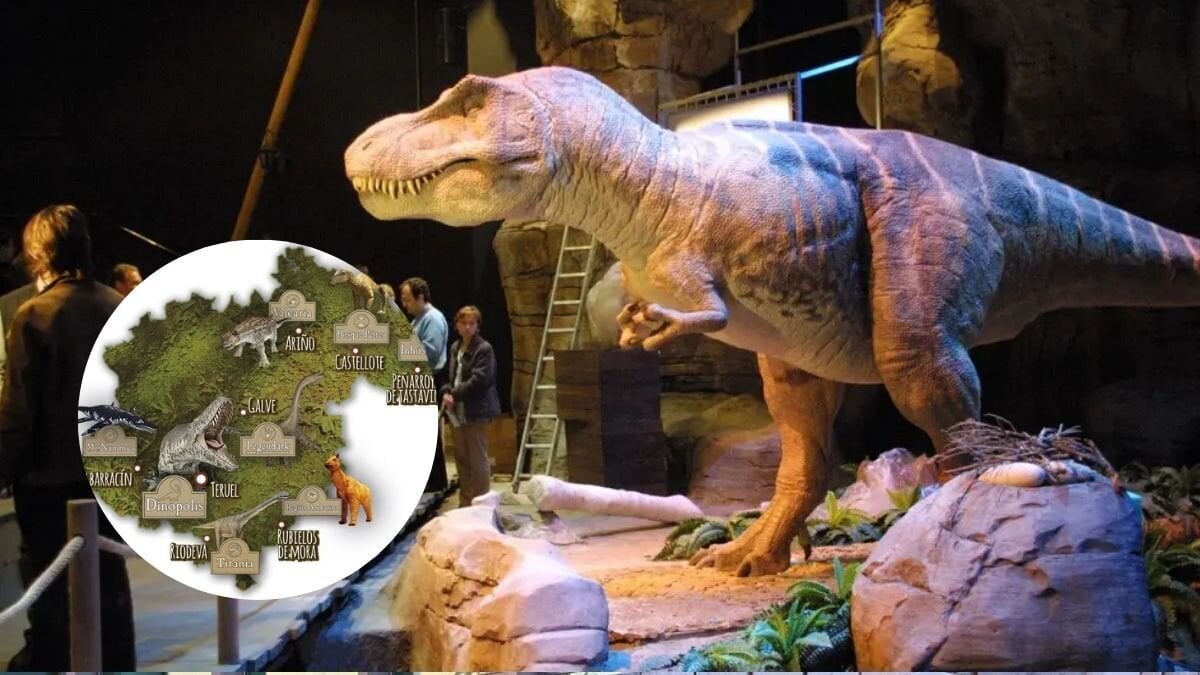
Teruel is also home to numerous ichnite sites—fossilized footprints—that offer a direct glimpse of the tracks left by these animals.
Initiatives to explore this heritage include the Dinosaur Footprint Route, promoted by the Dinópolis Foundation, as well as other paleontological sites and centers spread across different municipalities in Teruel province.
Here are some of the places where you can follow in the footsteps of dinosaurs in Teruel.
GALVE
We begin in Galve, one of the major centers of paleontology in Aragon. It is home to Legendark, one of the Territorio Dinópolis sites, where you can learn about Aragosaurus ischiaticus, considered the first dinosaur scientifically defined in Spain.
Legendark. Photo: Dinópolis.
The center features life-size replicas and offers visitors the chance to discover fossils and other remains found in this municipality in Teruel province.
But if you want to see authentic footprints, one of the standout sites is Las Cerradicas, located near Galve. This site preserves dozens of footprints arranged in several trackways and is of significant scientific importance.
EL CASTELLAR
We continue to El Castellar, one of the leading municipalities for exploring Teruel’s dinosaur footprints.
One of its most notable sites is El Pozo, where around 1,000 dinosaur footprints have been recorded, mainly belonging to sauropods, ornithopods and theropods. More than 2,000 ichnites have been documented across the municipality.
El Castellar. Photo: Dinópolis.
In addition, El Castellar returned to the international paleontology map in September 2026. Researchers from the Dinópolis Foundation identified remains belonging to Diplodocus at the La Tejería site.
The remains studied include 14 tail vertebrae and several chevrons from an animal that lived around 150 million years ago. They represent the first scientific identification of Diplodocus outside North America.
ARIÑO
Our next stop is Ariño, home to Valcaria, one of the Territorio Dinópolis sites.
The center was created following major paleontological discoveries made at the Santa María de Ariño mining operation. Numerous fossils have been recovered there, helping reconstruct what this territory was like during the Cretaceous period, around 111 million years ago.
Valcaria. Photo: Dinópolis.
Unlike other points on this route, Valcaria’s main paleontological attraction is not the footprints preserved in the ground, but the fossils found in the area and the reconstructions of the animals and ecosystems that existed at the time.
ABABUJ
We continue to Ababuj, whose historic dinosaur footprint site was declared an Asset of Cultural Interest in 2003.
It preserves around 25 ichnites, including footprints attributed to sauropods and other three-toed tracks.
Ababuj site. Photo: Dinópolis.
But the discoveries are not over. In 2025, excavations carried out by the Dinópolis Foundation at the Santa Ana site, also known as Ababuj 3, uncovered more than 250 new dinosaur footprints across an area of around 200 square meters.
They include ichnites made by sauropods, ornithopods and theropods. Some even preserve impressions of sauropod toes and claws, a type of detail that is uncommon in the fossil record.
CASTELLOTE
Our route continues in Castellote, the municipality where the Abenfigo site is located.
There, visitors can see 41 three-toed dinosaur footprints associated with theropods and preserved on limestone strata from the Upper Cretaceous.
Abenfigo site. Photo: Dinópolis.
The footprints were impressed in the sediments and later covered by new layers. Geological processes and erosion eventually exposed these tracks, which date back millions of years.
MIRAVETE DE LA SIERRA
To conclude this route, we arrive in Miravete de la Sierra, home to the Miravete 1 and Miravete 2 sites, both declared Assets of Cultural Interest.
Paleontological work carried out in the area has made it possible to record more than 500 ichnites across the site complex, following new work undertaken by the Dinópolis Foundation.
Sign inside the Miravete de la Sierra site. Photo: Dinópolis.
To reach the site prepared for visitors, you have to follow a trail of around 300 meters from the town. Along the route, various information panels offer a closer look at the footprints and reveal what this territory was like millions of years ago.
Galve, El Castellar, Ariño, Ababuj, Castellote and Miravete de la Sierra are just a sample of Teruel’s vast paleontological heritage. And the discoveries continue: the new footprints found in Ababuj and the recent identification of Diplodocus in El Castellar show that the province still holds many secrets beneath its rocks.