VALDERROBRES CASTLE
Valderrobres Castle, located in the Matarraña district of Teruel, is a prominent tourist destination with roots dating back to the end of the 12th century.
Built on the site of an ancient Muslim fortress after the Reconquista, this Gothic castle stands out for its hexagonal structure and impressive façade, typical of the architecture of the Crown of Aragon.
Valderrobres Castle. Photo: Tourism of Aragon
Inside the castle are notable spaces such as the Stables Hall, the Chapter House, the Chimneys Hall and the Golden Chamber, each offering a glimpse into medieval life.
Surrounded by a well-preserved wall and a parade ground, Valderrobres Castle is not only a journey through history but also an exceptional architectural attraction.
PERACENSE CASTLE
Peracense Castle, located in Aragon at almost 1,400 meters above sea level in the Sierra Menera, is a 13th-century fortress built to defend the border with Castile.
The castle stands out both for its impressive setting and its strategic design, with three concentric enclosures built on the rock that make it virtually impregnable.
Peracense Castle. Photo: Tourism of Aragon
The walls, made of reddish rodeno stone, add unique visual appeal to this medieval structure. Its architecture and location make Peracense Castle a historic landmark and one of the most notable castles in Aragon.
ALCALÁ DE LA SELVA CASTLE
Alcalá de la Selva Castle, with roots dating back to the Muslim period, played a crucial role in the town's defensive history, although few traces remain today of the walls that once protected it.
Alcalá de la Selva Castle. Photo: Tourism of Aragon
Located in an area where visitors must park in the town and continue on foot, this castle offers an enriching historical experience in an impressive natural setting.
For those interested in exploring this piece of history, the castle offers guided tours, allowing visitors to immerse themselves in its fascinating past, although it is currently permanently closed.
ALBARRACÍN ALCÁZAR
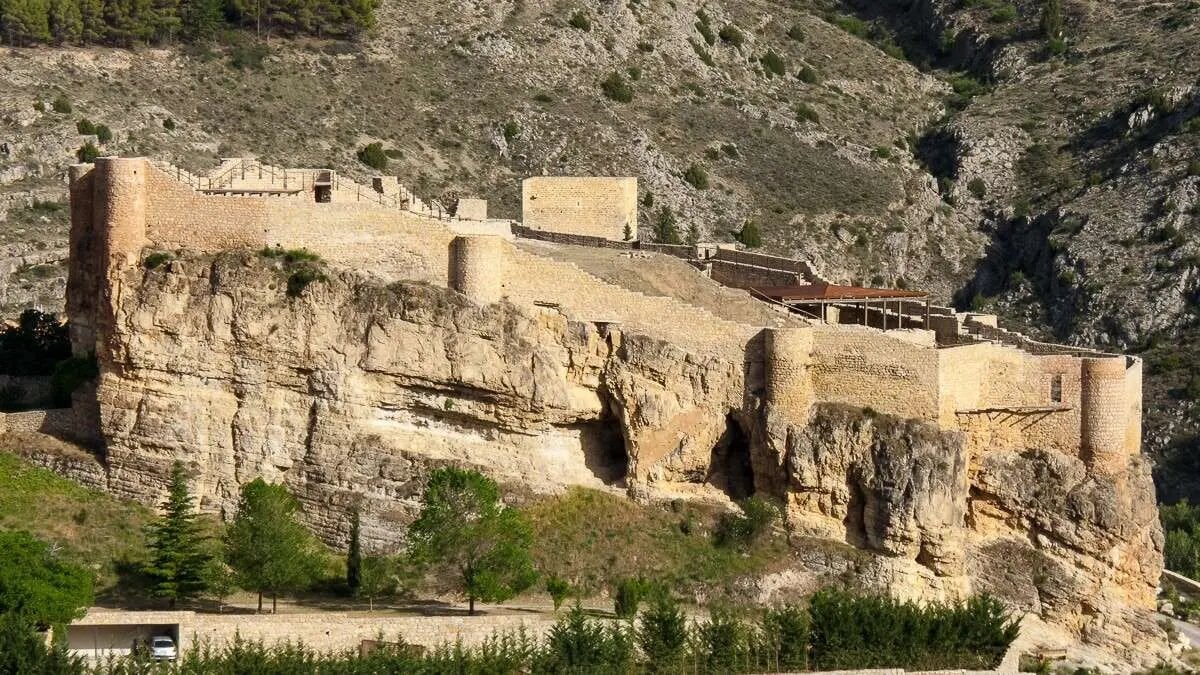
The Albarracín Alcázar, a 10th-century Muslim fortress built on Roman remains, is a key part of the heritage of this town, famous for its architecture and medieval walls.
Albarracín Alcázar. Photo: Wikipedia
Situated on a hill, it offers panoramic views over Albarracín. Although it lost its military function in the 12th century, restoration work in the 1990s preserved its towers and walls, making it an important tourist destination that reflects the region's rich military history.
PUERTOMINGALVO CASTLE
Puertomingalvo Castle, perched on an impressive rocky outcrop at almost 1,300 meters above sea level, is one of the province's most notable fortifications.
Although it has lost much of its original structure over the centuries, including the height of its keep, the castle remains a prominent historic symbol in the region.
Puertomingalvo Castle. Photo: Tourism of Aragon
Today, the former parade ground has been refurbished for cultural events and theatrical performances, giving it a new purpose as an open-air cultural center.
One of the castle's most striking architectural details is a mullioned window, distinguished by being made of lighter-colored stone that contrasts with the wall in which it is set.
ALCAÑIZ CASTLE (OR CASTLE OF THE CALATRAVANS)
Alcañiz Castle, also known as the Castle of the Calatravans, is a renowned attraction in the Bajo Aragón district and one of the most visited sites in Teruel.
Originally belonging to the Order of Calatrava and carefully restored, it stands out for its 14th-century Gothic keep and a Romanesque chapel with Gothic wall paintings.
Castle of the Calatravans. Photo: Tourism of Aragon
The castle also houses a 13th-century cloister and the Palace of the Commanders, now a Parador hotel, offering a unique immersion in history and culture.
MORA DE RUBIELOS CASTLE
Photo: Mora de Rubielos Castle
Mora de Rubielos Castle, in the Sierra de Gúdar, is a 13th-century fortress combining Romanesque and Gothic styles.
Known as the Castle of the Fernández de Heredia family, it stands out for its irregular quadrangular design covering 4,000 square meters. Its defensive features blend with palatial details, while its towers of various shapes, including an octagonal and a hexagonal one, give it a unique character.
During the summer, the castle comes alive with theatrical performances, and its covered chapel becomes a central attraction for visitors.
ALFAMBRA CASTLE
Alfambra Castle, located on a strategic hill in Teruel, has been recognized as an Asset of Cultural Interest because of its historical importance.
Alfambra Castle, in Teruel. Photo: Wikipedia
Today, only the remains of a tower survive, complemented by a monument to the Sacred Heart and a viewpoint offering panoramic views.
Visitors can access the castle free of charge by parking in the town and walking uphill, enjoying a significant fragment of Aragonese heritage.
ALIAGA CASTLE
Aliaga Castle, also known as the Castle of the Commandery, is an imposing 12th-century medieval fortress of Muslim origin, recognized as one of the largest in Teruel province.
Aliaga Castle. Photo: Wikipedia
Admission is free, and visitors can park near the municipal swimming pool and walk up to the castle.
In addition, a small picnic area can be found at the northern exit of the town, ideal for enjoying a full day of history and outdoor recreation in a unique setting.
CASTELLOTE CASTLE
Castellote Castle, located at a strategic point offering optimal defensive conditions and extensive visual control of the surrounding territory, has been the scene of numerous military conflicts throughout its history.
Castellote Castle. Photo: Wikipedia
The castle is reached via a path that begins at San Miguel Church. Although the route can be somewhat demanding, the castle is one of Castellote's most visited sites.