Spain's water reserves stood at 56.8% of total capacity on Tuesday, the highest level at the end of October since 2014. Reservoirs held 31,809 cubic hectometres (hm3) of water after falling by 253 over the past week, according to the Ministry for the Ecological Transition and the Demographic Challenge.
Rainfall over the past seven days significantly affected the Mediterranean side and was scarce on the Atlantic side, with the highest level recorded in Palma, where 58.5 litres per square metre fell.
BASIN BY BASIN
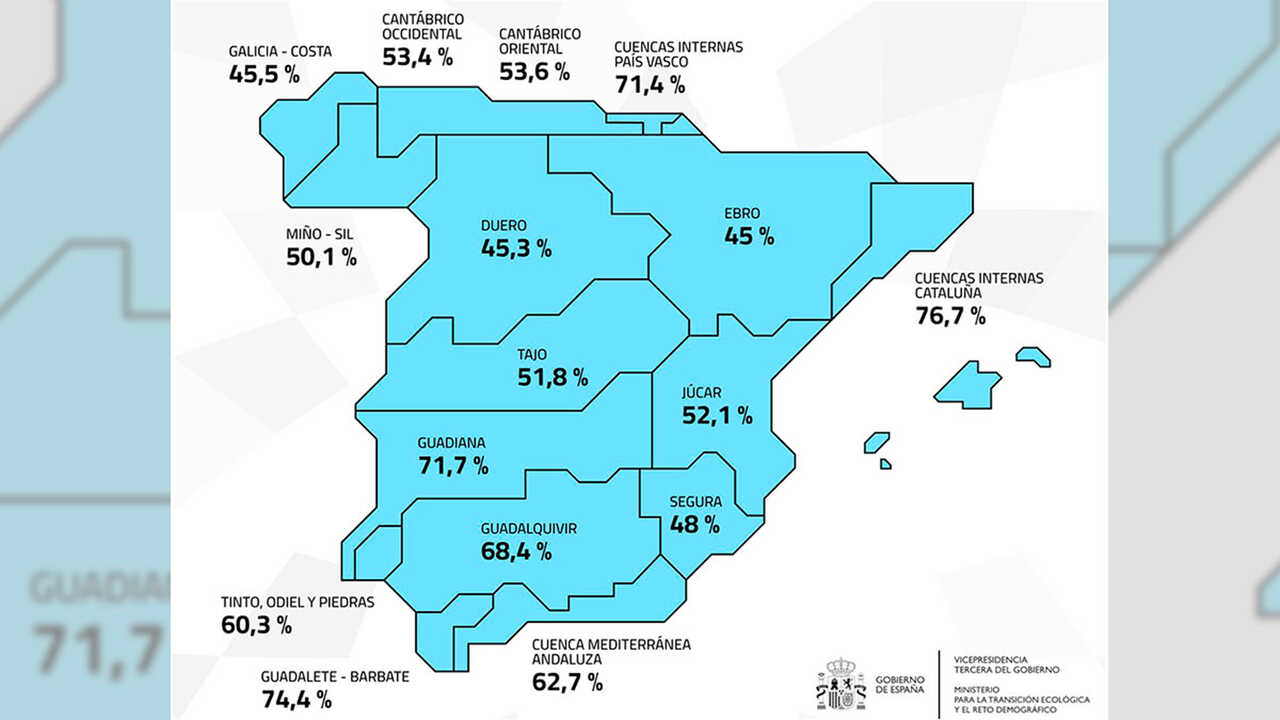
The highest water levels currently correspond to Catalonia's internal basins (76.7%), the Guadalete-Barbate internal basins (74.4%), the Guadiana (71.7%), the Basque Country's internal basins (71.4%), the Guadalquivir (68.4%), the Andalusian Mediterranean basin (62.7%), and Tinto, Odiel and Piedras (60.3%).
They are followed by the Western Cantabrian (53.6%), the Eastern Cantabrian (53.4%), the Jucar (52.1%), the Tagus (51.8%), the Mino-Sil (50.1%), the Segura (48.0%), the Douro (46.3%), Galicia Coast (45.5%) and the Ebro (45.0%).
EVOLUTION
The historical series shows that national water reserves began reaching record highs in mid-February last year after Storms Nils and Oriana, which raised the amount of stored water to 82.5%.
Afterwards, reserves grew gradually, with one temporary decline, before remaining at their highest ever levels for each point in the year until the end of March. The warm spell during Holy Week, with many hours of sunshine and temperatures more typical of May or June than early April, ended that run, and four heatwaves were declared in Spain last summer.
This, the 43rd week of 2026, currently standing at 56.8%, ranks as the seventh week with the highest reservoir reserves since 1990, behind only 1997 (57.6%), 1998 (59.0%), 2010 (65.0%), 2011 (59.2%), 2013 (65.6%) and 2014 (63.7%).