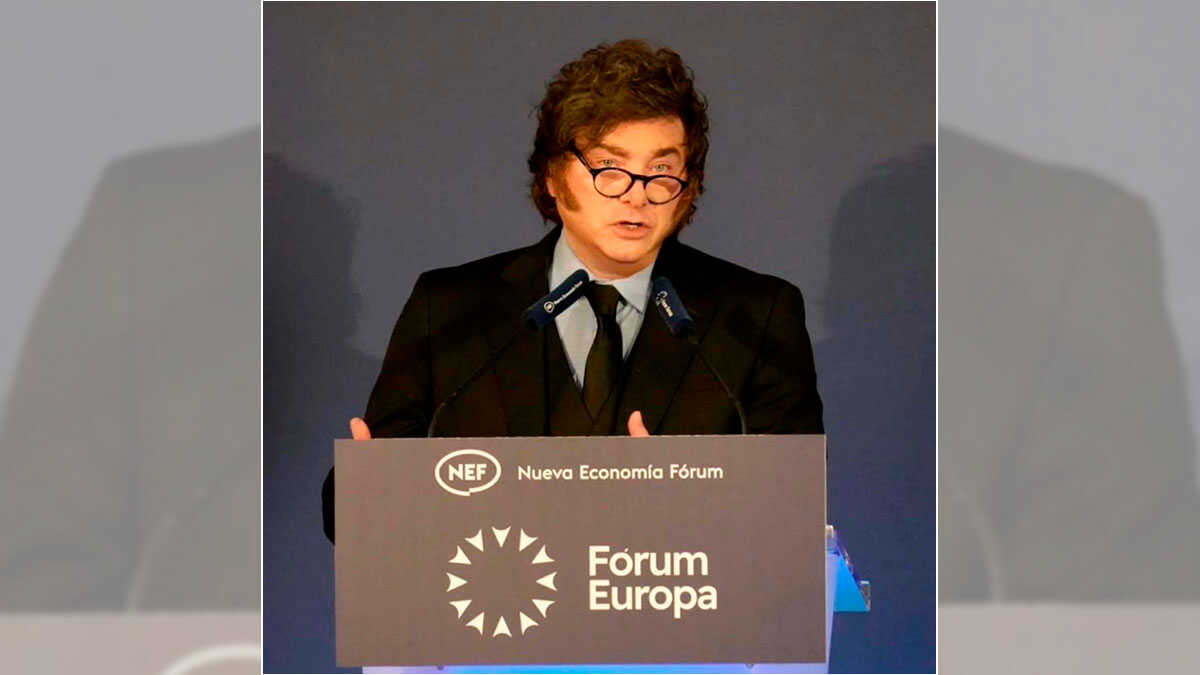
His statements come amid a day marked by the president’s visit to España and the political confrontation surrounding it. The PSOE has put up a banner at its headquarters in Ferraz reading “Left-wing men and women welcome you to España,” while Milei has used a phone conversation with Santiago Abascal to respond to rumors of tensions between them. The two episodes have brought an ideological confrontation to the forefront, one that Molina says should be toned down.
“THINKING DIFFERENTLY DOESN’T MAKE YOU AN ENEMY”
Molina, who has been in España for two and a half years, explains that he was able to vote in the election that brought Milei to the presidency, although he does not specify how he voted. He also does not share the policies of Argentina’s previous governments. However, that disagreement does not lead him to endorse insults: “I don’t think Milei has the right to call someone a dictator just because they have different ideas.”
“The fact that someone does not share your political ideals does not make them an enemy,” he maintains. In his view, the president’s responsibility demands different language: “The person who should set an example is him, as a politician and representative of the people.” He also rejects the use of labels as a substitute for debate and believes that, although Argentina’s right wing sometimes uses “very ugly rhetoric,” that does not amount to fascism.
WORKING WITHOUT BEING ABLE TO SAVE
Beyond the words, his concern lies in everyday economic realities. “I’m not in Argentina today, but I have family members facing a very difficult economic situation,” he says. His assessment of Milei’s decisions includes both successes and mistakes, although he believes that difficulties in saving money remain: “It wasn’t possible before, and it isn’t possible now.” Molina questions the president’s focus on inflation when, according to his account, many families are still struggling to make ends meet.
“Keeping prices stable does not mean that the country is functioning well, because people are not making it to the end of the month,” he says. In his view, the promised changes are still not evident in that reality, and he feels that the president “cares more about other people’s policies” by becoming involved in foreign conflicts, such as his extremist support for Israel.
ARGENTINA AND SPAÑA, DIFFERENT REALITIES
That criticism is linked to the way Milei’s message is projected in España. Molina believes the problems facing both countries require their own responses and rejects automatically transferring Argentina’s confrontations into Spain’s political debate: “The problems Argentina and España face are different.” Although he expresses his disagreements with socialism and its application in Latin American countries, he also rejects seeking solutions through messages of hate. “We have to be aware of the different realities,” he argues. From that perspective, he believes that calling on Spaniards to eliminate socialism amounts to delivering a message without taking their country’s context into account.
His position, he insists, does not stem from a desire for the current president to fail. “I don’t want Milei to do badly. The truth is that if the country gets back on its feet tomorrow, I’ll be the first to applaud him,” he says. What he calls for is for political alternation and differences to be accepted as part of democracy. “We only want Argentina to do well,” he says, summing up the sentiment he sees among Argentines living abroad. His criticism is directed at a division he considers recurrent: “The person in power always takes it upon themselves to divide us.”