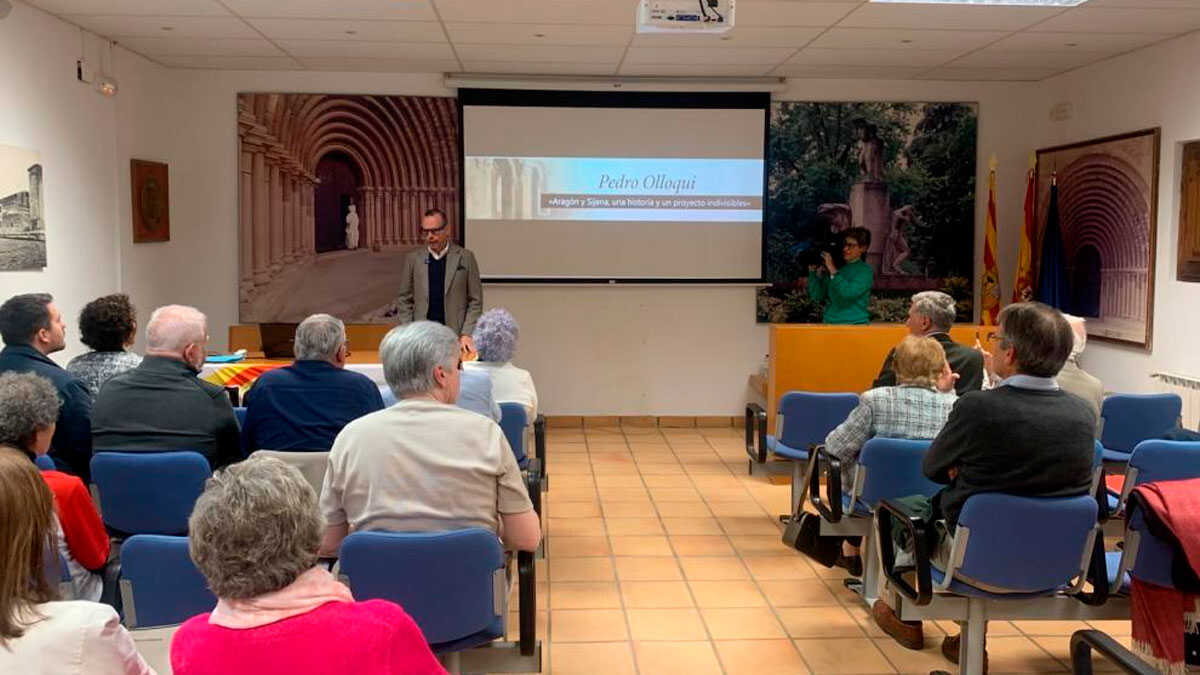
Aragón’s director general of Culture and Cultural Heritage made the statement while taking part in the event ’90 Years Since the Removal of Sijena’s Paintings: Memory, Truth and Justice’, organized by the Sijena Sí Platform and held at the Miguel Servet House in Villanueva de Sijena.
At the event, Pedro Olloqui recalled that exactly 90 years ago, “workers from Catalan institutions removed the monastery’s mural ensembles from Sijena Monastery with the intention of appropriating them.” It now marks “90 years of demands by the people of Aragón for heritage and paintings that should never have left Aragón to return home.”
In this regard, he noted that for practically a century, “Aragonese society as a whole has remained united and active in this demand,” and insisted that “there is no other way to repair our cultural rights than by recovering Sijena’s murals.”
For this reason, he stressed that “we will continue this fight,” despite the fact that “pro-independence sectors of Catalan society are hindering their return and compliance with the court rulings.” In response, the director general emphasized that the unity of all Aragonese people will secure the return of this heritage, “laden with meaning and symbolism.”
“For us, it is essential because it represents the splendor of the Crown of Aragón in the construction of the idea of Spain, a project greater than ourselves, and a symbolic value that Catalonia’s pro-independence culture also wants to appropriate, and we will not tolerate it,” he said emphatically, recalling that “Aragón is the cradle of Spain and Sijena is the symbol of the splendor of the Crown of Aragón.”
Therefore, the return of Sijena’s secular and religious paintings is a matter “of redress and justice, because we want to build the future of the people of Aragón from our history and heritage,” he concluded.