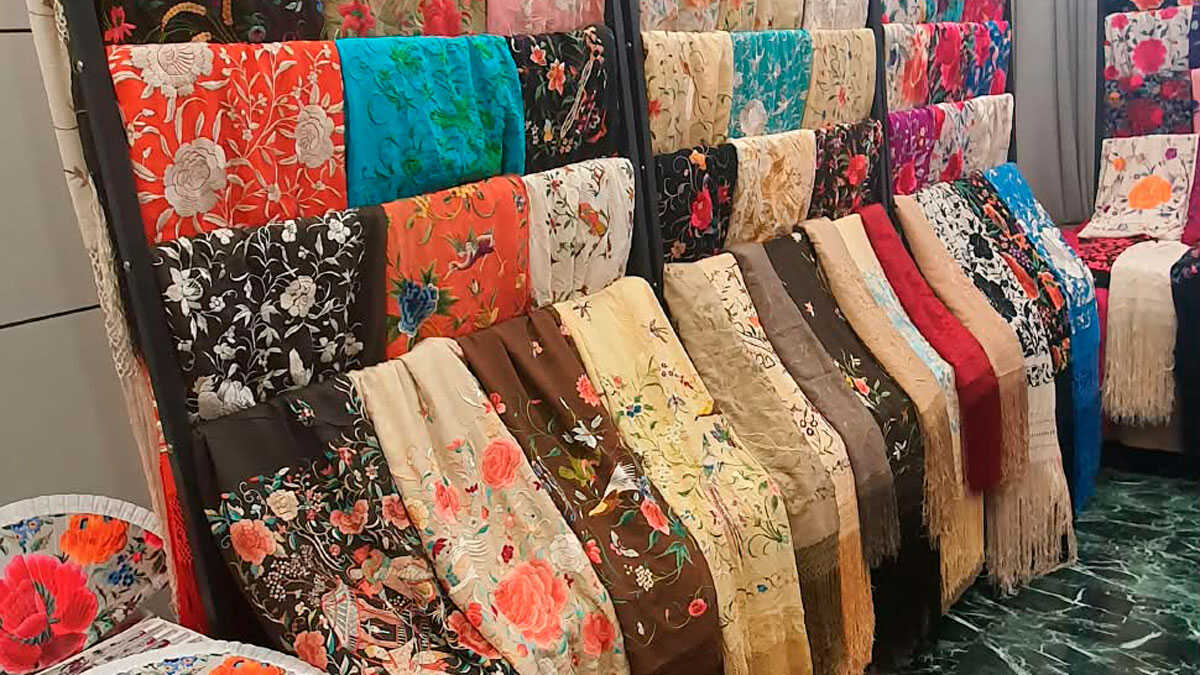
One of the people who knows these pieces best is María José Gutiérrez, a collector and owner of Tradición, a shop in Toledo specializing in antique shawls. She has spent 15 years studying, searching for and restoring examples, and her connection with Aragón has grown stronger over time. "I would say that 90% of sales are to people from Aragón. Over time, I have also specialized in your traditional clothing," she explains.
From October 2 to 4, she will return to the Aragonese capital for the 14th Exhibition and Sale of Antique Shawls, which will be held at the Hotel NH Ciudad de Zaragoza. Among the pieces she works with are examples nearly two centuries old, and some need to be restored to recover their full splendor. This experience has given her a thorough understanding of the care they require and, especially, the mistakes to avoid when cleaning and storing them at home.
HOW TO CLEAN AN ANTIQUE MANILA SHAWL
When it comes to an antique Manila shawl, water can become one of its main enemies. The problem lies particularly in the materials and techniques used to make these pieces. "It is important to bear in mind that antique shawls are embroidered with threads dyed using natural dyes. Any contact with moisture can cause the colors to run," Gutiérrez warns.
One of the people who knows these pieces best is María José Gutiérrez, a collector and owner of Tradición, a shop in Toledo specializing in antique shawls. Image provided
Therefore, if the piece needs a thorough cleaning, María José's best advice is not to experiment at home but to take the shawl to a dry cleaner, especially when dealing with antique examples.
The fringes are a different matter, as they are one of the areas that become dirty and tangled most easily with use. In this case, Gutiérrez does use water, but only on the fringes and taking great care not to let the moisture reach the embroidered section. "We spray a mixture of water and colorless fabric softener, carefully spraying it so as not to stain the embroidered fabric," she explains.
From there, it is a matter of being patient and detangling them one by one. "As I work, I spray them again so that the weight of the fringe wet with water and softener makes it fall into place," she explains. To finish restoring their appearance, she uses a ceramic hair straightener, running it slowly over the fringes to achieve a smoother effect. Even so, if it is a particularly old, valuable or delicate piece, the wisest course is to turn to a professional before doing anything to it.
HOW TO STORE AND PRESERVE A MANILA SHAWL
Knowing what to do with the shawl to preserve it properly is just as important as cleaning it. Here, Gutiérrez begins by debunking one of the recommendations passed down from generation to generation. "We have all heard the popular idea of letting it fall into a drawer. This is not the most suitable method because the shawl becomes very wrinkled, the fringes frizz and we have to iron it when we want to wear it," she points out.
The alternative Gutiérrez recommends is very different: "The most suitable way to store a shawl would be to roll it around a large cardboard tube and keep it stretched out, rolled up." This prevents pronounced creases and helps both the silk and the fringes remain in better condition during the months when it is not being used.
There is also a second method: carefully fold the shawl, tuck the fringes inside and roll it up on itself until it forms a kind of cylinder. It must then be protected with a suitable material. "We place it in any cotton or linen cloth, any natural fabric. For example, a pillowcase we no longer use or an old sheet," she advises.
And once it has been stored, it should not simply be forgotten until the following October. According to María José, "shawls should be taken out several times a year, and these folds should never be in the same places." Ideally, spread it out for a couple of days on a bed or place it over a railing "so that the shawl can breathe and air out." It can then be rolled up again, but the folding points should be changed to prevent the silk from remaining marked in the same areas.
After all this care, Gutiérrez's most important advice is also the simplest. "Above all, the most important thing for preserving a shawl is to use it and enjoy it," she adds.


