That said, although people may remember Cruz y Raya, the now-legendary New Year’s Eve specials, La Blasa or Tío la Vara, the reality is that Mota’s first film marks a slight change in direction. Under no circumstances, however, does it abandon comedy, as that is the only way he knows how to understand the world. The film follows Michi, a man marked by loss and hatred who, in the midst of the Spanish Civil War, encounters humor once again... and also his great love.
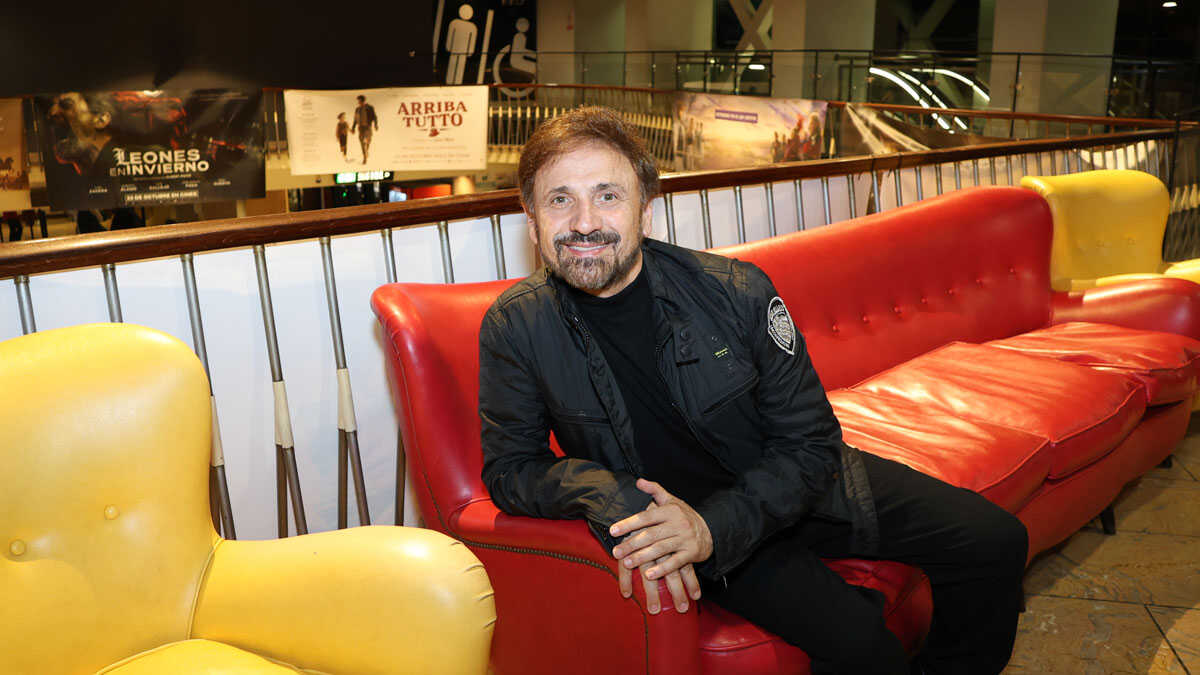
José Mota this Thursday. Photo: Pilar Álvarez
QUESTION.— You are presenting “Arriba tutto” in a Zaragoza that is very special to you... ANSWER.— Very special, indeed. In 1985, I did my military service in San Gregorio and became involved with the entire entertainment world at the time. There was a café called “El ángel azul” where all the artists used to go, and that is where I met everyone: entertainment entrepreneurs, variety performers, all of them. When I finished my military service, I was offered the chance to perform at Residencial Paraíso, in a pub called Bradbury. It was only supposed to be one weekend at first, but it ended up becoming a month and a half. And look where life has taken me.
Q.— And this is where you took your first steps before forming Cruz y Raya... A.— Exactly. If I had left Zaragoza that weekend, I would probably have enrolled in fine arts, but life sometimes has surprises in store for you. Everything began here; the dreams began here, as did the first shows I saw. I’m from Montiel, and I stayed here. It seems that sometimes life has your destiny underlined in bold, although you write the fine print yourself. But these things happen.
Q.— After performing in countless places, you take up the clapperboard on your first project as a director with “Arriba tutto.” Why now? A.— Because this is the point in my life that is asking me to write this story, which has a great deal to do with a whole range of emotions that have built up personally, experiences connected to what we are talking about here in Zaragoza: my beginnings, excitement... “Arriba tutto” is about using comedy as a counterforce to tension and hatred, to the things that attack us. Comedy has a great deal to say today; it always has a great deal to say. We are living through a complicated time, and I believe a little humor calms people down, acts as a balm and does a lot of good.
“The film uses comedy as a counterforce to tension and hatred, to the things that attack us.”
Q.— The backdrop is one of the darkest episodes in Spanish history, the Civil War, but also the utopian idea that comedy can change the world. A.— I really do believe it changes the world. When I was a child and listened to Gila telling his stories, there were two Spains listening to him, but when they heard him, they became one—a single Spain laughing. I find that wonderful, and only humor can achieve it. If I asked you, for example, what has done more for coexistence in the Basque Country—the politics of the past 40 years or “Vaya semanita” and “Ocho apellidos vascos”? I believe “Ocho apellidos vascos” has done more than all the politics carried out during those years. Humor is a very powerful weapon; it is not just a nice-sounding phrase. Humor can open rusty doors in people’s hearts, and I believe we have to use it well.
So, “Arriba Tutto” is all of that, isn’t it? It is a counterforce, as well as a reflection of personal experiences and of the importance of keeping the child you once were content and happy in your life today, as an adult.
Q.— Were you worried that the audience might be unable to see beyond La Blasa, the Cansino histórico and, ultimately, the humorous side for which everyone knows you? A.— People are being hugely surprised by the film. Word of mouth has been incredible. The movie got off to a slow start and suddenly we are tenth in the top 10, and on Tuesday we might move into second place. We are attracting a great many people my age, people over 40. They come because someone has told them there is a Mota film, and they think it will be like the New Year’s Eve special. Nothing could be further from the truth (laughs). It’s a roller coaster: you laugh, yes, but you also cry and smile... I’m very happy.
Q.— Michi’s father taught him to look at life with humor, imagination and magic. Is this film also a tribute to your father? A.— Without a doubt. My father was my great mentor. He was the person who taught me to love literature and poetry, everything contained in a verse, which seems to me like placing a flower in the darkness of life, along with everything that makes the world more beautiful. With this film, we have tried, with the utmost humility, to make it a declaration of love for life. My father was the person who taught me and filled me with sensitivity toward everything beautiful.
“My father was my great mentor, the person who taught me to love literature and everything contained in a verse.”
Q.— How does someone direct himself? A.— It was unsettling because when the director wanted to scold the actor, he wasn’t there; I never saw him, and the reverse was true as well (laughs). It was a process, a challenge, but the rest of the technical crew supported me and made everything very easy. For example, Kiko de la Rica, the director of photography, would suddenly say to me: “José, what do you think about moving the camera and putting it here instead?” Then I would look and see that it had improved a lot. I was very lucky in the sense that when everyone—the entire artistic team, the actors and the technical crew—read the script, they threw themselves into it like children. It was like one big team of children playing, with tremendous excitement. So that entire process was very easy for me.
Q.— When you see Michi and his father, you are reminded of “Life Is Beautiful.” Was it an inspiration? A.— Exactly. The film contains echoes of all the cinema that may have inspired me. It draws on “The Great Dictator” and is also a direct tribute to it. There are moments from “Voyage to Nowhere” as well; it contains “Cinema Paradiso,” Lubitsch’s “To Be or Not to Be” and, of course, “Life Is Beautiful,” which I think is a beautiful film, a very beautiful one. It is incredibly inspiring cinema. Another film that inspired me a great deal—and this may surprise you—is “Rocky.” I saw it when I was 13 and it made a huge impression on me. That was when I realized the immense power of fiction, what it can do when the person making it fills it with love and passion. In some way, that remains. As a viewer, you later watch it, and it completely overwhelms you.