QUESTION.- At the end of last season, you said culture should not be measured solely by the numbers, but record figures were achieved. What is happening in the municipal theaters? Are they experiencing their golden age? ANSWER.- I was right when I made that statement of intent. We all—the directors and programmers—are tempted to quantify the number of spectators and box-office figures, because they are indicators that offer no room for interpretation; no one can have an opinion about them, they are entirely objective data. It is also true that the world of culture introduces another series of factors that must be taken into account, especially when we are talking about a public theater or public theaters, those belonging to the city council, which on some occasions must set aside what would be a purely commercial approach in favor of broadening the reach and scope of the programming toward other market niches.
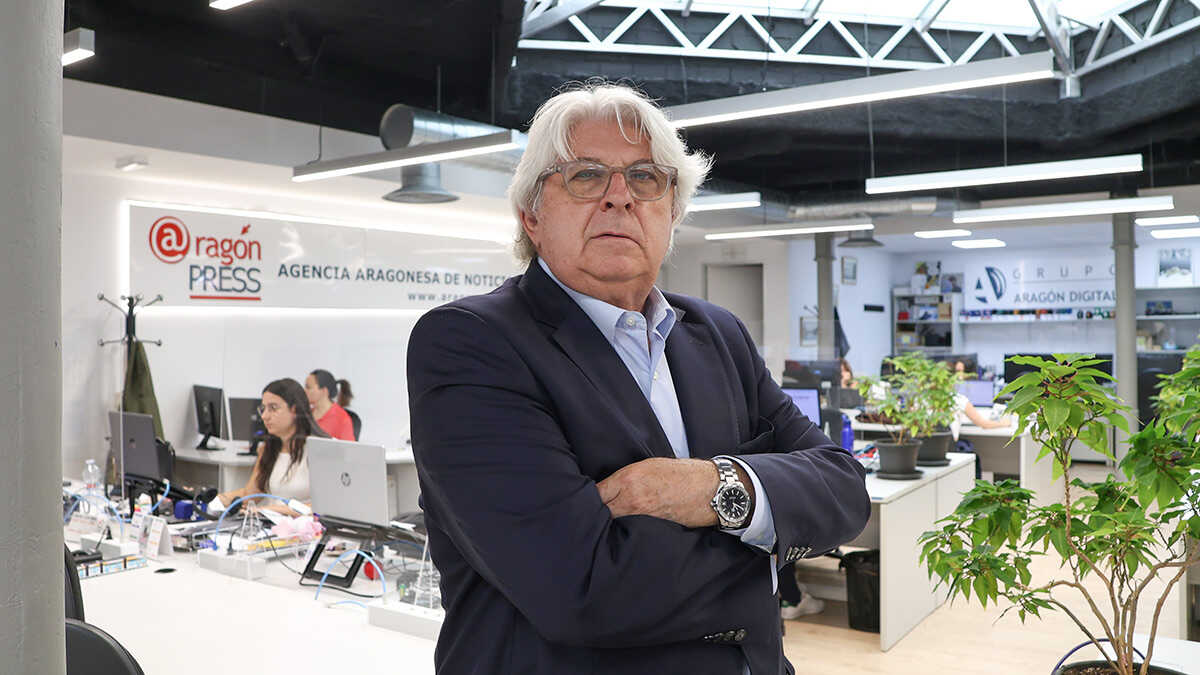
Turmo during the interview
We have to reconcile both factors. Certainly, this management places great importance on audiences coming to the theater and on achieving strong box-office results, because that is simply the indicator showing us that things are going well. If I try to program with great subtlety and no one comes, then I am left without arguments. The main argument is that audiences come to Zaragoza's municipal theaters. For six, seven or even eight seasons now—the period corresponding to the last two legislative terms—fortunately, very large audiences have been attending.
Q.- What does a production need in order to be programmed at the Teatro Principal? Actors and directors repeatedly stress that it is one of the most sought-after venues in Spain... A.- Because it is. We have one of Spain's most important cities, and we are a hub of attraction for the entire Ebro Valley. More and more companies are coming, as part of the policy of offering opportunities to groups not only from Aragon but also from neighboring regions.
Historically, the Teatro Principal has always been one of Spain's great theaters
And because the Teatro Principal, historically, since August 25, 1799—no less—and now with 227 years behind it, has always been one of Spain's great theaters. This places a great responsibility on us and demands that we raise the artistic stakes as much as possible, because in keeping with all this, Zaragoza audiences have always had discerning tastes and we must rise to the occasion. It is a top-tier venue that must measure up to its peers: the major theaters in Madrid, Barcelona, Bilbao, Valencia and a few others. From there, this would be the "premium" league in which we are delighted to play.
José María Turmo says the Teatro Principal has always been one of Spain's great theaters
Q.- "The NeverEnding Story," "Houdini," "The Pillars of the Earth," "Cabaret"... The Teatro Principal seems to have a special fondness for programming musicals. Is it a particularly popular genre? A.- Certainly. Musical theater is a genre that, for a decade or a decade and a half now, has enjoyed public favor because it is very appealing. It is true that it presents difficulties when brought into a 227-year-old performance space, but I believe we are solving the technical, artistic and financial challenges so as not to deprive audiences of the major musicals that pass through Madrid and tour wherever they can. This is a common problem for all musicals: they are large-scale productions that are not easy to bring here.
We do not take on versions; we go for the original productions. That is the case, for example, with "Houdini," whose first performance outside Madrid will take place here during the Fiestas del Pilar. In other words, Zaragoza can boast of being on the very top circuit.
Until the Auditorium opened, absolutely everything that happened in the city of Zaragoza took place at the Teatro Principal
Q.- Do you therefore believe there is a balance between commercial appeal and the rigor or sensitivity expected of one of Spain's most important theaters? A.- We try to ensure that every season has that balance and, above all, we shift the artistic focus considerably to reach every sensibility, every audience, every age group and anyone curious about all the genres offered on the Teatro Principal stage—which, fortunately, are many. Not many: all of them.
Until the Auditorium opened, absolutely everything that happened in the city of Zaragoza took place at the Teatro Principal, and if it did not go on at the Teatro Principal, that was a bad sign; it was not particularly important. Although today some programming has obviously been shifted in favor of the Auditorium, another major municipal facility that mainly hosts the great orchestras whose programming has carried an indisputable mark of quality for many years, we continue to do everything else with the greatest possible commitment and ambition.
We produce theater in all its forms: spoken theater, comedy, and the best of what we believe is happening across Spain. We present dance because all the major ballets that fit on our stage come here, although there are also world-class companies we have to do without simply because we can only offer what we can offer. In any case, we have excellent dance companies, opera, musicals and major concerts such as those by Ara Malikian and Santiago Auserón, who will be appearing soon... This year we have placed particular emphasis on the most international programming possible.
We are backing productions of unquestionable national and international quality: the two operas of "The Magic Flute," a Venetian company called Titizé with a show that is pure delight, and the musical Oliver Twist at Christmas... In short, we are following the most international and highest-quality path possible.
Q.- It is no secret that you are a great opera lover, and that opera is now programmed in small doses. Could the Teatro Principal aspire to program it as a season, as has happened throughout its history? A.- In 2026, the Teatro Principal unfortunately does not have the technical and financial conditions to stage large-scale productions on the scale of an opera season. It did, of course, and it had a lineup that very few theaters in Spain—very few—could boast, because not so many years ago, or perhaps it was, depending on how you look at it, during the 1970s, up to 47 productions were staged here over six years, featuring the best European voices of the time: Plácido Domingo, Alfredo Krauss, José Carreras, Bianca Berini, Aragall... In short, at that time it was comparable only to the Liceu.
The problem with opera is that costs have quadrupled, quintupled or even increased sixfold, from singers' fees to production costs, because opera must now be performed according to quality standards that are difficult to offer when you have 800 seats and cannot compete with the major opera houses that other cities were able to develop. The Liceu is obviously one example—it may be the oldest—but we are talking about 1,900 seats; the Teatro Real has practically 2,000; the Teatro de la Maestranza has 1,800... And this is a handicap we cannot lose sight of.
We can make some forays or offer the small doses you mentioned, and that is well put, because it is very tempting and it is also a genre in which we want to participate. In fact, we are going to offer some spectacular news in that regard. But unfortunately, we cannot become an opera house, among other things because an opera house is dedicated solely to opera, whereas ours is a theater for every genre. If we devoted ourselves to staging an opera season, every time you put on an opera you would practically have to wipe out a month's programming, and this forces us to strike a series of balances that are not easy to resolve.
Q.- Do you think audiences value the Teatro del Mercado? A.- They must value it, because we also break attendance records every year. More and more spectators come and we take in more revenue. It is valued above all by Aragonese production companies, because for many years this stage has been offered as a space dedicated to local talent. Anyone who had something to contribute—or those who could fit into the 10- or 11-month programming period during which it is open—was given the chance to do so there, with the necessary financial support, so that Aragonese production companies and Aragonese talent could see that the region's institutions are actively supporting them and allowing them to showcase their work, which, moreover, is generally very appealing.
Q.- The Zaragoza Film Archive will soon move to a new location in the new City of Cinema. What is the significance of this film archive in the city's cultural life? A.- I would say its first great achievement is having survived a policy of general restructuring, under which almost all the film archives in Spain ended up being managed by their respective autonomous communities.
The age, quality and vitality of a film archive with so many decades behind it, together with the importance of the historical collections inherent to a product as closely associated with Zaragoza as cinema, enabled Zaragoza City Council never to abandon it, even though in practically every other city these responsibilities were transferred, as I said, to the autonomous communities. Here, it remains under the city council's financial and artistic responsibility. Not only that, it is also going to move to such a new and important facility as District 7 will be.


