Printmaking was much more than a technique for María Cruz Sarvisé: it was a way of looking, experimenting and shaping much of her artistic career. Fuendetodos is now bringing together 82 prints by the Huesca-born painter, considered one of the leading figures in 20th-century Aragonese art, in an exhibition that offers an almost complete overview of her graphic work.
The exhibition can be visited from this Wednesday at the Ignacio Zuloaga Hall in Fuendetodos and brings together virtually all of the artist’s original prints, many of which she produced herself on the etching press in her studio in Huesca. The exhibition will remain open until December 31.
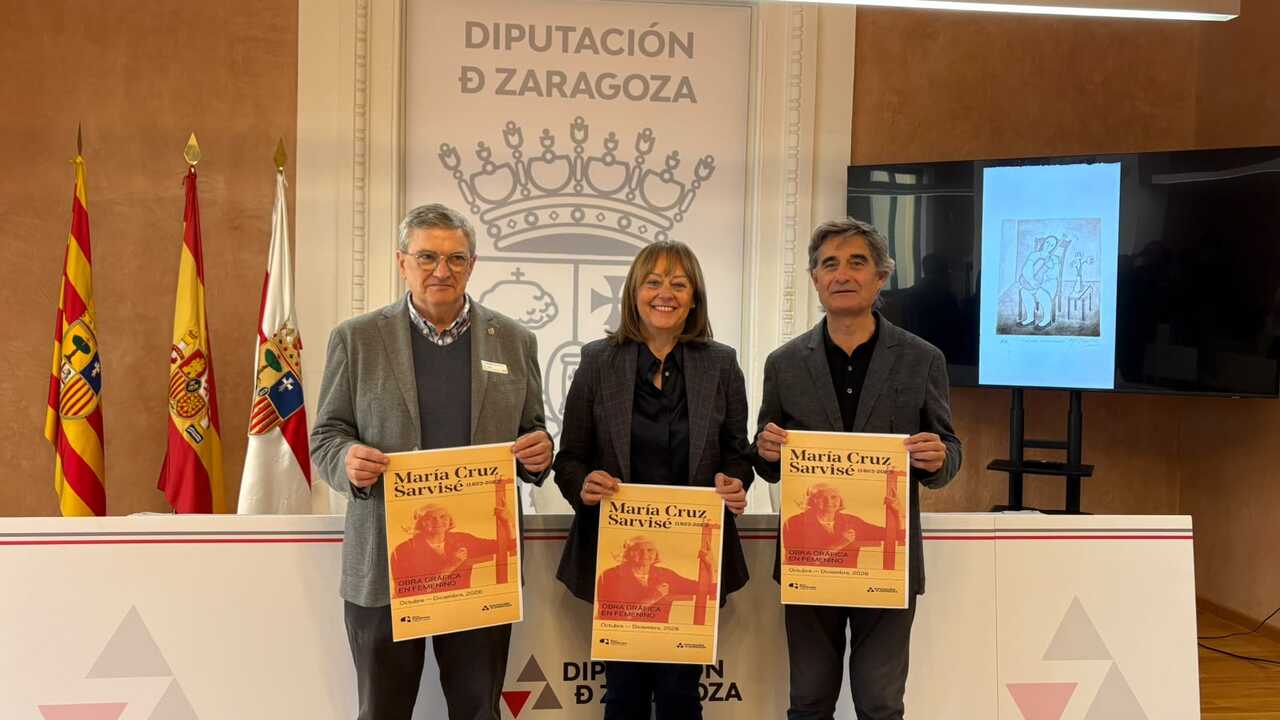
“Her graphic work had never been the subject of an exhibition,” said Ricardo Centellas, manager of the Goya Fuendetodos Consortium, during the presentation at the Zaragoza Provincial Council. He said it was important to give “visibility” to art “produced and created by women painters, printmakers and sculptors from Spain and Aragon.”
A LIFE LINKED TO PRINTMAKING
María Cruz Sarvisé spent most of her life and professional career in the province of Huesca. She studied Fine Arts at Barcelona’s La Llotja School, where she perfected the printmaking technique that would eventually occupy a central place in her work.
Through this discipline, she worked with different forms, lines and textures to create her own artistic language. The exhibition now offers an opportunity to explore this aspect of her work and gain a better understanding of both her approach to art and her creative process.
The exhibition also explores another of Sarvisé’s major pursuits: teaching. For years, she combined her artistic production with teaching and worked as a drawing teacher at the San Alberto Magno Institute in Sabiñánigo, as well as at other schools in Zaragoza and Huesca.
In 1996, she joined the Royal Academy of Nobles and Fine Arts of San Luis as an academic. Months before her death at the age of 100, the institution awarded her its Gold Medal in recognition of a lifetime devoted to art.
The exhibition can be visited Tuesday through Sunday from 11 a.m. to 2 p.m. and from 4 p.m. to 7 p.m. It will be closed on Mondays.
Printmaking was much more than a technique for María Cruz Sarvisé: it was a way of looking, experimenting and shaping much of her artistic career. Fuendetodos is now bringing together 82 prints by the Huesca-born painter, considered one of the leading figures in 20th-century Aragonese art, in an exhibition that offers an almost complete overview of her graphic work.
The exhibition can be visited from this Wednesday at the Ignacio Zuloaga Hall in Fuendetodos and brings together virtually all of the artist’s original prints, many of which she produced herself on the etching press in her studio in Huesca. The exhibition will remain open until December 31.
"Her graphic work had never been the subject of an exhibition," said Ricardo Centellas, manager of the Goya Fuendetodos Consortium, during the presentation at the Zaragoza Provincial Council. He said it was important to give "visibility" to art "produced and created by women painters, printmakers and sculptors from Spain and Aragon."
A LIFE LINKED TO PRINTMAKING
María Cruz Sarvisé spent most of her life and professional career in the province of Huesca. She studied Fine Arts at Barcelona’s La Llotja School, where she perfected the printmaking technique that would eventually occupy a central place in her work.
Through this discipline, she worked with different forms, lines and textures to create her own artistic language. The exhibition now offers an opportunity to explore this aspect of her work and gain a better understanding of both her approach to art and her creative process.
The exhibition also explores another of Sarvisé’s major pursuits: teaching. For years, she combined her artistic production with teaching and worked as a drawing teacher at the San Alberto Magno Institute in Sabiñánigo, as well as at other schools in Zaragoza and Huesca.
In 1996, she joined the Royal Academy of Nobles and Fine Arts of San Luis as an academic. Months before her death at the age of 100, the institution awarded her its Gold Medal in recognition of a lifetime devoted to art.
The exhibition can be visited Tuesday through Sunday from 11 a.m. to 2 p.m. and from 4 p.m. to 7 p.m. It will be closed on Mondays.
About this article:
Originally published in Spanish by AragonDigital.es and—following a selection process by our journalists—made available to the international audience of AragonDaily.com. Both newspapers belong to companies within the ARAGON DIGITAL GROUP.