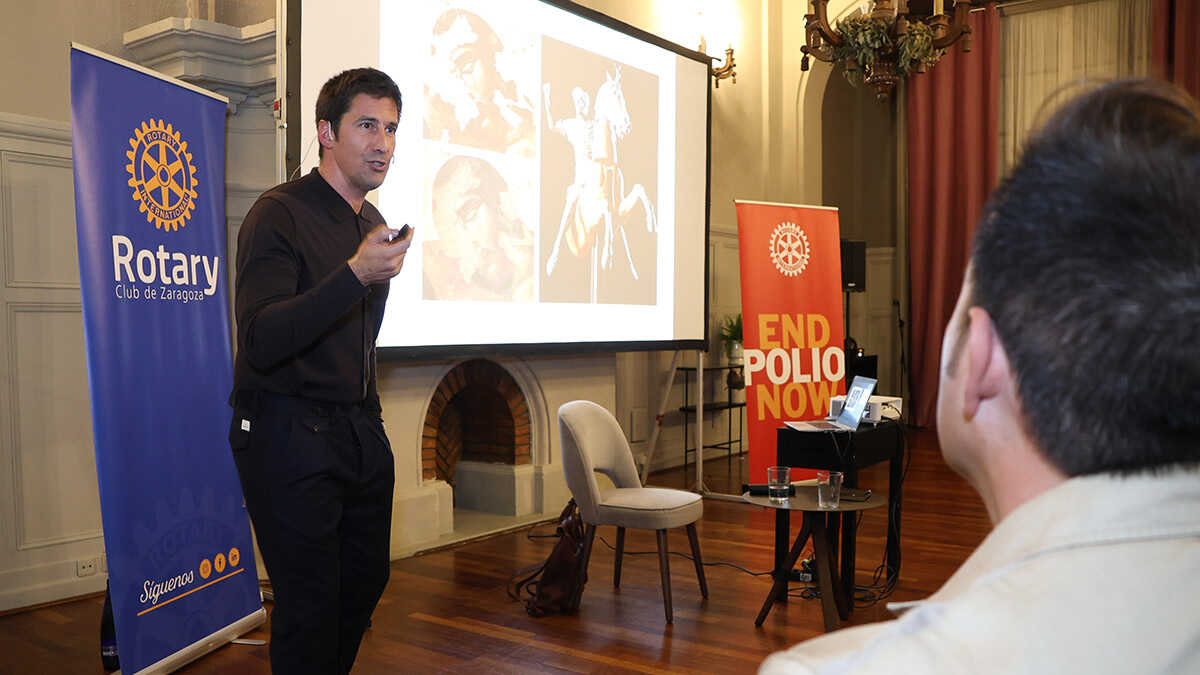
Through three of his most representative projects—the restoration of the Monastery of Santa María de Sijena, conservation work in the historic center of Ruesta, and the recent expansion and renovation of Zaragoza’s Goya Museum—Sebastián showed how contemporary architecture can engage in dialogue with the past, respect the memory of places and give them new meanings.
Sebastián showed how contemporary architecture can engage in dialogue with the past
The conference combined explanations of the architectural criteria behind each intervention with a carefully curated selection of images that revealed both the working processes and the results achieved. It was a visual and conceptual journey in which the architect “conveyed the emotion and personal commitment involved in restoring spaces steeped in history,” as explained by Francisco de Sales Salinas, president of the Rotary Club Zaragoza.
RUESTA AND THE “ROLLING STONE SPACE”: A NEW LIFE FOR THE REMAINS OF THE PAST
One of the most distinctive moments of the conference focused on the intervention at the hermitage of Ruesta, where Sergio Sebastián presented what he called the “Rolling Stone Space,” a proposal that turns the remains of the collapse of part of the structure into the centerpiece of a new architectural experience.
Rather than removing or discarding the materials that had been left exposed to the elements over the years, the intervention reuses them to create an installation close to the concept of arte povera, giving them new meaning within the space.
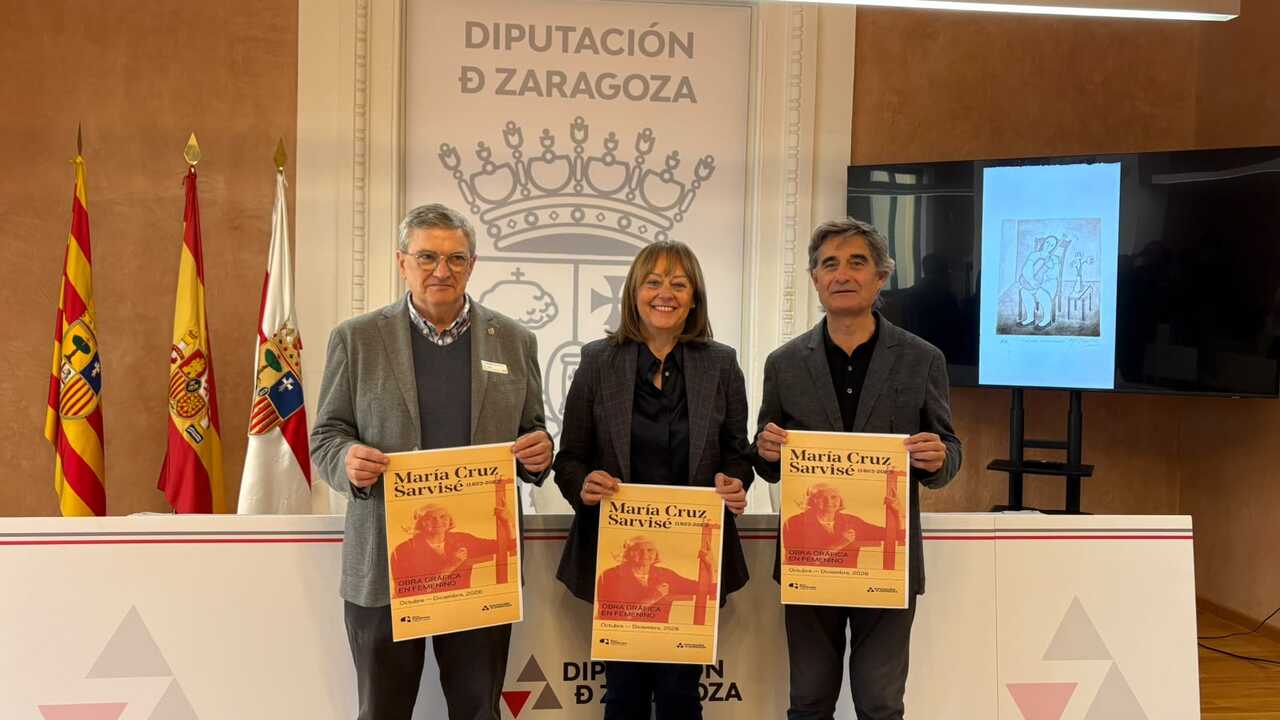
Francisco de Sales Salinas, president of the Rotary Club Zaragoza, and architect Sergio Sebastián during the event
In this way, elements that centuries ago were shaped and placed by master builders and artisans regain their presence through a contemporary composition that invites reflection on time, transformation and the memory of buildings.
THE GOYA MUSEUM FACADE, THE FOCUS OF THE DEBATE
Particular interest was generated by the recent expansion and renovation of Zaragoza’s Goya Museum, one of the architect’s most prominent recent projects and an intervention set to transform the museum’s relationship with its urban surroundings.
The new façade dominated much of the discussion following the conference, both because of its aesthetic proposal and the technical complexity of its execution. Sebastián explained the criteria that guided the selection of the images incorporated into the façade and the demanding process of producing and installing its elements, with pieces weighing approximately 800 kilograms each. Their placement posed a major technical challenge in the heart of Zaragoza’s historic center.
Attendees were thus able to learn the details of an intervention that combines modernity, respect for its surroundings and a new way of projecting cultural heritage toward the city.
The façade’s distinctive character and its ability to integrate into the urban landscape prompted a lively exchange of views on its architectural value and its potential to become, over the years, one of Zaragoza’s iconic images.