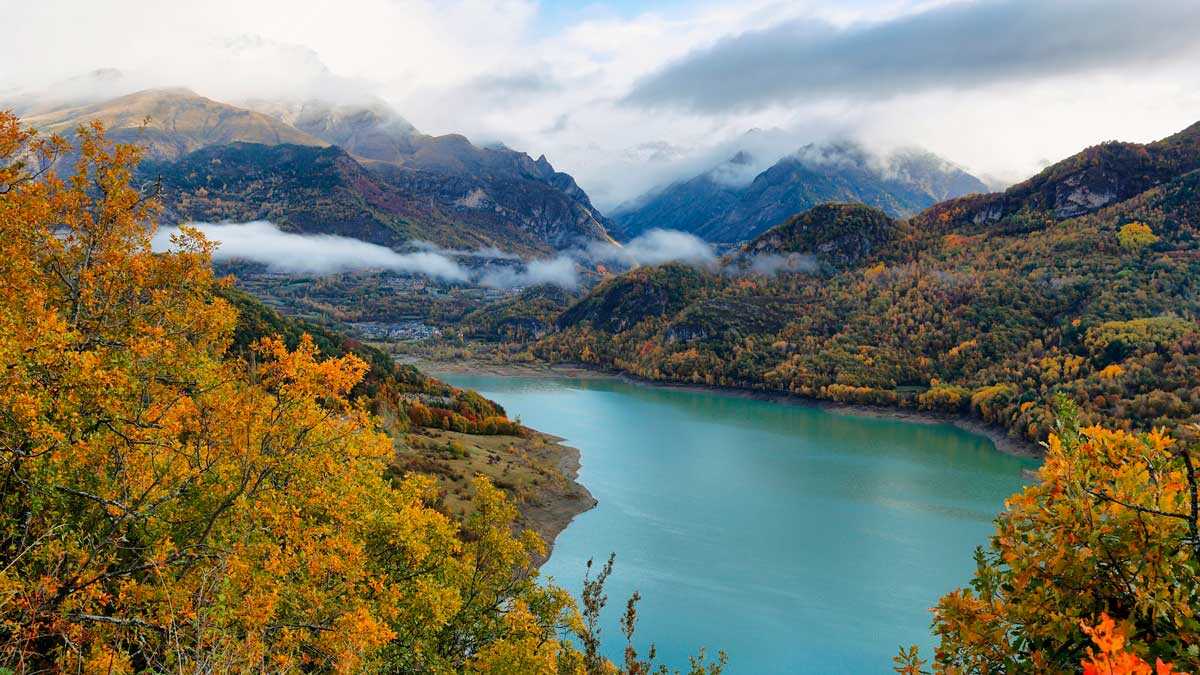
Through this landscape runs the Tena and Serrablo Wonders Route, one of Aragón’s Slow Driving itineraries. Its 147 kilometres, for which three stages are recommended, cross the Serrablo region before entering the Tena Valley, largely following the upper course of the Gállego River and its tributaries. Without stops, the journey takes around 3 hours and 19 minutes, although the many places along the way invite visitors to spend much longer exploring it.
Hidden waterfalls, forests, mountain lakes, reservoirs with blue waters, Pyrenean-style villages and some of the finest examples of Romanesque architecture in Huesca province appear throughout the journey. The road also leads to viewpoints over the Búbal Reservoir, the Panticosa Spa, Lanuza, Sallent de Gállego and the foot of Peña Telera, creating a road trip through the Aragonese Pyrenees that is difficult to fit into a single day.
FROM SERRABLO’S ROMANESQUE CHURCHES TO A WATERFALL HIDDEN AMONG ROCK WALLS
The route begins in Lárrede, eight kilometres from Sabiñánigo. Here stands the Church of San Pedro, built in the 10th century and one of the most representative examples of the group of Serrablo churches. The village also preserves traditional stone houses, Casa Isabal, the Torraza or Moorish Tower and the Serrablo Churches Interpretation Centre.
Biescas is one of the main gateways to the Tena Valley in the Aragonese Pyrenees. Photo: Turismo de Aragón
Just two kilometres separate Lárrede from San Juan de Busa, a small 10th-century church that stands almost alone in the middle of the landscape. Its simplicity is precisely part of its appeal: it has a single rectangular nave, a pitched wooden roof, no bell tower and an appearance very close to its original construction. The route continues towards Oliván, where the Church of San Martín once again recalls the remarkable concentration of medieval temples found in this part of Alto Gállego.
Nature takes centre stage in Orós Bajo. A path leads from the village to the Orós Bajo waterfall, hidden among the walls of the Os Lucás gorge, in approximately one hour there and back. Two consecutive cascades, around five and seven metres high, plunge into a pool and form one of the most striking spots along this section of the route.
The road then reaches Biescas, the gateway to the Tena Valley and a town located within the Ordesa-Viñamala Biosphere Reserve. From here, it is worth heading to the Hermitage of Santa Elena, set above a gorge and accompanied by the Fuente de la Gloriosa spring, the military fort, several bunkers from the former P Line and a dolmen that points to human presence in this territory for thousands of years.
HOZ DE JACA AND PANTICOSA: VIEWPOINTS, MOUNTAINS AND THERMAL WATERS
The climb towards the Tena Valley leads to Hoz de Jaca, located at an altitude of 1,272 metres. The village serves as a natural balcony over the Búbal Reservoir and preserves mountain buildings and façades bearing coats of arms. One of its essential sights is the Muro Viewpoint, suspended above the reservoir and offering views of Peña Telera, Sabocos and much of the valley. Those seeking an adrenaline rush can also find the Tena Valley Zip Line here.
The journey continues through El Pueyo de Jaca, on the shores of the Búbal Reservoir, before reaching Panticosa. Its stone houses, narrow and steep streets and mountains closing off the horizon create one of the characteristic images of the Pyrenees in Huesca. The town is also a starting point for numerous mountain activities and is home to the Aramón Panticosa ski resort.
The Orós Bajo waterfall is hidden among the rocky walls of the Os Lucás gorge. Photo: Turismo de Aragón
The road can climb even higher. Around eight kilometres from the village lies the Panticosa Spa, located at 1,636 metres in a glacial basin surrounded by peaks exceeding 3,000 metres. Ibón de los Baños and the granite walls surrounding the complex make the arrival one of the most spectacular moments of the route.
The use of its thermal waters also has a long history. The discovery of Roman coins from the eras of Augustus and Tiberius near the Tiberius spring suggests that their properties were already known in Roman times. The first building was erected in the 17th century, and the site underwent major development during the 19th century, shaping much of the historic complex that can be seen today.
LANUZA, SALLENT AND PEÑA TELERA: THE TENA VALLEY’S GREAT POSTCARD VIEW
On the return journey towards the heart of the valley, the route passes through Escarrilla before reaching Lanuza, one of those places where it is difficult to keep driving without stopping. The village climbs the hillside beside the reservoir that bears its name and faces Peña Foratata. After being almost abandoned when the reservoir was built in the 1970s, its homes were gradually restored, from the stone façades to the last doorknob, bringing the village back to life.
Today, as well as being known for hosting the floating stage of the Pirineos Sur International Festival of Cultures every summer, Lanuza offers access to the Natural Path around the reservoir. From different points, views open up over the water, Peña Foratata and Sallent de Gállego, the next stop on the itinerary and the historic head of the Tena Valley.
Located at 1,305 metres, Sallent combines traditional architecture, a 16th-century Gothic church, a medieval bridge and surroundings defined by the great Pyrenean peaks. It is also the starting point for well-known hikes to places such as the Anayet mountain lakes, the Piedrafita Cirque and the Infierno Peaks. From here, the itinerary also approaches Formigal, one of the main snow destinations in the Aragonese Pyrenees and a gateway to numerous high-mountain routes.
The final section changes sides of the valley to approach the Partacua range. Sandiniés and Tramacastilla de Tena preserve stone houses, balconies and coats of arms, with views towards Peña Telera and the Búbal Reservoir. From Tramacastilla, visitors can enter the Betato Forest, linked to old stories of witchcraft in the valley, before continuing towards Piedrafita de Jaca and Lacuniacha. This wildlife park offers around 4.5 kilometres of trails through forests, where visitors can observe semi-free-ranging animals such as lynxes, wolves, deer, bison, reindeer, chamois and Przewalski’s horses.
The Tena and Serrablo Wonders Route ends in Búbal, beneath the gaze of Peña Telera and beside the reservoir that forever changed the history of the village. After 147 kilometres through Alto Gállego, the route offers an unusual succession of Romanesque churches, waterfalls, Pyrenean villages, mountain lakes, forests and sweeping views over the Tena Valley, making it one of the most comprehensive road trips for discovering this part of the Aragonese Pyrenees.