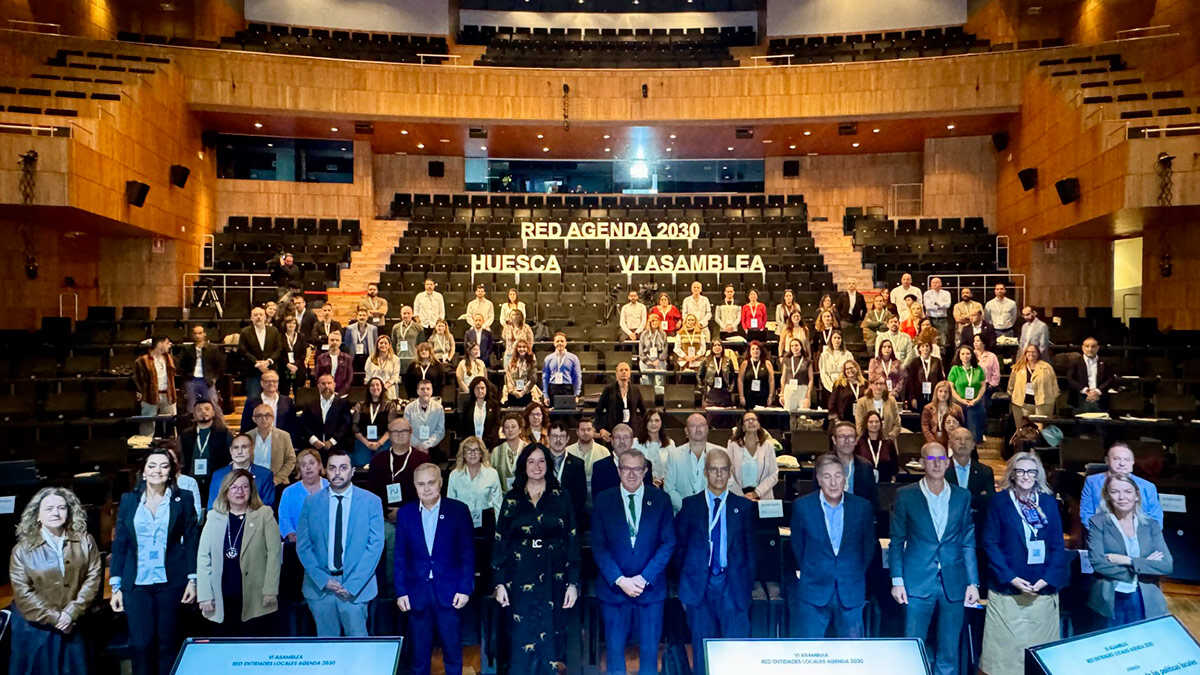
Huesca Mayor Lorena Orduna; Director-General for the 2030 Agenda David Perejil; FEMP Secretary-General Luis Martínez-Sicluna; and Network President and Mayor of Benidorm Antonio Pérez took part in the institutional opening. The capital of Huesca province was chosen as the venue by the Network’s Governing Council from among the five applications submitted. The sessions are being held at the Convention Center.
SUSTAINABILITY, ALSO FROM THE TERRITORIES
The assembly aims to strengthen the consistency of local policies with sustainable development, incorporate the SDGs into municipal plans, budgets and services, and promote the exchange of experiences and practical tools among the participating entities.
The first day includes a panel on the coherence of local policies in the multilevel dimension, another focused on involving young people in municipal 2030 Agenda policies, and a panel on Local Voluntary Reviews, with representatives from Alhaurín de la Torre, Rafelbunyol and Alcobendas.
Thursday’s debates will address innovation as a driver of transformation and communication as a tool for impact, with experiences from Esplugues de Llobregat, Riba-roja de Túria, Torrevieja, Periana and the Soria Provincial Council. The plenary session of the Network’s 6th Assembly will take place at midday.
ORDUNA CALLS FOR A 2030 AGENDA THAT LISTENS TO THE PRIMARY SECTOR
During the opening, Lorena Orduna welcomed attendees to “a city that believes in its future, is committed to development and understands that sustainability must, above all, be an opportunity to improve people’s lives.” The mayor argued that the Sustainable Development Goals “are clear, necessary and goals we all share” and insisted that “sustainability is not a matter of ideological labeling.” She therefore called for “opening spaces for dialogue and listening to different opinions.”
Orduna devoted a significant part of her speech to farmers and livestock breeders, recalling that “Huesca is a land of farmers and livestock breeders.” In this regard, she warned that “agriculture without farmers and livestock farming without livestock breeders do not represent any model of sustainability.” She also argued that “environmental sustainability, economic sustainability and social sustainability must move forward together” and that the transition toward more sustainable models “must be carried out with the primary sector, listening to it and supporting it.”
The mayor highlighted the role of town and city councils and other local authorities as “the administrations closest to citizens.” She also called for “a 2030 Agenda that listens more to the territories” and turns major international goals into concrete solutions for municipalities.
“Fighting depopulation is also sustainability. Providing housing for our young people is also sustainability. Supporting our businesses and creating jobs is also sustainability,” Orduna said, concluding her speech by advocating for “sustainability that keeps its feet on the ground and its eyes on the future.” “Protecting the planet and protecting people are not conflicting goals; they are two parts of the same responsibility,” she concluded.