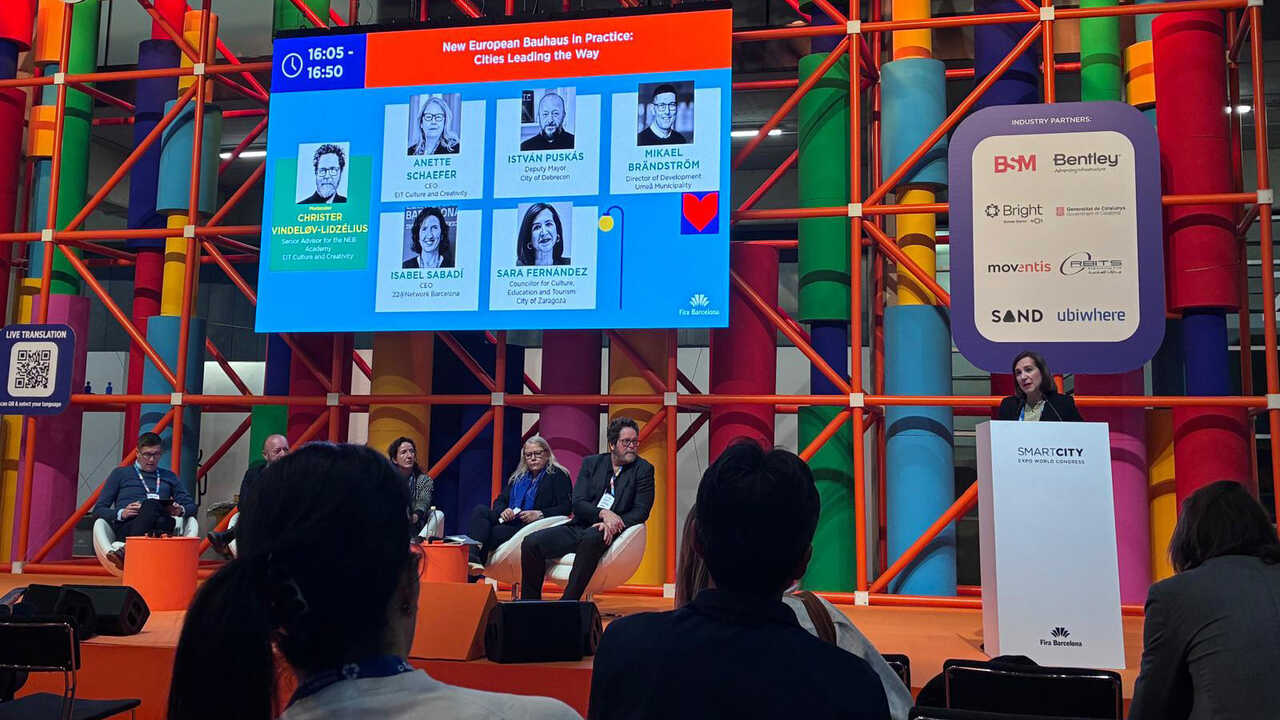
The congress, held from November 3 to 5 at Fira Barcelona Gran Via, brings together more than 600 international speakers, public administrations, companies and specialists. Technology, mobility, energy, the environment, governance and inclusion are among the major issues discussed at an event where Zaragoza is seeking to highlight its urban transformation.
The Councillor for Culture, Education and Tourism, Sara Fernández, was responsible for presenting Zaragoza's model at the 'New European Bauhaus in Practice: Cities Leading the Way' session. There, she defended a city in which innovation, accessibility and sustainability are not isolated concepts, but tools for improving everyday life.
ZARAGOZA HIGHLIGHTS ITS ACCESSIBILITY AND SUSTAINABILITY IN EUROPE
Fernández argued that a smart city cannot be measured solely by the technology it incorporates. "There is not one city for those who live in it and another for those who visit it," she said, insisting that urban initiatives should make Zaragoza more comfortable, inclusive and ready for the future for both residents and tourists.
One of Zaragoza's main arguments is its selection as Accessible City 2026, a European recognition accompanied by the 2025-2030 Universal Accessibility Strategic Plan. The strategy seeks to incorporate accessibility from the design stage of infrastructure, mobility, culture, commerce, tourism and communications, preventing it from becoming a later adaptation.
Measures such as tactile models, audio description, easy-read information and NaviLens, a digital tool that facilitates orientation, are already being applied in the tourism and cultural sectors. The City Council's goal is for every visitor to discover Zaragoza without barriers and for these solutions to also improve the daily lives of those who live in the city.
EUROPEAN GREEN CAPITAL 2028 WILL ACCELERATE NEW PROJECTS
The second major recognition Zaragoza has brought to the congress is its designation as European Green Capital 2028. Under the slogan "Zaragoza cares, naturally," the city aims to accelerate projects linked to the banks of the Ebro, the Zaragoza Forest, the circular economy, resource reuse and green infrastructure.
The strategy also includes measures to prepare Zaragoza for phenomena that are becoming increasingly decisive for cities, such as heat, flooding and drought. Sara Fernández linked these initiatives to a new tourism model: the aim is not merely to attract more visitors, but to offer a more liveable, responsible and attractive city.
Zaragoza's presence in Barcelona will also continue to be linked to gastronomy. This year, Zaragoza is the guest city at Foodie Black Week BCN, held from November 9 to 15 and attended by more than 600 people. The event will promote Zaragoza and Aragonese cuisine after the city was recognised as a UNESCO Creative City of Gastronomy.