The explanation lies in the clash between tradition and law. Islamic funeral tradition prioritizes leaving the deceased, wrapped in a shroud, in direct contact with the earth. In Aragon, however, health regulations require a coffin for burial. In this context, the holes serve as a local adaptation that remains fully in use.
A MUSLIM CEMETERY CREATED IN 1936
The history of the section dates back to October 1936, when two tabors of the Tetuán Mehalla arrived in Zaragoza. The military authorities requested land to bury Moroccan soldiers in an area separate from the Christian cemetery. The City Council approved the location on October 28, although municipal records place the first burial on the 14th, before that decision was formally adopted.
Those soldiers were buried directly in the ground and without coffins. The burials were overseen by the Moroccan Army Corps, with adules handling testamentary provisions and faqihs responsible for the layout of the graves.
The history of the section dates back to October 1936, when two tabors of the Tetuán Mehalla arrived in Zaragoza. Photo: Diego Sanz
The last Muslim burial from that period was recorded on April 9, 1942. In the following years, part of the land was used to expand the civil and Protestant cemeteries. In 1988, the City Council proposed transferring the soldiers’ remains to an ossuary to free up space. Morocco’s ambassador objected on religious grounds and, in April of the following year, the mayor decided to maintain the concession for the maximum period allowed by law.
WHY ARE COFFINS USED IN TORRERO?
Muslim burials resumed in Torrero in 1996. The agreement signed in 2013 between the City Council and the Islamic Community of Zaragoza established the conditions for operating the section and included the obligation to use a coffin in accordance with current legislation and municipal ordinances.
Aragon’s Decree 106/1996 refers, for matters it does not regulate, to the 1974 national Regulation on Mortuary Health Police. Article 9 prohibits transporting, moving and burying bodies without a coffin, except in cases of disaster or emergency provided for by the regulation.
Other autonomous communities have adapted their regulations to allow direct burial in the ground under certain conditions. Castile and León approved new regulations in December 2025 that allow coffins to be dispensed with for religious reasons when a body is buried, although not during transport. In Aragon, changing the regulations has been a longstanding demand of the Muslim community that has yet to materialize.
THE FUTURE OF THE MUSLIM SECTION
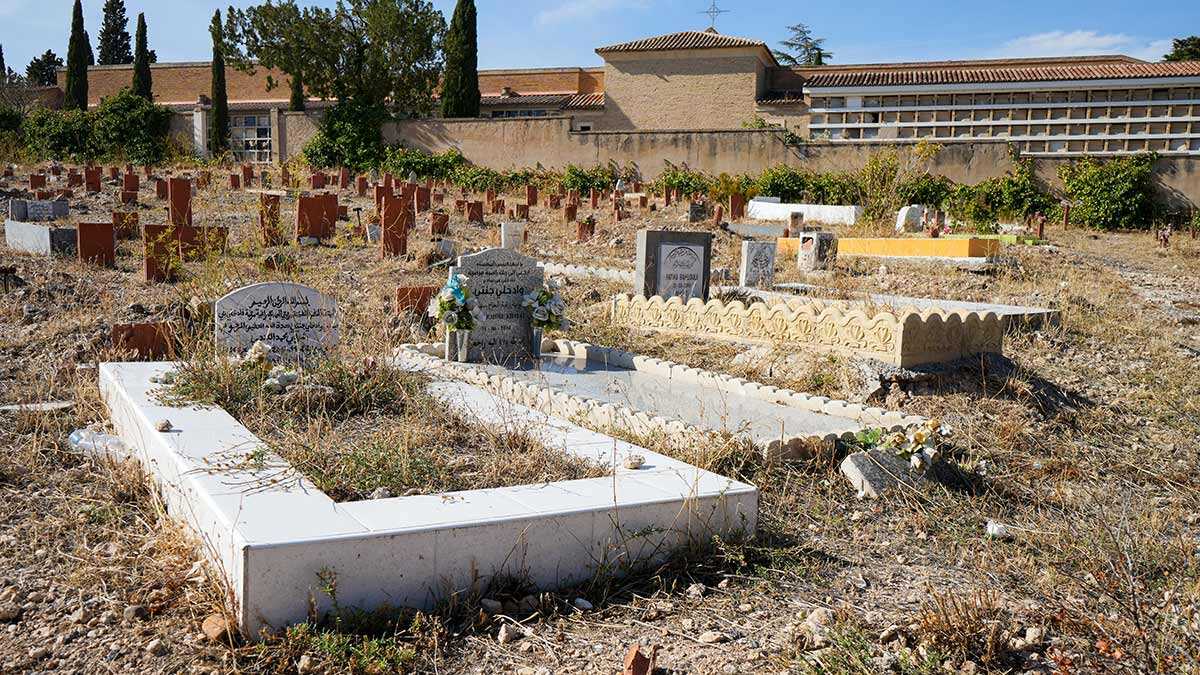
Day-to-day life in Torrero also faces space constraints and marked diversity among its graves. The area contains graves of different sizes, some with cement, tiles or benches added by relatives, as well as rabbit burrows that frequently undermine the headstones.
The Islamic Community of Zaragoza has proposed placing in a common grave the remains from graves that are at least 25 years old and whose relatives no longer claim them, while preserving the names and registration numbers. After that period, the body is considered to have fully decomposed. The proposal contrasts with the 1988 dispute, when the City Council proposed transferring the remains and the Moroccan Embassy objected.
The Islamic Community of Zaragoza has proposed placing in a common grave the remains from graves that are at least 25 years old and whose relatives no longer claim them. Photo: Diego Sanz
Ninety years after the section was created, holes in coffins remain the visible symbol of an unresolved tension between Islamic funeral practices and administrative requirements. It is an improvised solution that keeps the ritual alive on the ground while regional regulations remain unchanged.