Aragonese villages are custodians of a unique identity, where traditional architecture blends with monuments of great historical significance. Romanesque churches, medieval castles and Baroque squares bear witness to the passage of time and reflect the region’s cultural diversity. In addition, the hospitality of its people and the authenticity of its customs make every visit an unforgettable experience.
In this context, the village of Chodes, in the Valdejalón comarca of Zaragoza province, stands out as an exceptional example of Aragonese heritage, not only for its beauty but also for its connection to the world of cinema. This small municipality in Zaragoza is home to one of the most curious and beautiful squares in Spain, a testament to outstanding urban planning and an iconic Spanish film.
THE SQUARE OF CHODES
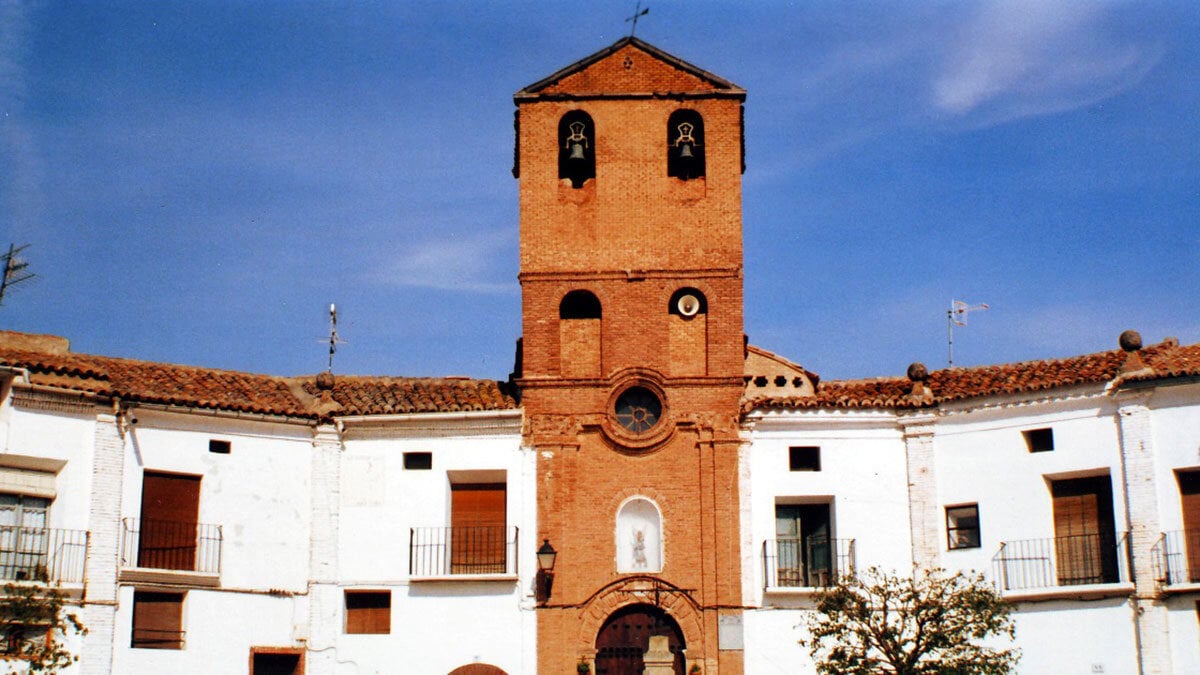
Chodes’s Plaza de España, popularly known as “La Plaza Ochavada,” is one of the most original surviving squares in Aragon. It was built in the second half of the 17th century on the orders of the new Count of Morata and Marquis of Villaverde, following his purchase of the Luna family’s rights over old Chodes.
This square is one of the best-preserved in Aragon. Photo: FB Pueblos y Lugares Más Bonitos de España
To reaffirm his status as the new owner, the Count of Morata commissioned an urban complex designed by the architect Juan de Marca between 1676 and 1678. This was how Chodes’s square came into being: a 12-sided polygonal plaza with 24 homes, three entrances and the parish church.
These homes have survived almost entirely intact and have gradually been restored to preserve their original structure and architectural style. The façades of the houses surrounding Chodes’s Plaza de España are separated by Tuscan stones in the giant order. The homes have two floors and double-pitched roofs.
The square is entered through three gateways, while the parish church dedicated to Saint Michael occupies a fourth side. One of its major milestones came in 2002, when Chodes’s square was declared a Site of Cultural Interest to preserve its urban and architectural structure.
A CINEMATIC PAST
However, the square reached its peak several years ago. In 1985, Chodes was chosen as one of the filming locations for the movie "Requiem for a Spanish Peasant," based on the novel of the same name by Ramón J. Sender.
Chodes was one of the locations chosen for the filming of this movie
The film, directed by Francesc Betriu, featured actors including Antonio Banderas, Antonio Ferrandis and Terele Pávez. Chodes’s Plaza de España, with its distinctive architecture, served as the backdrop for several scenes, and many local residents took part as extras during filming. The feature was also shot in the nearby towns of Embid de la Ribera and Arándiga.
THE VILLAGE’S OTHER TREASURES
For all these reasons, Chodes’s square has been popularly recognized as one of the most beautiful squares in Spain, and it is constantly visited by tourists who want to see it for themselves.
However, this is not the only thing Chodes has to offer visitors, as the village is also home to other treasures. Among them is Chodes Castle, whose remains stand near the present-day municipality on a high rocky outcrop. Its construction dates back to the 12th century, and it is included among the castles considered Sites of Cultural Interest.
The aforementioned Church of Saint Michael the Archangel, with its main altarpiece by Manuel Bayeu, is also noteworthy. Finally, the Capurnos Bridge, which crosses the Jalón River and is shared with the municipality of Morata de Jalón, adds another attraction to Chodes’s historic ensemble.
HOW TO GET TO CHODES
If Chodes’s historic and cinematic legacy has completely captivated you, do not miss the opportunity to travel to this municipality in Zaragoza province and immerse yourself in its past and present.
To help you organize your trip in the best possible way, here is how to reach Chodes from the three main cities in Aragon. That said, given the village’s location, the most advisable option is to use a car or motorcycle, so these types of transport will serve as the reference for the routes.
From Zaragoza
From the Aragonese capital, take the A-2 toward Morata de Jalón and then turn onto the A-2302 to reach Chodes in approximately 50 minutes.
From Huesca
From the capital of Huesca province, follow the A-23 to Zaragoza and, once you reach the Aragonese capital, take the A-2 toward Morata de Jalón as in the previous route. Finally, turn onto the A-2302 to reach Chodes after a total journey of around an hour and a half.
From Teruel
Finally, traveling from the capital of Teruel province involves the longest and most demanding route. First, take the N-211 to Caminreal, then turn onto the A-23 toward La Almunia de Doña Godina. From there, take the A-2 and continue to Chodes. The total journey takes around two hours.
In conclusion, Chodes is a clear example of how Aragon’s small villages preserve heritage of great historical and cultural value. Its distinctive Baroque square, monuments and role in Spanish cinema make it a destination that deserves to be known and appreciated. Dare to discover Chodes!