A TOWER REDUCED BY HALF
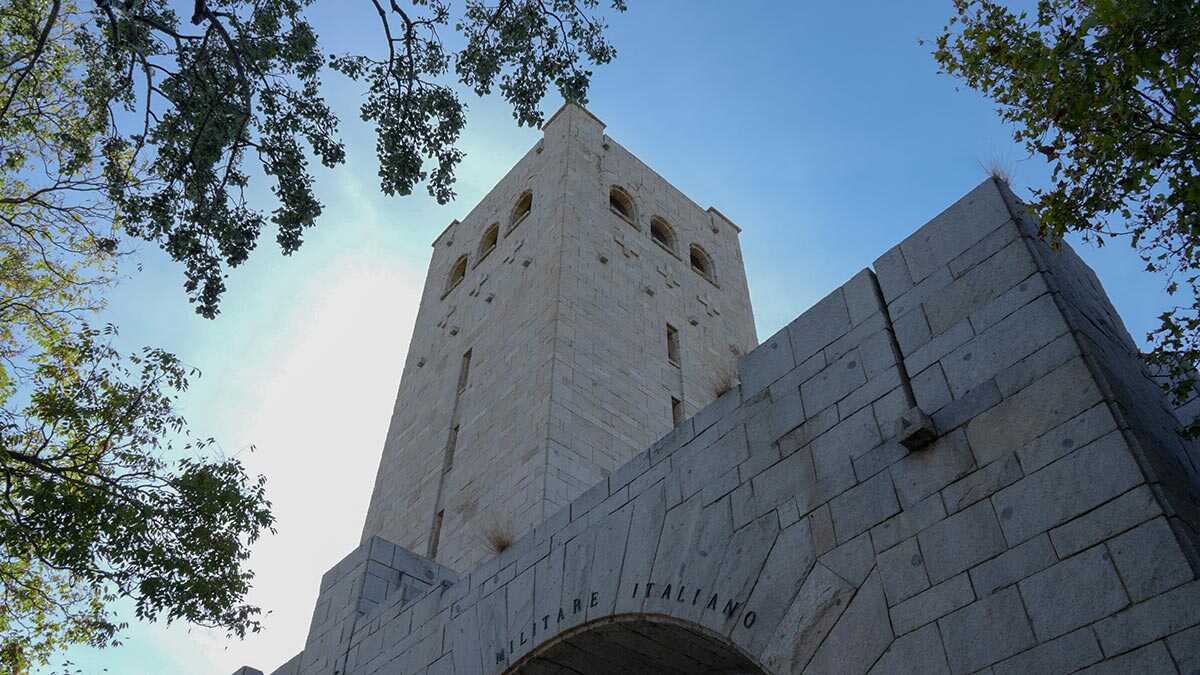
The original project by Navarrese architect Víctor Eusa called for an 86-meter tower, later reduced to 70 meters. The Capuchin friar behind the construction, Pietro da Varzi, envisioned it as the city’s tallest building and as a small Italian Escorial, indestructible and clad in the same granite as the Madrid monastery.
Franco’s government facilitated the project by providing the land, as well as reducing the cost of materials and arranging free transport by rail and military vehicles. A shortage of cement slowed construction, and in May 1943 the tower barely rose above its foundations.
In September, with the Cassibile Armistice already signed, the structure had reached 20 of the planned 70 meters. After Mussolini fell, Badoglio’s government decided to continue the work to avoid straining relations with Franco, and the first governments of post-fascist Italy chose to complete it. Two years later, Ambassador Gallarati Scotti ordered the project to be reduced to more modest proportions, and the tower ended up measuring 42 meters.
WHY ZARAGOZA?
The choice of Zaragoza for such a large ossuary was based on four clear reasons. The Aragonese capital held a significant number of the remains of Italian legionaries, had served as a logistical base for operations in the Ebro and Catalonia, and offered a Roman imperial past that fitted Mussolini’s rhetoric as he sought to portray himself as Augustus’s heir. Added to this was the Basilica of El Pilar, whose proximity gave the mausoleum powerful religious backing in the eyes of the fascist regime.
This monument is also known as the Italian Military Shrine. Photo: Marta Presumido
A FASCIST MAUSOLEUM WITH ANTI-FASCISTS INSIDE
The tower belongs to the Italian state and was created to honor the legionaries Mussolini sent to fight alongside Franco’s troops. According to Italy’s Ministry of Defense, 2,889 fallen soldiers are buried inside, including 21 Italian International Brigade members who fought for the Republic. In addition, seven plaques commemorate the names of 385 Italian anti-fascist combatants.
The presence of the latter is due to an initiative by Ambassador Gallarati Scotti, who in 1945 proposed also including Italians who had died fighting in the Republican ranks. A year later, he presented the inscription on the entrance arch, L'Italia a tutti i suoi caduti in Spagna (Italy, to all its fallen in Spain), as proof of the monument’s apolitical character.
ANIELLO FAZZI, NUMBER 2904
Among the plaques lining the walls is that of Aniello Fazzi, a sergeant from Modena. On November 18, 1936, he was piloting a Romeo biplane escorting a trimotor between Seville and Talavera de la Reina. Traveling aboard as an observer was Alonso de Orleans, 24, the son of Infante Alfonso de Orleans and a second lieutenant for barely two weeks. Amid the fog covering the mountains of Badajoz province, the aircraft crashed on an estate in the municipality of Monesterio and caught fire.
According to Italy’s Ministry of Defense, 2,889 fallen soldiers are buried inside. Photo: Marta Presumido
Although the prince’s service record listed him as having been shot down in combat, several historians maintain that it was an air-navigation accident. The mayor of Monesterio ordered the remains taken to the town in sacks, unaware that one of the dead was a member of the royal family; he was later dismissed. The municipal archive preserves the bill for loading the aircraft wreckage onto a truck, for a cost of 33 pesetas.
The prince’s body lay in state in Sanlúcar de Barrameda beneath Spanish and Italian flags, with three planes flying over the cortege, while Fazzi was buried in Seville. In 1940, his remains were transferred to Torrero Cemetery alongside those of 168 other Italian airmen, until in 1948 they were moved to their final location, on the tower’s fifth floor.
THE WOMAN FROM ZARAGOZA WHO MAY HAVE CARED FOR HIS GRAVE
According to Zaragoza historian Dimas Vaquero, Fazzi had a wartime godmother in the city, Pilar Sáez Pérez. These women exchanged letters with soldiers stationed at the front to ease the distance and loneliness of the campaign. According to Vaquero, Pilar cleaned and maintained the sergeant’s gravestone until her death in 2008, and wrote letters to the aviator’s mother in Modena. For now, this story of affection is known through that testimony.
Every November 2, prayers return to the foot of the tower. The name of Aniello Fazzi remains on one of its walls, watched over for many years by a local woman who refused to let him be forgotten.