This richness has much to do with the mountain's characteristics. Moncayo reaches an altitude of 2,315 meters at San Miguel Peak and acts as a natural border between Aragon and Castile, as well as separating the basins of the Ebro and Duero rivers. Its location between the Ebro Valley and the Castilian plateau favors the presence of very different forests, from Mediterranean pine woods to beech forests typical of cooler, wetter climates.
In its different habitats, saffron milk caps, boletes, chanterelles, grey knights and other varieties grow, appearing according to altitude, humidity and soil characteristics.
WHY SO MANY MUSHROOM SPECIES GROW IN MONCAYO
The variety of mushrooms in Moncayo can be explained by the diversity of its ecosystems. On the same mountain, holm oak and Mediterranean pine forests coexist with oak woods, birch groves, beech forests and mountain pine woods. This combination of environments promotes a wealth of flora, fauna and fungi.
Among the most distinctive species is Hygrocybe monscaiensis, described as a new species to science in 1997. The Mycological Center of San Martín de la Virgen del Moncayo cites it as one of the examples of fungi that are especially rare or exclusive to this mountain.
The natural importance of this area is also reflected in its protection. The Aragonese side of Moncayo has been designated a Natural Park since 1978 and is the only natural park in Zaragoza province.
WHICH MUSHROOMS CAN BE FOUND IN MONCAYO'S PINE FORESTS
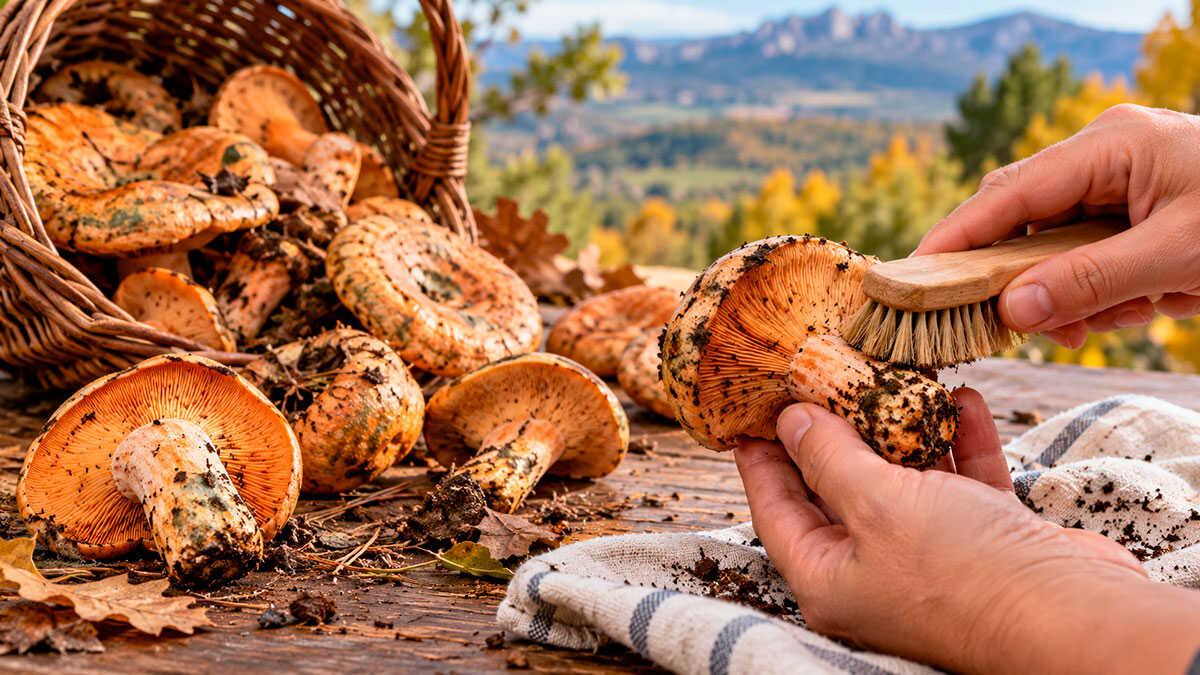
Pine forests are one of the main places to look for saffron milk caps. At higher altitudes, Scots pine (Pinus sylvestris) grows and can produce abundant saffron milk caps when found on basic soils. Morels, hygrophorus mushrooms and grey knights also appear.
The terrain directly influences the species that grow there. Boletes, Hygrophorus marzuolus and chanterelles are more commonly found in acidic soils. Varieties found in these pine forests include the orange-latex saffron milk cap (Lactarius deliciosus), the wine-colored-latex saffron milk cap (Lactarius sanguifluus), the white bolete (Boletus edulis) and the red bolete (Boletus pinophilus).
Pine forests are one of the main places to look for saffron milk caps. Photo: Aragón Press Archive
In mid-mountain areas, black or Austrian pine (Pinus nigra) appears, growing mainly on limestone terrain. These forests also offer good conditions for saffron milk caps and other mushrooms such as the chanterelle (Cantharellus cibarius) and the grey knight (Tricholoma terreum).
Moncayo also has maritime pine forests (Pinus pinaster), which grow on acidic soils. Their presence depends more on the terrain than on altitude, and they can produce large quantities of saffron milk caps. Grey knights, capuchinas and white waxy caps (Hygrophorus gliocyclus) can also be found there.
MONCAYO'S BEECH FORESTS, A PLACE WHERE BOLETES GROW
Beech forests offer conditions very different from those of pine forests. These forests of European beech (Fagus sylvatica) occupy the coolest and wettest areas of Moncayo and develop mainly on acidic terrain.
The shade of the trees helps maintain soil moisture and creates a favorable environment for the growth of numerous species of fungi. The most characteristic include the white bolete (Boletus edulis), the red bolete (Boletus pinophilus) and the summer bolete (Boletus reticulatus).
Beech forests also shelter chanterelles (Cantharellus cibarius) and Hygrophorus marzuolus, making them another area of interest for mushroom-gathering enthusiasts.
PERMITS TO COLLECT MUSHROOMS IN MONCAYO
Mushroom gathering in the Moncayo Mycological Park is regulated to make the activity compatible with forest conservation. According to data published by MicoAragón, the area covers 12,127 hectares and allows a maximum of 23,624 gathering permits. The average annual sustainable production is listed as zero, although the record does not explain what that figure refers to.
The Mycological Center of San Martín de la Virgen del Moncayo also provides information and advice on the different species. During mushroom season, it helps identify them and determine which are suitable for consumption, while also offering a space dedicated to mycological education.