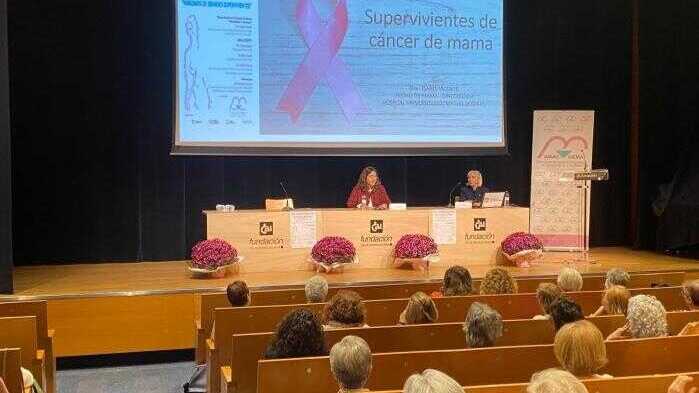
Surviving breast cancer does not always mean returning exactly to the life women had before. Although the five-year survival rate is around 90%, many women continue to face physical, emotional, occupational or social effects after being discharged. These needs were the focus of the 25th Aragon Breast Cancer Conference, organised by AMAC-GEMA in Zaragoza this Monday.
Held under the slogan “Let’s talk about long-term survivors”, the event brought together healthcare professionals, patients, relatives and institutional representatives at the Joaquín Roncal Centre to address the challenges that emerge once the most acute phase of the disease has been overcome.
During the conference, Health Councillor Ángel Sanz stressed that “overcoming the disease does not mean that all its consequences disappear”. “Many women are medically discharged, return to their lives, their jobs and their projects, and regain much of their normality. However, the disease leaves a mark,” he said.
73% OF TUMORS DETECTED THROUGH SCREENING ARE AT AN EARLY STAGE
One of the key figures highlighted was the performance of the Breast Cancer Screening Programme in Aragon. Participation currently stands at 73%, above the benchmark set by the European Union, and 73% of tumors diagnosed through the programme are detected at an early stage.
Sanz also defended the need to continue supporting patients during survivorship and stressed the importance of prevention, early diagnosis and increasingly personalised care. “Talking about survivorship is undoubtedly talking about hope,” he said.
The conference also featured Dr Isabel Vicente, head of the Breast Unit at Miguel Servet University Hospital, as well as a round table on the challenges faced by survivors, with oncology, psychology and social work professionals from AMAC-GEMA.