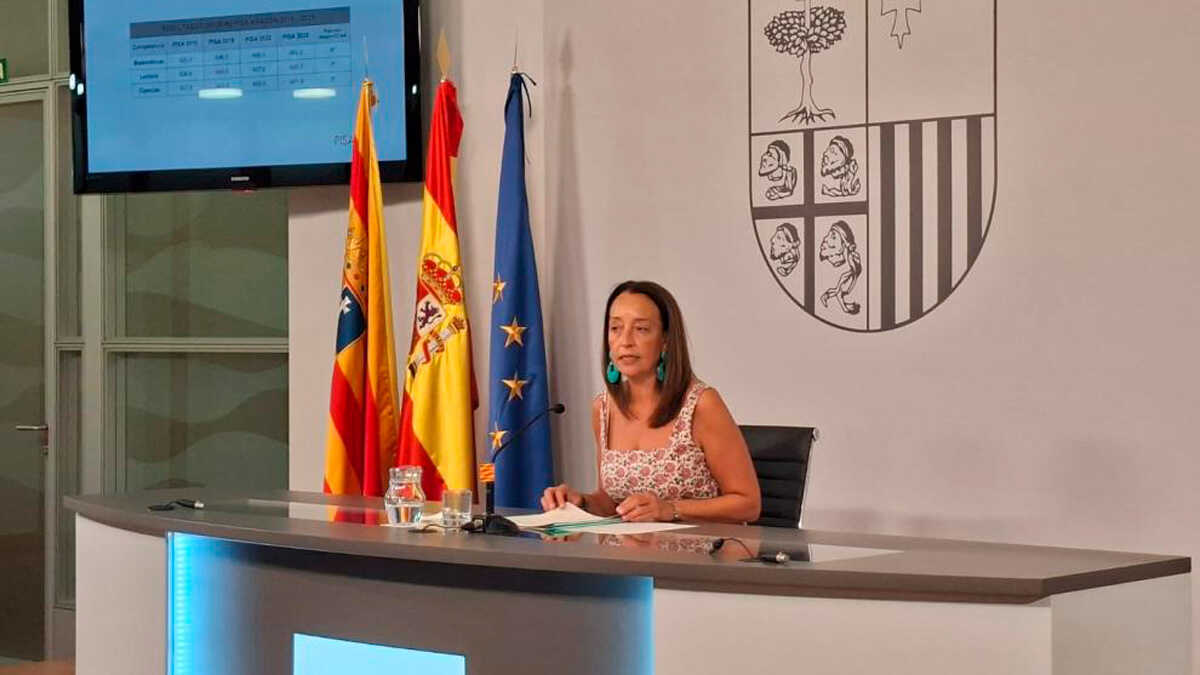
Susín said the results represent Lomloe’s “first real exam” – the Organic Law amending the LOE –, which has been in force since 2021 and whose implementation was completed in the 2023/24 academic year. “This is what happens when the left, which believes education is an ideological toy, starts making laws,” the education minister said, stressing on several occasions that "learning must be at the center of the education system."
The data released on September 8 show a decline in the skills of 15-year-old students in Aragón, whose results have fallen to some of the lowest levels in the historical series. “Students are not being assessed; the system educating them is, and we knew the results were going to be terrible. The previous edition had already pointed to a deterioration,” the minister recalled.
“Aragón’s education system is suffering the catastrophic consequences of the reform imposed by Pedro Sánchez’s government, a sectarian reform approved without consensus and behind the backs of the education community,” Susín said. “We are talking about a free fall caused by a failed educational model,” a “collapse” pointing to “a loss of excellence” and a “worrying shift of students toward the low-performance bands.”
ARAGÓN LOSES UP TO 45.7 POINTS IN A DECADE
Performance-level data are another concern raised by the Government of Aragón. Some 32.3% of students in Mathematics and 28.6% in Reading are now relegated to Level 1, the lowest. At the other extreme, high-performing students classified as Level 6 account for just 0.6% in Mathematics and 0.2% in Reading. Susín said the figures reflect “an unequivocal trend of widespread decline and loss of excellence” in Aragón’s educational performance over the past decade.
The evolution of Mathematics shows one of the sharpest declines. In the ten years between PISA 2015 and 2025, Aragón lost 38.3 points, while Spain fell by 28.4 and the OECD by 27.2. Aragón’s average score stood at 462.0 points in 2025, 24.9 points below its 2022 score of 486.9 and well below the 500.3 recorded in 2015. This is the worst result recorded since 2006 and places Aragón eighth nationally.
In Reading, Aragón lost even more points. The decline reached 45.7 points since 2015, when its score fell from a peak of 506.4 to 460.7 points in 2025. The region ranks seventh among Spain’s autonomous communities in this area, and its decline exceeds both that recorded by Spain (-44.2) and the OECD (-31.6).
In Science, the score fell to 481.9 points, compared with 499.5 in the previous edition. Since 2015, when Aragón reached 507.6 points, the accumulated loss has been 25.7 points. The region ranked eighth, while Spain lost 15.7 points over the period and the OECD 11.3.
The Government of Aragón believes this decline has brought the region to the lowest levels in its historical series and has narrowed the lead it traditionally held over national and international averages. For Susín, Lomloe has represented “an attack on equity and effort; that is the legacy left by the left.”
The minister also argued that the results stem from having devised “a sectarian and ideologized law, approved without consensus,” which replaces rigor with automatic promotion and devalues merit, a move that systematically discourages students from making an effort.
ARAGÓN WILL REVIEW THE CURRICULUM “FROM TOP TO BOTTOM”
Beyond the diagnosis, the Aragonese government has announced measures intended to improve students’ skills. Susín said the region would not give up on an education “of quality, worthy and based on knowledge and effort” and announced the forthcoming creation of a working group made up of education professionals with classroom experience and the ability to manage and assess the system.
The team will be tasked with reviewing the Aragonese curriculum “from top to bottom” and examining how core instrumental subjects are being taught. Susín also pledged to work toward “a drastic reduction in teachers’ bureaucratic workload” so educators can focus “on what they do best: teaching.”
The DGA will also work during this legislative term to reorganize the workloads of schools and adapt them to actual learning needs. This will be joined by a future data unit to collect and analyze all assessment indicators so that decisions on education policy, Susín said, are made “on the basis of rigor and science, not sectarian criteria.”
Susín also recalled the 1.2-million-euro cut made by Pilar Alegría during her time as education minister to territorial cooperation funds intended to promote equity and combat early school leaving, citing it as an example of “ineffective management lacking medium-term planning.” She also criticized the central government for allowing Catalonia to try to “camouflage the disaster” of its PISA results, while Aragón, like other autonomous communities, is doing its homework and providing answers.
After analyzing these results, the government of Jorge Azcón is committed to working to “resolve the educational collapse to which Sanchismo has brought us.” “Faced with the dismantling of academic education to which the socialist laws have led us, Aragón will not give up on an education of quality, worthy and based on knowledge and effort,” Carmen Susín concluded.


