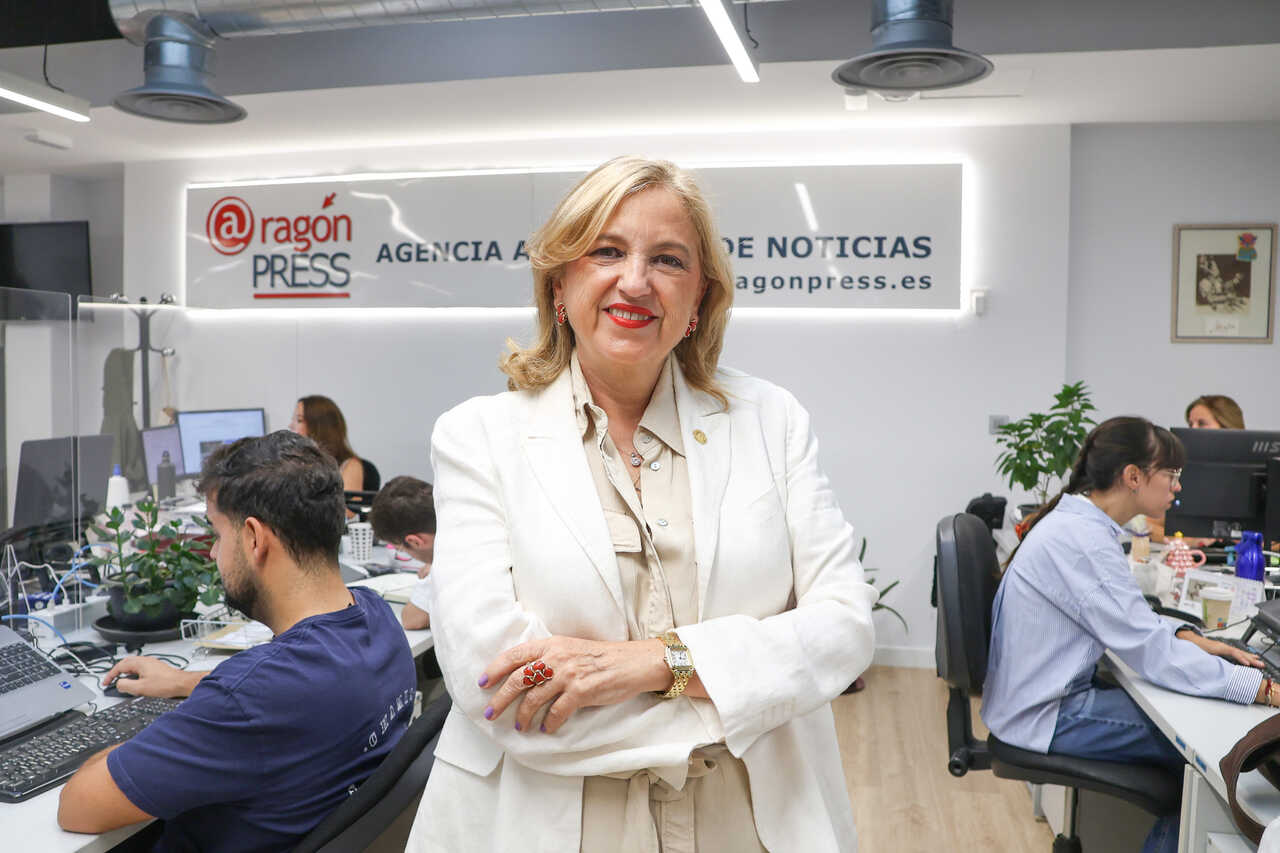
The academic year at the University of Zaragoza begins with nearly 95% of new-entry places filled and several academic developments underway. In this interview, Rector Rosa Bolea discusses the arrival of Medicine in Teruel, the new degrees being prepared by the institution and the renovation of Zaragoza’s Faculty of Medicine. She also addresses the expansion of micro-credentials, the future funding model and the possible introduction of free tuition during the first year of university.
QUESTION.- This is the second start of the academic year with you at the helm of the University of Zaragoza. How has this first week been? How many new students have enrolled and what percentage of places have been filled? ANSWER.- The week has been excellent. There have been no incidents and all the classrooms are operating completely normally. As for the students we already have at the University of Zaragoza, we had around 6,800 new-entry places and almost 6,500 have already been filled. We are at around 95% occupancy and still have one round of admissions left, which will take place next week, so our expectations are very good.
At this point in the admissions calendar, we are slightly ahead of last year, with around 155 more students. Considering that demographic trends are working against us, we are very satisfied because it seems that our university remains even more attractive than it was last year.
Q.- One of the main new developments this academic year is Medicine in Teruel. It is a milestone both for the people of Teruel and for the University itself, since the degree can now be studied in all three provinces... A.- That’s right. Medicine is one of the most sought-after degrees across the country. In Aragon, we already offer the full Medicine degree at the San Francisco Campus in Zaragoza and at the Huesca Campus, where we are starting the complete cycle this year. In Teruel, we have replicated what we did in Huesca several years ago: establishing the first two years there so that students can then complete the degree at the San Francisco Campus of the University of Zaragoza.
This is very important to us for several reasons. On the one hand, we are responding to a demand that is no longer merely regional but national. There is a shortage of doctors, and we are increasing the number of places so that there will be many more professionals in our area. But we are also having a direct impact on Teruel, both the city and the province.
Approximately half of the students are from Aragon, while the rest come from different parts of Spain, since it is a single admissions district. I believe that getting to know the city and province and studying at the Teruel Campus, in smaller groups and with all the University’s services close at hand, will help ensure that, when our future professionals have to choose a position, they take the province of Teruel much more into consideration.
Pharmacy and Aerospace Engineering will be introduced during the 2027-2028 academic year. Photo: Pilar Álvarez
Q.- International Business and the joint program in Hispanic Philology and Classical Studies have also been launched this academic year. How have they been received? A.- The reception has been extraordinary in both cases. The places were completely filled from the first round of admissions. International Business is our only full degree taught in English at the University of Zaragoza. It is a commitment to the internationalization of our university’s degrees that is becoming a reality this year, and I am sure it will be a great success.
As for the joint program in Hispanic Philology and Classical Studies, it has also been an incredible success. This year we launched it as a pilot scheme with just five places, and the admission score was extremely high due to demand, at 12.814. The places were filled from the very beginning.
Q.- Looking ahead to the 2027-2028 academic year, the degrees in Pharmacy in Huesca and Aerospace Engineering in Teruel are still pending. What stage are they at? A.- Pharmacy and Aerospace Engineering are a very important commitment for the University of Zaragoza and the Government of Aragon, which is supporting these degrees. That means a significant budget to get them up and running. We are preparing the verification reports required for the degrees to be introduced. They must pass a very important filter and quality-control process conducted by the quality agencies. We will probably submit them in November, and we hope to receive a positive assessment so that both degrees can begin in the 2027-2028 academic year.
Q.- Are you planning to launch any other degree programs in the future? A.- At the moment, we have no new official degree in mind because a great deal of funding is genuinely needed. We are considering future initiatives, but we do want to make some changes to Tourism studies, and we also have several university-specific degrees in mind. They would not be official degrees, but I cannot announce them yet.
Q.- As for infrastructure, the renovation of Zaragoza’s Faculty of Medicine is still pending. What stage is it at? A.- When we took office at the Rectorate, the project had been planned in two phases. We made a series of adjustments and saw that, if we combined it into a single phase, the result would be better, both economically, because the cost of the project is already extremely high, and in terms of execution time. That is why we have spent this time adjusting the project so that it can be carried out in a single phase.
The tender for the Medicine project is also taking place at a time when we are caught between two funding models: the one that will end at the close of this year and the one that will begin in 2027. This means that we have to find a special mechanism to tender a project of this scale and with such a large budget. That is what we have been negotiating with the Government of Aragon through an agreement that will link the two funding models, and we practically have it in hand. Our aim is to put the project out to tender by October at the latest, so that companies can begin bidding and construction can start as soon as possible.
The University of Zaragoza’s new funding model will arrive in 2027. Photo: Pilar Álvarez
Q.- When could construction begin? A.- We can provide approximate dates for the tender, but once that process begins, companies submit their bids and, if there are no problems, the period can be relatively short. If there is an appeal or any other problem, the deadlines become longer. That is why I prefer not to give a date, not even an approximate one, for the start of construction. What I can say is that the tender is imminent.
Q.- I would like to ask you about micro-credentials. How many are expected to be introduced this academic year, and how are people responding? A.- Micro-credentials are flexible courses accredited by our University and also certified through a European platform. Among Spanish universities, we have been pioneers in developing micro-credentials.
Micro-credentials are short courses that can begin at 15 credits, with the option of extending them. They allow us to focus on cutting-edge topics. We have announced 39 micro-credentials, divided into five pathways, aimed mainly at people in our region, although not exclusively, since much of the content is also offered online. In total, we already have 15,000 certified micro-credentials.
We are very satisfied with the results and, as rector, I believe they are the perfect complement for extending education toward the areas our society needs in its daily life.
Q.- You mentioned the University’s funding. How are talks with the Government of Aragon progressing? Is an extension expected? A.- I believe we will meet the deadline because that is the intention of both the Government of Aragon and the University of Zaragoza. We have already held preliminary talks in which we have brought our models closer together: what the University is asking for and what the Government of Aragon is considering putting in place for this funding model. I believe we will reach a very good understanding and that we will have the new funding model in 2027. That is what I hope.
Q.- The president of the Government of Aragon, Jorge Azcón, announced free tuition during the first year. Is there a date scheduled for implementing this measure? A.- We do not yet have a date because we are currently working on the funding model, and it must include whether we are going to carry out measures of this scale. We know that the Government of Aragon is concerned about this issue and has put it on the table, but we have to work out the details with them. I believe that, in the short or medium term, this measure will be introduced at the University of Zaragoza.


