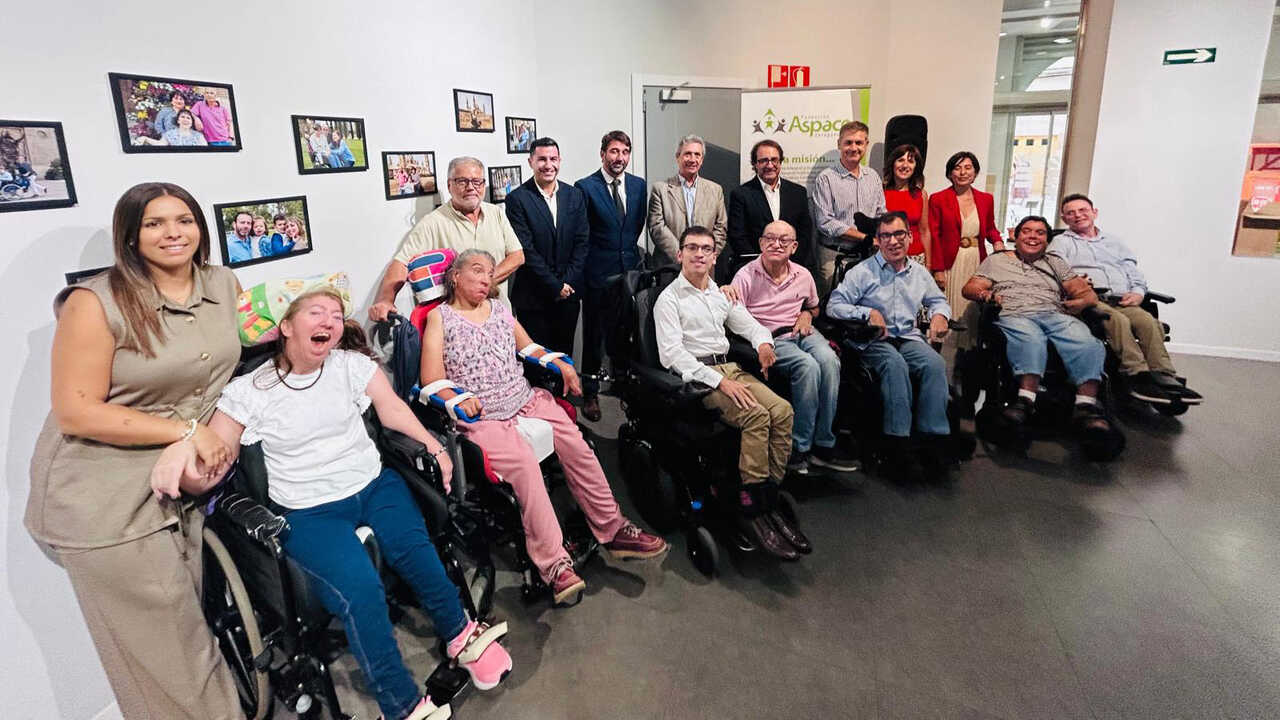
The exhibition brings together 26 photographs taken by Óscar Alijarde, Carlos Grasa, Vicky Romeo, José Gracia, Marc Moya, Mari Luz Altimasveres and Virginia Navarro. During April, May and June, the photographers spread out across different parts of Zaragoza to meet the families and decide for themselves how they wanted to portray them. To do so, they used cameras and various forms of support adapted to each participant’s needs.
“Taking these photographs is very rewarding,” says Óscar. He has spent several years learning alongside photographer Simón Aranda, who leads the workshops, and is now delighted that the work can be seen by the public. He also says the exhibition demonstrates that “each person’s functional diversity does not have to be a limitation. Sometimes we impose limits on ourselves, out of fear or for some unknown reason, but there is nothing to be afraid of.”
A FAMILY KEEPSAKE
On the other side of the camera are families such as Marta Binaburo’s and her son Juan’s. For them, taking part in "Junto a ti" has also meant achieving something that is ordinary for many people but complicated in their case: a photograph of the whole family. “This is the first time we have been able to take a photograph like this, all together. Because of our son’s disability, it is quite difficult to take a photograph of him. So we are left with a very pleasant and beautiful memory,” Marta explains.
The experience came just after they had joined Aspace Zaragoza. “Through this activity, we realized how much the Foundation cares for its participants and looks after the families,” she says. During the session, she recalls, they spent time with the photographers and other families and “really bonded.” The result, she says, is a set of “truly beautiful” images taken by photographers who, she emphasizes, “are first-rate.”
For Marta, giving visibility to projects of this kind helps show a reality that often remains out of the spotlight. “It is important to give it a voice so that everyone can see what they are capable of and what families with children who have disabilities are like,” she maintains.
“SEEING OURSELVES REFLECTED IS A SOURCE OF PRIDE”
José Gracia, another of the exhibition’s photographers, was also clear from the outset about where the project’s focus should lie. “"Junto a ti" is aimed at families, giving them the importance they deserve,” he explains. To that end, the participants spread out across different locations in Zaragoza and arranged to meet families linked to the organization for the sessions.
Now, after months of preparing the photographs, “being able to see themselves reflected in a project like this, in an exhibition that everyone can see, is a source of pride,” José says. And he has no hesitation when asked whether it is worth visiting the Joaquín Roncal Centre: “Of course. People should come and see it; everything has turned out beautifully.”
"Junto a ti" will remain open at Zaragoza’s Joaquín Roncal Centre until September 26. The exhibition is accompanied by a book about the project and texts in which the families and the photographers themselves explain what family means to them. It is an exhibition in which those who usually appear in front of the camera have decided this time what to look at, how to frame it and when to press the shutter.


