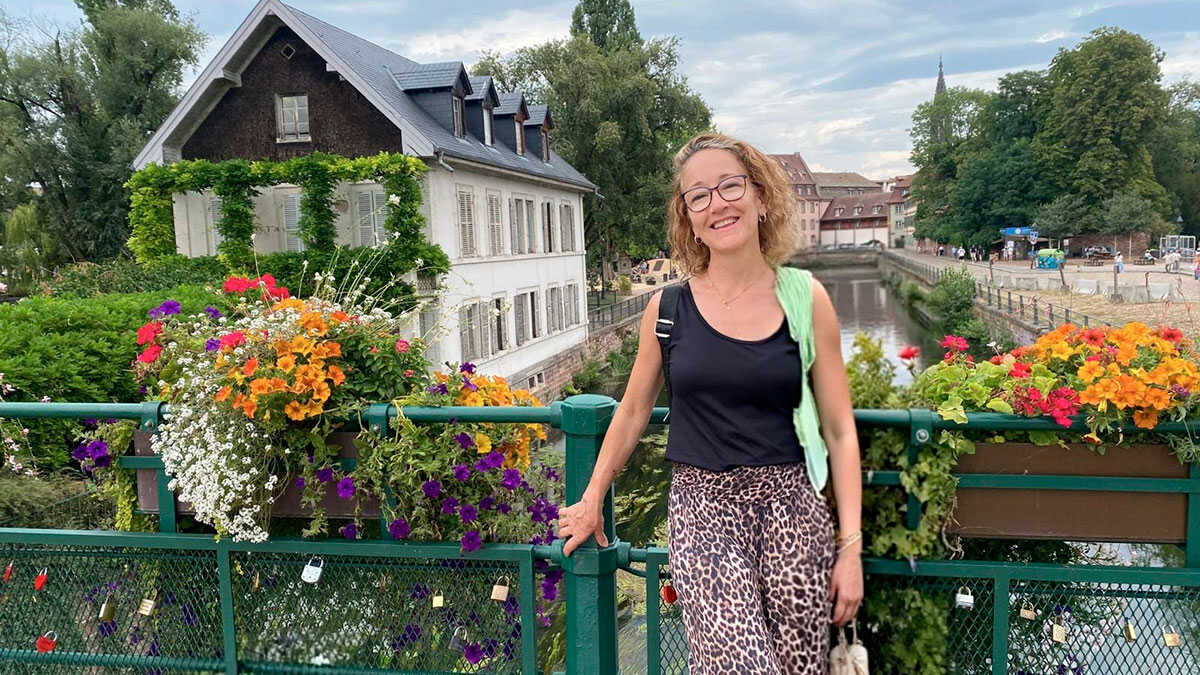
Mallorca, Peñíscola, Ibiza, Gran Canaria, Alsace, Malta and Amsterdam are among the destinations Marian, from Zaragoza, has visited thanks to the platform, which she has been part of for eight years. The HomeExchange member has completed 40 exchanges: on 18 occasions she has hosted people in her home, and on 22 she has been a guest in other members’ homes.
The woman from Zaragoza discovered this possibility almost by “chance”. “I searched Google for affordable holiday rentals. My family and I usually travelled somewhere on the Spanish coast every summer for around 15 days, and until then we rented apartments from private owners. During that search, I discovered the platform, which operated through home swapping,” she explains. She then created a profile, added details about her home and took the plunge with her first exchange in Peñíscola, where she spent the weekend.
Since her first exchange, Marian has continued travelling with her family
Since that first exchange, Marian has continued travelling with her family, both on “short getaways” and holidays lasting more than ten days. This past summer, in particular, they took a domestic trip to Gran Canaria and an international trip through Alsace and the Black Forest. Although during the first few years all her trips were within Spain, when her daughter got older she decided to use the platform to travel abroad in order to “practise English”. They have since also explored the streets of Malta and Amsterdam.
SAVINGS OR FLEXIBILITY AS THE MAIN ADVANTAGES
For her, “the main advantage is the savings”, since the system works through an annual membership costing 175 euros, which allows members to stay as many times as they want in different destinations. This means that money that would otherwise have gone towards accommodation can be used for more getaways or spent on other aspects of the trip.
The exchange system is organised through so-called “GuestPoints”. When users register with HomeExchange and take out an annual subscription, they receive an initial number of “GuestPoints”, allowing them to start travelling even if they have not yet hosted anyone. From then on, they can earn more points by welcoming other members into their home: guests use their “GuestPoints” to stay there, while the host accumulates them to use later in another home and another destination.
Although during the first few years all her trips were within Spain, when her daughter got older she decided to use the platform to travel abroad
Although savings are one of the main “advantages”, Marian also highlights the “flexibility” this way of travelling offers. “In Tavernes de la Valldigna, we initially planned to stay for a week, but because we were so comfortable and there was availability, we ended up extending our stay by another five days,” she explains.
Comfort and privacy are additional benefits. “In a hotel you normally have one room, whereas in a house you have much more space and privacy. You may have several bedrooms, a living room, a kitchen and communal areas where you can spend time more comfortably,” says the woman from Zaragoza. This type of accommodation also makes it easier to experience “living like a local” rather than travelling as a tourist. During their stays, she explains, they shop for groceries, cook and organise their schedules more freely, becoming more naturally integrated into the destination. “Ideal for travelling with children,” she says.
THE FEAR OF LEAVING YOUR HOME TO STRANGERS
When swapping your home, you can choose to leave it empty for guests or use the “hospitality” model, in which the owner remains in the property and offers the guest a room. But is it easy to get it right? It is normal for fear or uncertainty to arise when offering your home to a stranger. In Marian’s case, she has always had “good experiences” and found things “just as I had left them”.
Doubts can also arise when deciding where to stay
“One of the things that gives me the most peace of mind is that you decide whom to accept. You can view the person’s profile, see the reviews left by other members and speak to them before finalising the exchange. You are under no obligation to accept someone who does not inspire confidence,” she explains.
The only occasions on which she has encountered a “minor inconvenience” involved smells. “Once I stayed in a house where people smoked — I am a former smoker — and the smell of tobacco was a little unpleasant.” However, she acknowledges that this was indicated in the home’s profile: “It taught me to pay even closer attention to a home’s details and conditions before accepting.”
In her case, she has hosted people from all over Spain as well as a French family. “Some came to visit friends or relatives, others because their children had a competition or activity in Zaragoza, some attended the Fiestas del Pilar and others were simply stopping over during a trip,” she says. For her, the most important thing when hosting someone is to leave the home “perfectly prepared: clean, tidy and well cared for, so that when they arrive they feel truly comfortable”.
THE UNCERTAINTY OF “CHOOSING WELL”
“Will I have chosen well?” or “Will everything be as I expect?”. Doubts can also arise when deciding where to stay. To reduce that uncertainty, the woman from Zaragoza recommends carefully reviewing the user’s profile, the reviews left by other hosts or guests and the photos of the property, which usually provide “quite a lot of information about what you are going to find”.
But above all, she highlights “communication”. “The messages you exchange before finalising the swap say a lot. They allow you to get to know the person a little better and see whether they inspire confidence,” she explains. Even when dealing with a new user, Marian does not rule out an exchange: in such cases, she prefers to speak by phone or video call first to get to know the other person better.
“I think having experienced both sides is important because it allows you to understand very well what it means to be on each side: both the responsibility of opening your home to other people and the peace of mind of knowing that someone is welcoming you into theirs,” says the woman from Zaragoza.
Marian acknowledges that HomeExchange is not for everyone: “If you expect everything to be exactly like in a hotel, this system probably is not for you.” But “if you have a minimum of hospitality and are able to put trust and a desire to share ahead of that initial fear, I think it is absolutely worth trying”.
MORE THAN 2,800 EXCHANGES IN ARAGON
According to data provided by the platform, Aragon currently has 953 members offering their homes for this type of exchange. So far this year, 2,861 stays and 38,967 overnight stays have been recorded, representing increases of 43% and 36%, respectively, compared with 2025.
Madrid, Barcelona, Valencia, San Sebastián and Cambrils are the favourite destinations for people from Aragon, while those arriving in the region mainly come from Barcelona, Valencia, Madrid, San Sebastián and Bilbao. Within Aragon, Zaragoza, Jaca, Sallent de Gállego, Villanúa and Aísa are among the places most in demand among visitors.


