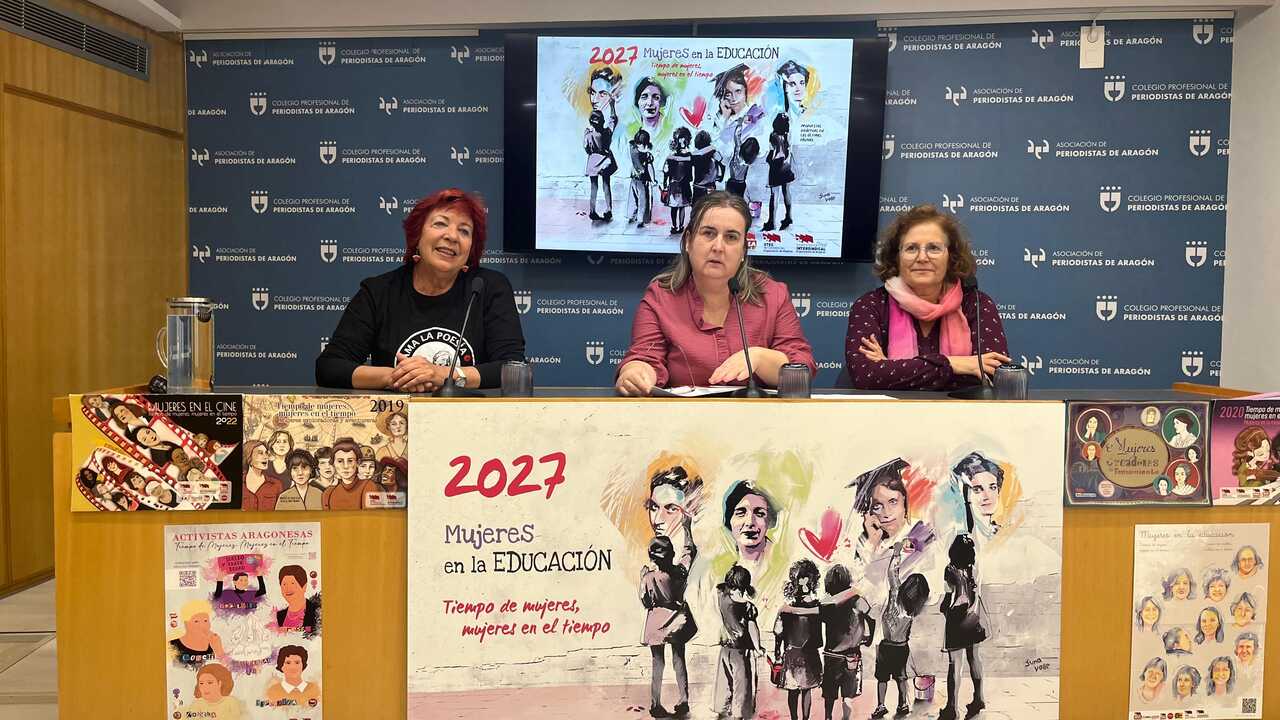
The project, promoted by the Women’s Organization of the Intersindical Confederation and the Trade Union of Education Workers of Aragon (STEA), dedicates its 2027 edition to women in education and pedagogy. Its aim is not only to remember their names, but also to bring them into classrooms and turn their life stories into educational tools for students of all ages.
“We see that there is a lack of female role models in the materials we commonly use in the classroom,” explained María José Giménez, a representative of the Women’s Organization of the Intersindical Confederation. She therefore stressed the need to continue working on equality and highlighting the work of so many women which, both throughout history and today, “has often been ignored.”
WOMEN WHO CHANGED EDUCATION BUT ARE STILL ABSENT FROM CLASSROOMS
The 2027 Women’s Calendar highlights international figures such as Gabriela Mistral, María Montessori, María Zambrano and Maude Kerns, while also focusing on closer-to-home role models. Among them is the Aragonese teacher Casilda Manzana y Lleida, born in Tolva (Huesca), a pioneer in defending equal education for girls.
The project was launched in 2012 with a simple idea: to transform a wall calendar into a resource capable of making women’s contributions visible in different areas of society. Since then, each edition has focused on a different sector and combined illustrations, anniversaries and teaching proposals that can be used from early childhood education through adult education.
The 2027 edition also arrives at a symbolic moment, coinciding with the 50th anniversary of the creation of education workers’ trade unions. According to Giménez, this commemoration led to the unanimous choice of education as this year’s central theme.
90,000 CALENDARS AND 365 WOMEN TO DISCOVER THROUGHOUT THE YEAR
The project reaches across Spain. In total, 90,000 free paper copies are distributed, around 5,000 of them in Aragon, and the calendar can be downloaded under a Creative Commons license in seven languages, including Spanish, Aragonese and Catalan.
Each month is devoted to a theme linked to education, such as pioneers, inclusion or equality, and is accompanied by illustrations of prominent women. For this edition, Andalusian artist Suna Valle created 35 watercolor portraits, in addition to the cover.
But the calendar goes far beyond its twelve months. Each day of the year commemorates an event linked to a woman or organization, meaning that 365 female role models appear throughout 2027. The final six pages also include activities, ideas and materials for working directly with their stories in the classroom.
AN ARAGON SUPPLEMENT TO REMEMBER ITS OWN ROLE MODELS
The project also includes a specific supplement on Aragon, featuring eleven women linked to education, equality and the region’s social transformation. Their portraits were created by Zaragoza-based artist Raquel Viver.
They include Carolina Giral, a teacher who prepared young people to enter the Baccalaureate and teacher-training programs during the Franco era; Begoña Garrido, who promoted the Gender Equality Promotion program in Aragon from its introduction in 2014; Rosa Bolea, the first woman rector of the University of Zaragoza in its more than 500-year history; and Peña Martínez, a role model in special education after 34 years working at the Gloria Fuertes school in Andorra.
During the presentation, Peña Martínez emphasized that there is still a significant lack of female role models in school content. The aim, she explained, is to provide tools to tackle an absence that remains visible “in textbooks and also in the traditional school curriculum.” Carmen Choliz, Alicia Fernández Maurel, Carmen Carramiñana, Ángela Rodríguez, Leyre Núñez, Patrocinio Ojuel and Judith Urioitia are also included in the publication.
FROM THE PARANINFO TO THE CLASSROOMS
The official presentation of the calendar will take place this Wednesday at the Paraninfo of the University of Zaragoza, where several of the Aragonese women featured, or their families, will share their experiences and life stories. The event will also pay tribute to pioneers such as Patrocinio Ojuel, who introduced the Montessori method to Aragon, and Carolina Giral.
Beyond institutional recognition, the calendar aims to bring these stories into classrooms and make them part of everyday education. Because, as its promoters point out, it is difficult to imagine new paths when the representation of those who paved them before “is, unfortunately, scarce in books,” Martínez concludes.