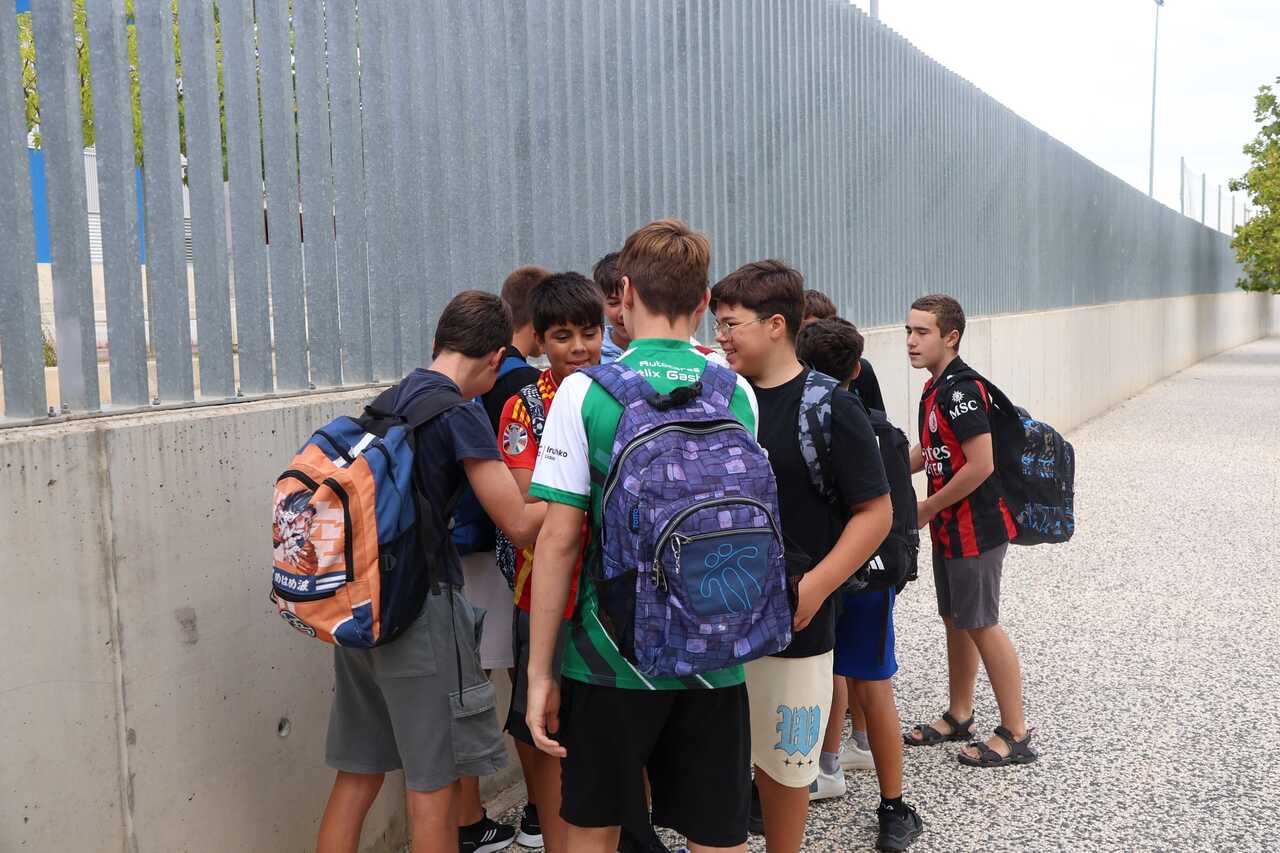
A total of 153,136 students are enrolled in preschool, primary and compulsory secondary education (99,093 in preschool and primary education and 54,043 in compulsory secondary education). Among the youngest students, 8,588 children starting the first year of preschool will begin their education for the first time, 257 fewer than last academic year. The figure, said Education Minister Carmen Susín, confirms the “decline in the birth rate” in the region.
In addition, 13,488 Baccalaureate students will begin classes on September 9, while 25,407 vocational training students will do so on September 10. Sports education will start on September 11, plastic arts and design on September 14, and higher artistic education, as well as elementary and professional music and dance education, on September 21. On October 1, students at official language schools, specialization courses and the virtual vocational training program will begin classes.
In the first cycle of preschool education, Aragon will have 62 two-year-old classrooms this academic year, serving 731 students. Four new classrooms are being added at CPI Julio Verne in Zaragoza, CP Montecanal, CRA El Frasno and CP Villa de Utrillas. They join the 11 nursery schools run by the Government of Aragon, which have 852 students.
Aragon’s education network is expanding this academic year with 17 new specialized ASD classrooms, 11 new special education classrooms and four new early enrollment classrooms. Specifically, the ASD classrooms are distributed across the three provinces, with four new ones in Huesca, 12 in Zaragoza and one in Alcañiz (Teruel). In terms of inclusion, the academic year also begins with a record 796 special education assistants, 26 more than in the previous period. They are joined by 125 healthcare professionals (63 physiotherapists, 38 nurses and 24 nursing care assistants), compared with 118 last academic year.
RECORD ENROLLMENT IN VOCATIONAL TRAINING
Vocational training continues to be one of the main priorities of the Government of Aragon as a “pathway into employment and an economic driver,” according to Luis Mallada, Director General of Planning, Schools and Vocational Training. This academic year, more than 600 active training programs are being offered at 112 publicly funded centers.
As of September 4, 25,407 students were enrolled in in-person programs, around 2,000 more than at the same point last academic year. This figure does not yet include students in virtual and blended programs, late enrollments or specialization courses.
By level, there are provisionally 11,041 higher-level students, 10,879 intermediate-level students and 3,203 basic-level students. The programs in greatest demand are Administrative Management, Administration and Finance, and Networked Computer Systems Administration. This academic year, 21 new programs and 495 new places are being added, almost half of them linked to technology or STEAM fields.
The main new developments in educational planning this academic year include the opening of the Calatayud Professional Music Conservatory, the introduction of a higher-level vocational training program in Jaca for the first time, and the rollout of specialization courses at the Digital Campus, focused on technology, data centers and AI. Huesca is also introducing an intermediate-level program in Machinery Electromechanics, meaning the training is now available in all three provincial capitals, while Refrigeration and Air Conditioning Installations is launching at IES Miguel de Molinos in Zaragoza.
FEWER TEACHING HOURS FOR STAFF
The academic year will begin with 17,083 students already incorporated into educational centers, of whom 10,875 are career civil servants: 5,773 primary teachers and 5,102 secondary school teachers. In addition, substitute positions were offered and the dates were brought forward to the end of August so that temporary teachers assigned to these positions could join schools before students. As a result, these 963 temporary teachers are being added to the overall teaching staff this Monday, September 7.
Throughout the academic year, the Education Department will continue adopting measures to address the structural shortage of teachers in certain specializations. These include once again asking the Education Ministry to authorize primary teachers to teach the first and second years of compulsory secondary education, as well as resorting again to exceptional measures in the most understaffed specialties to ensure the system’s needs are met.
This academic year also completes the agreement on improved working conditions and salaries for teachers, who will receive the full 4.5% pay increase corresponding to the two 2.25% installments applied over the past two academic years. In addition, secondary school, Baccalaureate, language school and vocational training teachers joining in September will have a maximum of 18 teaching hours per week, while primary teachers will teach 23 hours for the first time, two fewer than in the 2022/23 academic year.


