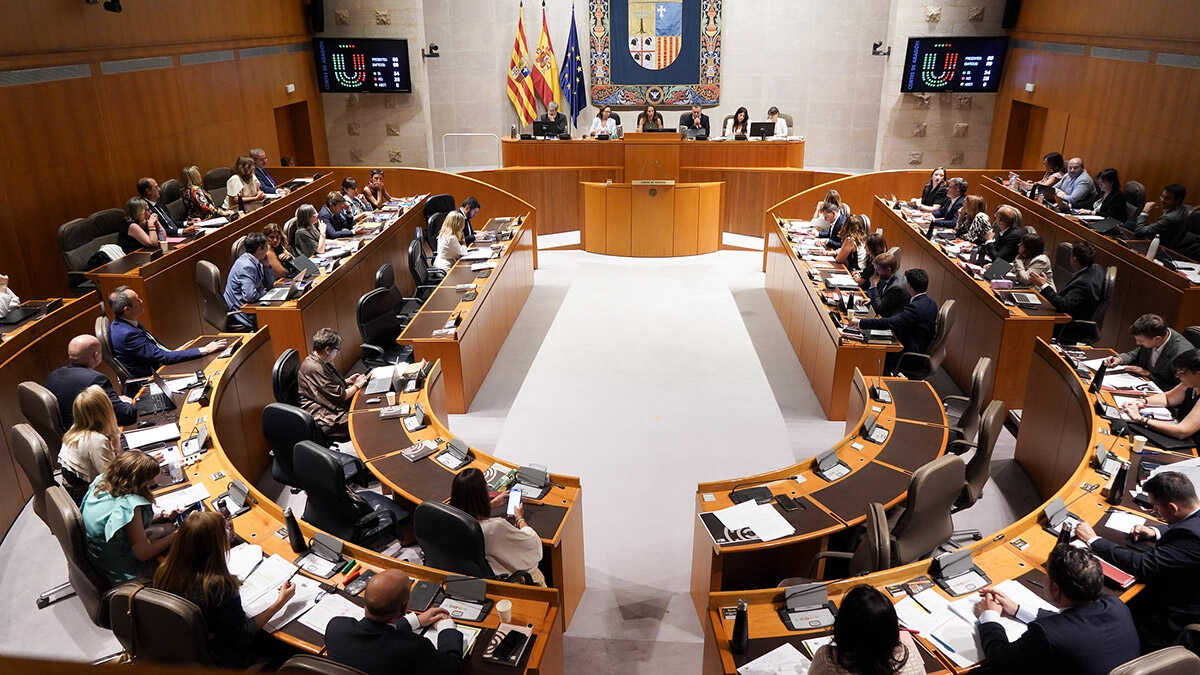
The proposal put forward by the People’s Party was defended by lawmaker José Luis Bancalero, who was born in Melilla and lived in Ceuta for 21 years. “Since July 30, the people of Ceuta have been living in a situation of fear, uncertainty and insecurity that we cannot normalize or accept. We cannot get used to our compatriots being afraid,” he said.
PP CRITICIZES THE CENTRAL GOVERNMENT’S ACTION
The People’s Party lawmaker questioned the actions of Pedro Sánchez’s government. In his view, when a situation like this occurs, “citizens expect their government to be there, to protect them, respond and provide explanations, and it has not done so.”
Bancalero also acknowledged the work of those working in Ceuta, including healthcare workers and the security forces. He also highlighted the response from Spanish and Aragonese society on September 2, although he lamented the absence and silence of the Aragonese left.
VOX SPEAKS OF AN “INVASION” AND BLAMES MOROCCO
“Ceuta and Melilla are inseparable parts of Spain,” Vox lawmaker David Arranz began, reaffirming that what happened in the city of Ceuta was an invasion and accusing Morocco of “organizing a hybrid war maneuver against our nation and our territorial integrity.” Arranz denounced the autonomous city’s “unsustainable insecurity,” with an “overwhelmed healthcare system” and schools unable to guarantee the safety of their students.
He also identified Pedro Sánchez’s government as responsible for the situation. “It had that information from our intelligence services, it knew what was going to happen and did nothing.” The Vox lawmaker accused Spain’s prime minister of crimes such as treason, for which, in his view, he should answer before the courts.
“Morocco is not a friendly country,” Arranz argued, citing statements by several ministers from that country calling for sovereignty over Ceuta and Melilla. For this reason, he said he could not understand why the Spanish government had not formally condemned those statements by summoning Morocco’s ambassador to Spain. He also called for the suspension of the Treaty of Friendship and Cooperation.
PSOE, CHA, TERUEL EXISTE AND IU REJECT THE MOTIONS
PSOE lawmaker Fernando Sabés insisted that Melilla and Ceuta are part of Spain. He criticized both motions for their clear partisan nature and defended the transparency of the Spanish government, while expressing the hope that some of the autonomous regions governed by PP and Vox would show the same transparency. “Spaniards are interested in a common position and strength,” he maintained.
CHA member María del Carmen Bozal said that “the people of Ceuta deserve protection and resources,” since Morocco cannot use “human beings as a tool of pressure.” However, she refused to accept “the racist framework” that PP and Vox seek to impose around immigration. “You sow hatred, and the problem is that vulnerable people bear the brunt of the storms of hatred,” she concluded.
Teruel Existe lawmaker Pilar Buj lamented that what happened in Ceuta was “another example of the use of human beings as a tool in political and nationalist conflicts.” She said her priority was to stand with the people of Ceuta, but defended the need not to forget the rights of “all the people who have been caught up in this crisis.” Finally, Buj asked the Spanish government to clarify what had happened: “One day they say one thing and the next day a minister says the opposite.”
IU spokesperson Marta Abengochea expressed her “deep shame” that it had not been possible to agree on a minute of silence for the more than 140 people who died at sea “trying to reach a better life.” She reproached Vox for having an “atrocious fear of life” and for “compensating for it with hatred and walls.” She reminded the PP that it is possible to criticize the Spanish government while also being patriotic.


