The museum will once again welcome visitors across 4,661 square metres (around 1,000 more than before the renovation), spread over four floors, with a new entrance opening onto Plaza del Pilar, immersive galleries, a terrace overlooking the basilica and an international exhibition that aims to make it one of Zaragoza’s leading cultural attractions.
Technology will be key to rediscovering Goya’s work and legacy. Photo: Goya Museum
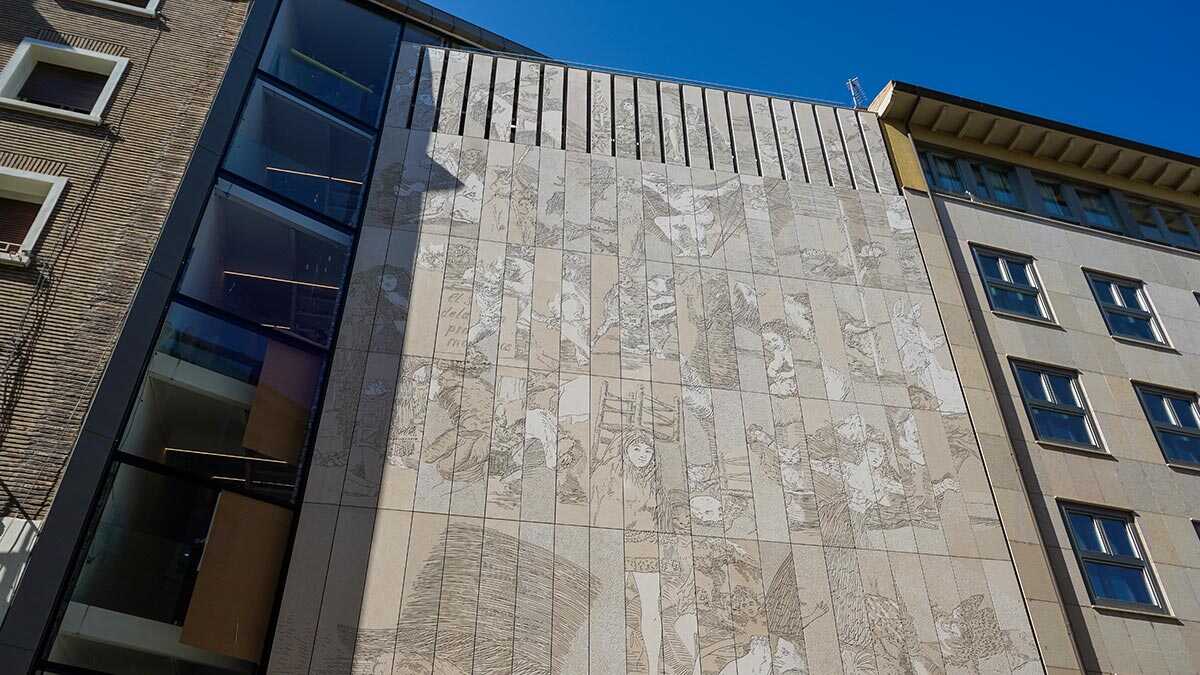
Amid cranes, workers, materials and the final finishing touches, one of the main new features of the Fundación Ibercaja Goya Museum has been visible practically since work began: the new entrance on Calle Santiago, which connects it directly to Plaza del Pilar. In addition, with the aim of introducing visitors to Goya’s universe even before they walk through the doors, the new façade can already be glimpsed, formed by large stone blocks that will feature fragments of the painter’s prints.
It will be "a 21st-century museum," as its director, May Forcén, acknowledged, in which technology will play a fundamental role in bringing visitors closer to Goya. The project has had to reconcile the architecture of a 16th-century Aragonese house with the needs of a modern art gallery. It preserves elements such as the Renaissance courtyard and restores the gallery of arches on the third floor, while introducing ramps, stairways and lifts to make the entire route accessible.
A UNIQUE MUSEUM IN THE WORLD
The Goya Museum houses around 500 works and preserves an important collection of art from before and after the painter’s time. After the Prado Museum, it is one of the spaces with the largest number of Francisco de Goya’s paintings on display, and it is the only museum in the world to permanently show all the series of prints he produced between 1778 and 1825. They include the Velázquez Copies, Los Caprichos, The Disasters of War, La Tauromaquia, The Follies and the Bulls of Bordeaux.
Architect Sergio Sebastián has designed the interior as a “Goya passage,” an itinerary in which the different rooms will be visually connected. The lighting, colours and placement of the works have also been reviewed to provide a clearer reading of the artistic content and the symbols used by the painter.
The temporary exhibition gallery will take on greater importance within the complex. It will have double-height ceilings and an area of 315 square metres, allowing it to host larger exhibitions and projects from major national and international collections.
IMMERSIVE GALLERIES TO STEP INTO GOYA’S PAINTINGS
The new Goya Museum will not merely change partitions, routes or entrances. The renovation introduces a new museographic approach in which technology will help explain the artist’s technique, historical context and the distribution of his work among museums and collections around the world.
One of the new features will be an immersive gallery in which paintings can be projected onto the walls, floor and ceiling. There will also be information totems, interactive installations, content about the techniques used by Goya and a geolocated tool showing where his works can be found around the world.
A GLASS TERRACE OVERLOOKING THE PILAR
The upper part of the building will be another highlight. The museum will have a glass terrace overlooking the Basilica del Pilar, designed as a space for concerts, performances, gatherings and other cultural events.
The third floor will also house a multipurpose area dedicated to workshops, educational activities and cultural mediation. It will also be home to the Francisco de Goya Study Centre, a documentation space that will bring together more than 1,000 volumes from different Fundación Ibercaja collections. Its purpose will be to facilitate research and turn the museum into a gateway for those wishing to explore the artist’s life, thinking and work in greater depth.
“SOLO GOYA. THE ART OF SEEING,” THE GRAND OPENING EXHIBITION
The reopening will be accompanied by the temporary exhibition “Solo Goya. The Art of Seeing,” curated by Estrella de Diego and Luis Fernández-Galiano. The exhibition will examine the way Goya observed and represented the society of his time.
The project will bring together pieces from collections in the United States, Latin America, Europe and different parts of Spain. Fundación Ibercaja has also announced a programme related to history, art, education, theatre and music to keep the museum active beyond its permanent exhibition.


