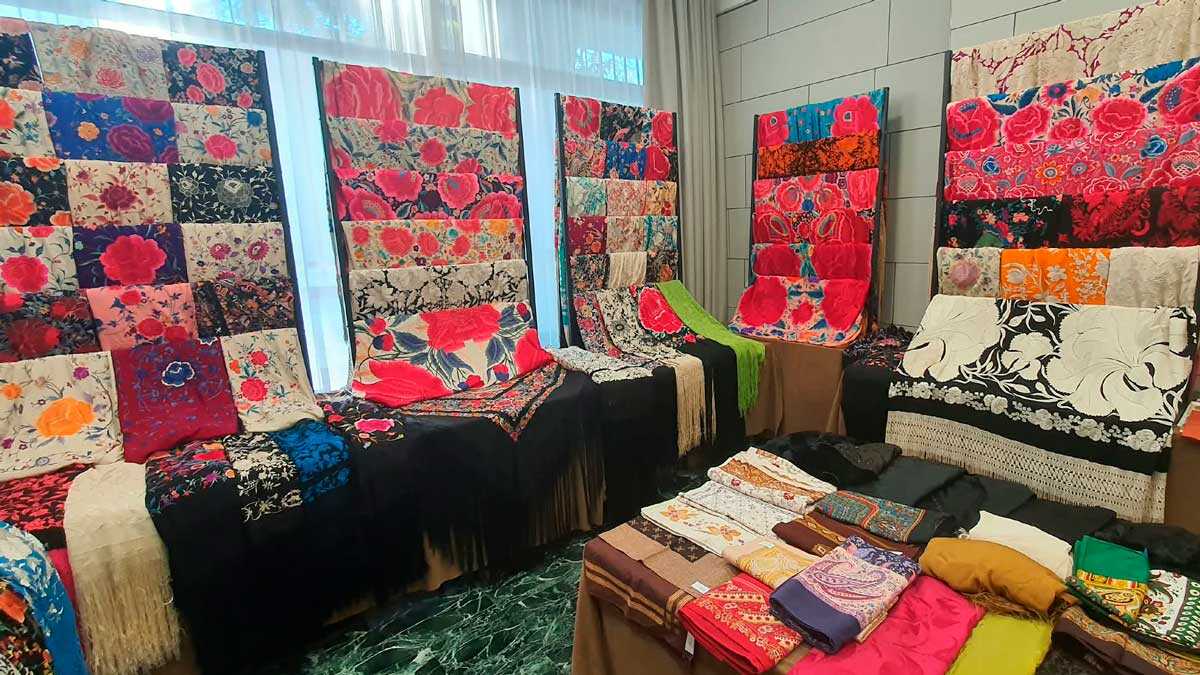
There, they are welcomed by María José Gutiérrez, owner of Tradición, a collector and expert in antique shawls who has spent 15 years searching for, studying and restoring these garments. Although her shop is located in the heart of Toledo, much of her business is connected to Aragón: “I would say that 90% of sales come from Aragón,” she says.
Her shop houses around 300 pieces dating from 1810 to 1920. For years, the collection has also traveled to Zaragoza, where Tradición holds an exhibition and sale of antique shawls every autumn. This year, the event reaches its 14th edition and will take place from October 2 to 4 at the NH Ciudad de Zaragoza Hotel. But the truth is that many of her Aragonese customers do not even wait until October. “They come specifically to buy them here. It is not just that they wait all year for the exhibition I hold there; they come to the shop from all over Aragón to buy shawls,” Gutiérrez explains.
A TOLEDAN WOMAN PASSIONATE ABOUT ARAGONESE TRADITIONAL DRESS
Fifteen years ago, Gutiérrez turned her passion for shawls into a profession and opened Tradición in Toledo. Since then, she has continued studying these garments and traveling to find antique examples, a job that has led her to describe herself as a “hunter of antique works of art.” Her passion for Aragonese traditional dress, however, came about almost by chance. She had no previous connection to the region, but she began sharing her work on social media, and more and more Aragonese people became interested in the pieces she found. First came the customers, and with them, a curiosity to learn more about the garments and traditional dress in Aragón.
María José Gutiérrez, owner of Tradición
Over the years, that connection has grown increasingly stronger. Gutiérrez began traveling frequently to Zaragoza, while her customers made the trip in the opposite direction to Toledo, and what began as a business relationship eventually moved beyond the shop counter. “Those who started out as customers are now like family friends,” she says. Whenever she can, she also attends the Fiestas del Pilar and acknowledges feeling particularly connected to the region: “From the very first minute I set foot in Zaragoza, you made me feel completely Aragonese.”
That ongoing contact has also led her to delve ever deeper into Aragonese traditional dress and gain firsthand knowledge of changing preferences. Looking ahead to this year's Pilar celebrations, Gutiérrez believes lighter pieces will take center stage. “I would lean toward people choosing lighter shawls this year—Isabelline shawls, Empire-style shawls and especially gros,” she says. There is also growing interest in Indianas, cottons and wools, compared with the large floral shawls that have been more prominent in other years.
PASSION AND TRADITION: HER CONNECTION WITH ARAGÓN BEYOND THE SHOP
Gutiérrez's relationship with Aragón has ultimately extended beyond the doors of her shop. At the end of last year, she launched Pasión y Tradición, an audiovisual project in which she travels to different parts of Spain to promote its historic traditional dress and explore the role garments such as the shawl have played in traditional attire.
Aragón has played a particularly important role. In gratitude for the welcome she has received over the years, she decided to dedicate one program to each of the region's three provinces—Zaragoza, Huesca and Teruel—using 19th-century dress, its garments and their uses as the central theme.
The recordings were also made in some of the region's most emblematic locations, including the Aljafería, the Huesca Museum and the Museum of the Lovers of Teruel. “The fact that the Government of Aragón made such emblematic sites available to me is a true privilege and an honor,” she says.
Behind the pieces that bring so many Aragonese people to Toledo is also an increasingly difficult search process
People connected to jota and traditional dress, including Beatriz Bernal, Nacho Delgado and maestro Almarza, among others, also took part in the project on an unpaid basis. Their involvement has further strengthened her connection with the region. “There is something about you that I praise and admire: the ability and love with which you care for your land and look after what is yours,” she says.
SHAWLS THAT CAN BE ALMOST 200 YEARS OLD
Behind the pieces that bring so many Aragonese people to Toledo is also an increasingly difficult search process. Gutiérrez travels to locate antique shawls, although her years of experience have also led private individuals and families to approach her directly with garments inherited and preserved over generations.
“It is becoming increasingly difficult to find them, especially the quality we deal with,” Gutiérrez acknowledges. Their value can vary enormously depending on their age, size, embroidery, uniqueness and state of preservation, from more affordable options to genuine collector's pieces worth several thousand euros.
But perhaps what surprises Gutiérrez most after so many years is not only the interest in finding these pieces, but also who is taking up the tradition. The expert says that more and more young people are approaching traditional dress with a curiosity to learn what people really wore and how each garment was used. In her view, this interest ensures that shawls, Indianas, woolens and other pieces with centuries of history will continue to have a place far beyond display cases and collections.
For Gutiérrez, much of the value of traditional dress lies precisely there: in ensuring that these garments continue to pass from one generation to the next and remain part of the present. Young people wanting to learn what those who came before them wore and make it their own ensures this continuity and proves, as she always argues, that “the best way to preserve a shawl is to wear it.”


