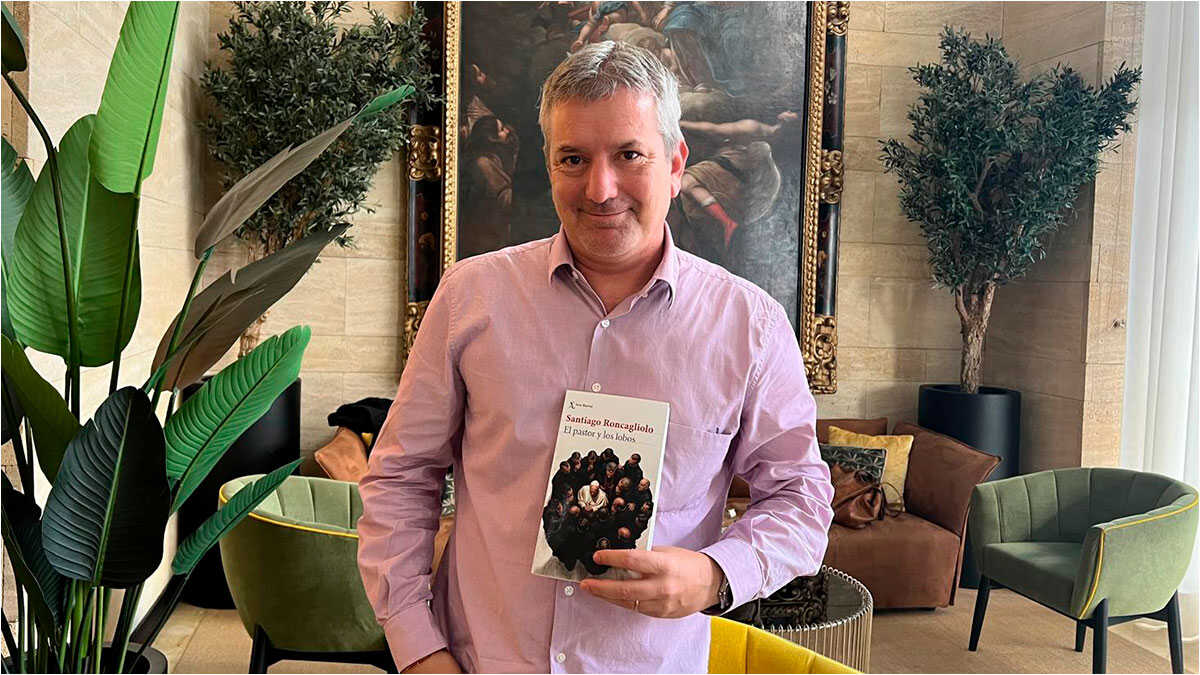
The book "The Shepherd and the Wolves" traces the pope's career through the writing of Santiago Roncagliolo in a thriller about power and the internal struggles of the Catholic Church. The book reconstructs Leo XIV's rise from the division left by Francis' death to the election of the new pope, and exposes the institution's deepest cracks.
QUESTION: ¿Why did this new pope catch your attention? ANSWER: I have written many things related to the Catholic Church and power. This is also a very personal book because it has come to me at a time when I believe in very few things. We are all on the verge of cynicism and do not want to be. So I wanted to believe in something. I truly wanted to write about someone good because I usually write about rather bad people. In the end, the book is a reflection on something as universal and ancient as the struggle between good and evil.
Q: ¿The struggle between good and evil? A: Yes. What struck me most during the entire year of research was feeling that I had encountered the best and the worst in human beings. Monsters in cassocks who destroy children's lives, but also missionaries and laypeople who devote their lives to helping others live better. And both the monsters and the wonderful people were part of the same institution.
Q: ¿How did you approach researching this pope? A: The story I found was very unexpected. When you begin an investigation looking for a story, you do not know whether there will be anything to tell; perhaps nothing noteworthy has happened in a priest's life. But I thought that if he had gone from Chiclayo, at the ends of the earth, to the papacy in two years, there had to be a story there. And then, if he was there, he must be a missionary, he must be connected to liberation theology, which is the Christianity I was taught. So I thought there was an interesting story to tell that not everyone knew.
Q: ¿And what did you find? A: The story of a priest who has managed the Church's sins: sexual abuse, financial crimes, the mafias... And who, precisely because of his talent for fighting them, has become pope. And when he is about to become pope, he is himself accused of having covered up for a sexual abuser. No pope has ever had a story like that. It was as if he had done it to be the subject of a novel.
Q: ¿What qualities did Leo XIV have that led to his election as pope? A: He is a Florentine politician, very subtle, much more so than Francis. So he can maneuver, manage and resolve these matters without creating wars within the Church, which was what prevented them from being fought. Francis detected that talent and immediately brought him to the Vatican. He thought that talent alone made him the ideal candidate to be his successor. He is someone who completely believes in what he does and, at the same time, is very cerebral and practical. It is a strange, even cold combination: once he considers all possibilities for an agreement exhausted, he acts and is implacable.
Q: ¿Why do you consider Francis' death a turning point? A: Francis ended his papacy on the brink of a schism. The Church is deeply divided between, broadly speaking, conservatives and progressives, in a war that had been going on for decades and began with the Second Vatican Council. Francis understood this and was clearly on one side of that war. Leo XIV's story shows that sexual abuse began to be used as a political weapon in that war, with each side accusing the other, and that if this continues, it is self-destruction: everyone loses. So the issue is not who wins this war, but how to end it; that is Leo XIV's main mission.
Q: ¿Do you think it is close to ending? A: It never ends, but I do believe his actions can be effective, or have an impact in slightly reversing the trend. Many steps have been taken in the internal war: many of Francis' sworn enemies have been placated and are much more diplomatic toward him; they have been neutralized. He is trying to mend the wounds. Curiously, sexual abuse is the issue on which he had the worst track record. When he came to Spain, on a hugely successful trip in which everything went well and people from all political sectors were delighted with him, the only people to speak out against him were victims of sexual abuse.
Q: ¿What is your assessment of his visit to Spain? A: It was a very interesting visit because it brought together matters of worship, cathedrals, abbeys and sanctuaries with social issues, prisons, immigrants and people who are suffering. He tried to unite worship with social commitment, and he did so to applause from all the members of Congress. It demonstrated his political skill and his commitment to the poor, prisoners, immigrants and people suffering for social reasons.
Q: ¿How did you write the scenes from his life? A: They were very difficult because nobody remembered anything. He is a deeply discreet man and, in his dealings with people, invisible. It is exasperating because you want headlines. You asked people: "¿And what did he say?" "Oh, I don't remember." Nobody remembered anything. Everyone remembered that he listened, and that was his talent: everyone felt heard. So it was a challenge to write this character as a narrator, because he speaks only through his actions. But at the same time, that was precisely what made him mysterious and fascinating.
Q: ¿What do you foresee for his papacy? A: I think he will carry out his mission, because it is also very clear where he is heading. He will consolidate the Church's social mission, which Francis launched and revived. He will commit to the poor, peace and refugees. He will avoid other sensitive issues, especially that of LGBT people and the traditional rite, which is an internal dispute within the Church.
And he will try to confront a world in which nothing guarantees human dignity anymore. No one talks about human dignity anymore, not even the leaders of democracies: people talk about bombing people, shooting Black people, bombing cities and killing children. His commitment will be to equality, to the idea that all human beings should have dignity. I hope he succeeds in that; we very much need him to.


