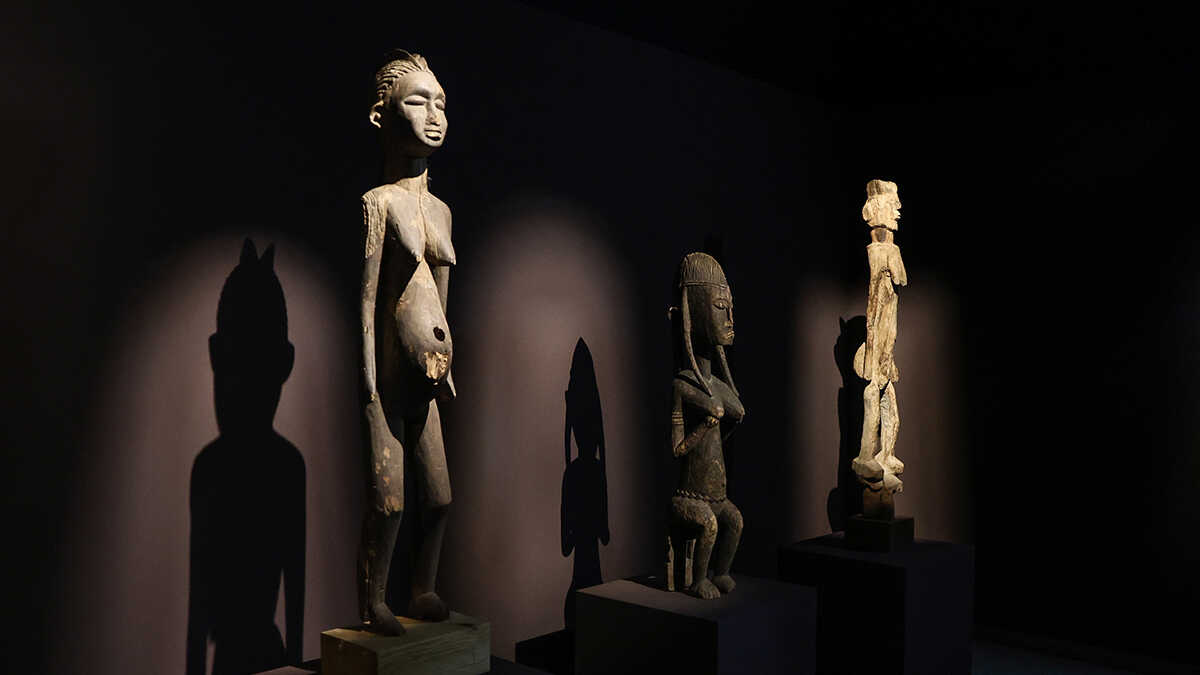
This is just one example of the dozens of pieces on display from this Thursday through March 28, 2027, in the exhibition "The Dance of the Spirits." The exhibition follows a thematic journey through five major symbolic areas of African culture, moving among unusual masks, enormous traditional currencies and striking ancestral figures, as well as abstract concepts such as fertility and divination.
REMOVING OBJECTS FROM A FORMALISTIC VIEW
Curated by University of Zaragoza professors Alfonso Revilla Carrasco and Raúl Ursúa Astrain, the exhibition brings together pieces linked to cultures including the Dogon, Bozo, Ejagham, Makonde, Bamana, Toma, Chamba, Mossi, Yoruba, Fali, Senufo, Kongo, Lobi, Moba and Ewe, among others. The aim is to move these objects, many of which were used in everyday life, away from an exclusively formalistic view and restore their status as objects connected to specific communities, capable of establishing relationships between the living and their ancestors, the earth and abundance, or the visible and the invisible.
The journey into the past begins with masks and continues with traditional currencies, which reveal different ways of understanding exchange and prestige. Fertility and abundance take center stage in the third area, with pieces related to the continuation of life, care and collective prosperity. The exhibition then explores divination and protection, before concluding with the ancestors through figures intended to preserve the bond between the living and those who embody the memory and continuity of the lineage.
DECOLONIZING THE GAZE
"The Dance of the Spirits" seeks, therefore, to "decolonize the gaze" by reflecting on how African art has historically been viewed and presented, as well as on the categories used to interpret it. The exhibition advocates a more attentive and respectful approach to the contexts in which these pieces were created and used.
The objects on display come from a shared private collection with venues in Huesca and Valladolid. Visitors in Zaragoza can immerse themselves in Black African culture at Centro de Historias until March 28, 2027.