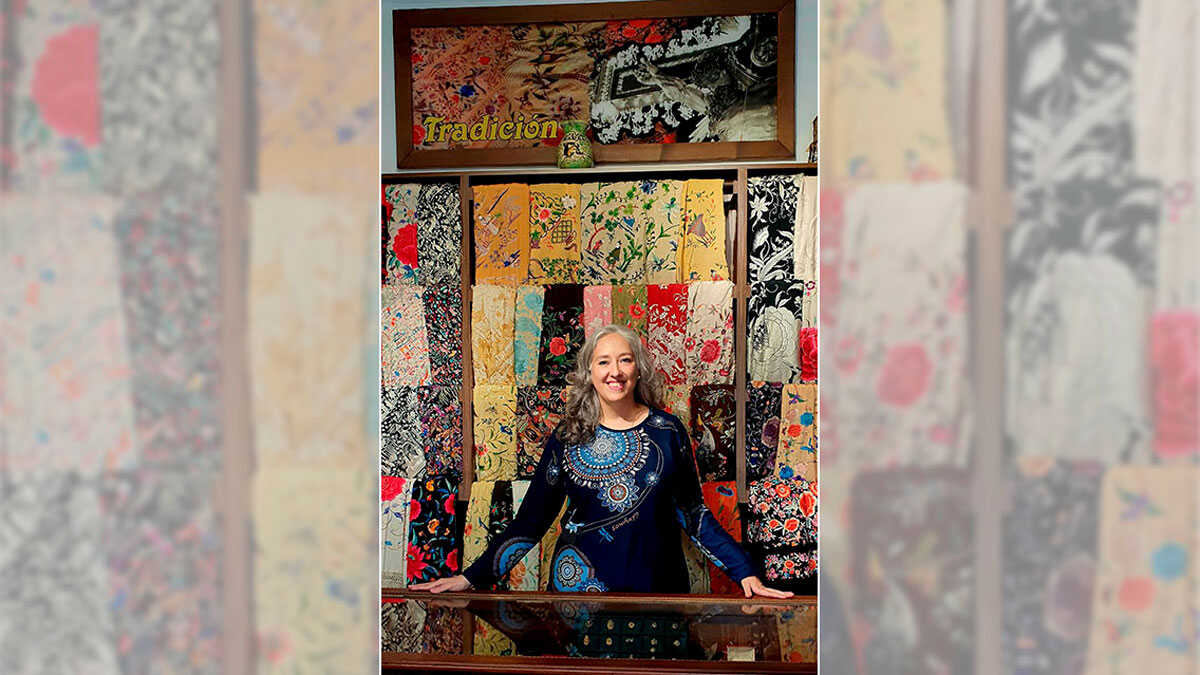
What will we see in 2026? María José Gutiérrez, a collector and expert in antique shawls with 15 years of experience, has a clear prediction. "I would say that this year people will opt for lightweight shawls, Elizabethan and Empire-style shawls, and especially gros-grain silk shawls," she explains.
Although she continues her work at her Tradición store in Toledo, Gutiérrez knows well how these preferences are evolving among Aragonese society: "I would say that 90% of sales come from Aragon. They come here specifically to buy. It is no longer just that they wait all year for the exhibition we always hold in Zaragoza in the autumn; they come to the store from all over the region to buy the shawls." Her shop houses around 300 shawls dating from 1810 to 1920, featuring different styles and designs.
THE GROS-GRAIN SILK SHAWL GAINS GROUND THIS PILAR
Among them, there is one name Gutiérrez hears increasingly often: the gros-grain silk shawl. It is a lightweight silk piece, and very old examples can be found, some dating back to the late 18th century.
Her shop houses around 300 shawls dating from 1810 to 1920, featuring different styles and designs. Image provided.
That versatility is precisely one of its attractions. "At any given moment, it can be combined with either silk or calico. It offers plenty of possibilities," she explains. Alongside gros-grain silk shawls, Elizabethan and Empire-style shawls are other options that, in her view, could become more prominent during these festivities.
Weather also plays a role in that choice. Gutiérrez recalls that Pilar traditionally arrived with cooler temperatures, whereas in recent years the heat has been felt more intensely in October. Spending several hours outdoors during the Offering or the Rosary makes lighter fabrics more comfortable as well.
FROM LARGE-FLOWERED SHAWLS TO INDIANAS
Beyond the thermometer, Gutiérrez sees a change in the way traditional dress itself is understood. "There have been years when we saw large-flowered, more eye-catching shawls in Zaragoza, at the Rosary or the Offering," she recalls.
Now the range is opening up to different garments. "You no longer see as many Manila shawls, and you are starting to see more Indianas-style cotton kerchiefs, wool and other fabrics," she points out.
But behind this Pilar's trends lies a change Gutiérrez considers especially significant. More and more young people are taking an interest in traditional clothing, researching how each garment was used, recovering family pieces or looking for original examples to create their outfits.
That perspective is gradually bringing back to the streets garments and combinations closer to those that were actually worn. Large shawls will continue to appear at the Offering, but they will share the spotlight with Indianas, cottons, wool and other pieces that for years remained in the background. "Little by little, we are getting closer to what it really was," Gutiérrez says.


