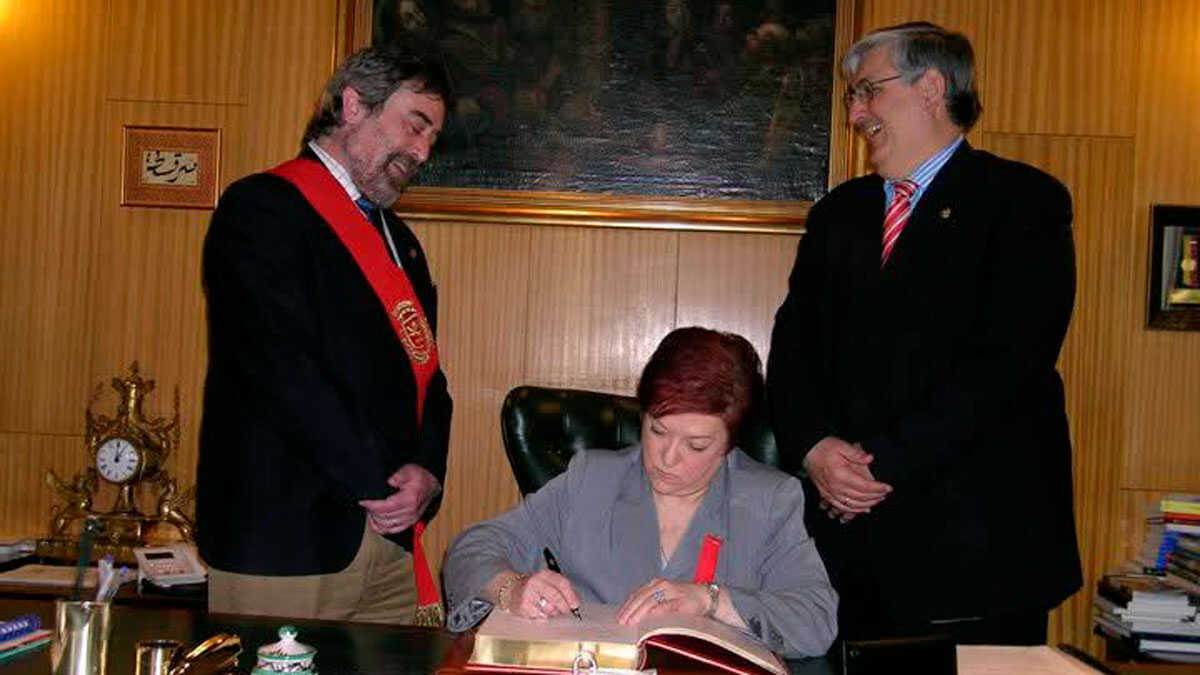
The writer and art historian meant Corita "many things." Among them was the Silver Medal she received in 2007, when Buesa was president of the Zaragoza branch of the PP (he was also a mayoral candidate in 2007). "I remember that he gave a memorable and wonderful speech about my life. Then, when a plaque was unveiled at the house where I was born on Contamina Street, he couldn't attend and his daughter Brianda did it on his behalf. He was always very thoughtful," she says.
The news came to Corita as a "tremendous blow." "I spoke to him a week or two ago and he told me he wasn't feeling well, but I tried to cheer him up; we did that for each other. A great man has been lost, a great writer, an intelligent man who loved Sabiñánigo, where he was born, but also Jaca and Zaragoza."
Another of the beautiful moments Corita remembers sharing with Domingo Buesa was when Carmen Sevilla took part in a recital organized by the artist. "I remember that he arranged everything, stayed with her and came with her. The truth is that he was an impressive man, incredibly intelligent, as I have said, and above all, he was a great friend to his friends. You would tell him: "Domingo, I need this," and five minutes later he would have it sorted out. I have a great deal to thank him for. He felt great affection for me, and I for him. Thanks to him, in part, I am who I am in Zaragoza. I can only send a kiss to heaven, which is where he will truly be."
Domingo Buesa was one of the most prominent figures in Aragonese culture. A historian, writer and popularizer, he devoted much of his life to studying and bringing the history and heritage of Aragón to the public, with particular attention to Romanesque art and the origins of the Kingdom. He presided over the Royal Academy of Nobles and Fine Arts of San Luis and also held positions in the cultural sphere of the Government of Aragón. His career left an extensive body of research and popularization work, particularly connected to Jaca, the Pyrenees and Aragon's historical identity.


