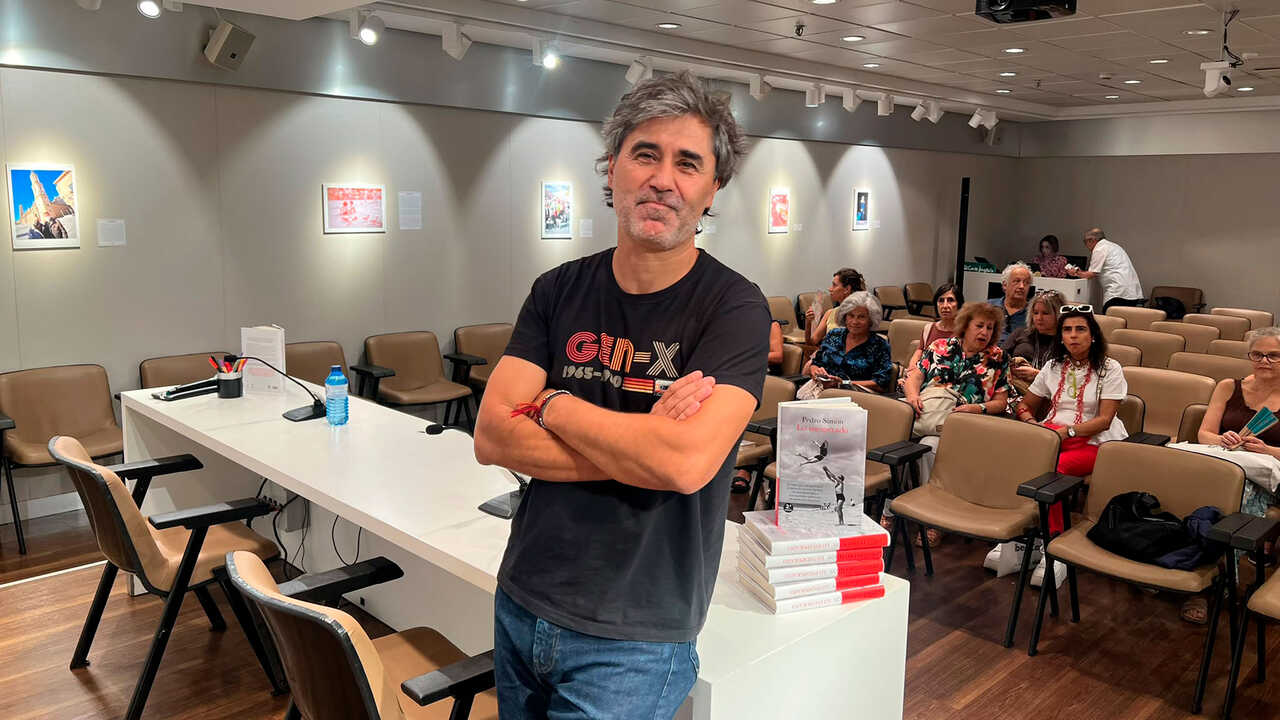
Following “The Ungrateful,” “The Misunderstood” and “The Next Ones,” the writer once again turns his attention to ordinary people to explore the passage of time and what can still begin when it seems too late. Simón took part in El Corte Inglés’s reading club in Independencia to discuss the novel with readers in the Aragonese capital.
QUESTION: What can readers expect from “The Unexpected”? ANSWER: A story that sheds some light. It’s true that the “The Family” trilogy, my three previous books, is about the passage of time as something that can scratch you. And I believe this next novel, “The Unexpected,” is about the passage of time as the possibility of an embrace.
It presents the passage of time as something good rather than something bad. It’s like finding a winning lottery ticket on the ground at an age when you don’t even play the lottery. Or when your team scores in stoppage time. Stoppage-time goals are celebrated much more; so I believe “The Unexpected” is that: a celebration of second chances and the good things that are still to come.
Q: Do you think that, over time, second chances become less visible, or less clear? A: What I believe is that if we asked anyone about something unexpected that happened to them in the past four years, including you, you would surely mention something bad. That’s what the brain is like: when we’re asked about the unexpected, we tend to focus on the bad. And what I claim in “The Unexpected” is that many more good things happen to us. The problem is that we don’t keep track of them. We have the bad things in mind every morning when we wake up and obsess over them, but we don’t pay attention to the good ones.
Many good things have happened to me. This morning I was reading a wonderful novel by Guillermo Arriaga on the AVE, I listened to Bill Evans on the piano while I worked, I heard the birds singing and had a really excellent cup of tea. “The Unexpected” is about all of this: the good things that are yet to happen to us and those that are already happening without us realizing it.
Pedro Simón: “The novel is a celebration of second chances and the good things that are still to come”
Q: In these books, as well as in the three novels in the previous trilogy, you balance illness and the saddest moments with flashes of humor. How do you manage that combination? A: I strongly believe in literature about pain and literature about what has been restored. I believe we could all be the protagonists of a novel; the question is whether you tell me the part of your life that could become a novel. It almost always has to do with something broken and restored: heartbreak, loss, loneliness, misunderstanding…
I strongly believe in books that work this way, because my journalism has to do with that: people who are struggling, the margins, broken people. But of course, a novel with all that and nothing else would be quite unbreathable. That’s why I like to introduce humor and children, who bring a lot of air to novels, as well as very uninhibited people who speak without filters and make us laugh—usually older people or even people who are ill.
Q: Why do you think you are drawn to stories about people on the margins? A: Because I am from the margins. And not only geographically, although that too, but also because I come from neighborhoods with fewer opportunities, or work with people who are having a hard time, or with people who have no platform. All of that interests me. In fact, I don’t think I could write novels about things that didn’t happen on my street or in my town. I wouldn’t dare write the story of a king in the 15th century; I have to tell the story of a woman who works in a supermarket. That’s where I feel confident, because those are my people. I see remarkable resilience in people who have suffered and rebuilt their lives, a kind of example that ought to be featured on the evening news and in textbooks. At least it is in my books and on my news programs.
Q: Is there anything left for you to explore, something you still have in the pipeline? A: Yes, there’s a subject I’m working on, which will become the novel I publish in 2028. It will be written in a more syncopated and harder language, similar to that of the novels I like to read. I like horror novels and those dealing with explicit or bureaucratic violence. It will have that feel, while also being a very social novel. And this is where I wanted to get: the subject I’m going to address is housing. I want to write about a story someone told me that left my head spinning.
Pedro Simón: “I couldn’t write novels about things that didn’t happen on my street”
Q: In addition to the intergenerational conflict, the story each family passes down and family memory are very important. What role do they play in this story? A: Borges said that we are memory, that collection of broken mirrors. In my books, there is always a large rearview mirror looking at the past—not so much from a perspective of melancholy or nostalgia, but as a form of teaching: what we can take from it. In my daily life, I always try to get close to people with gray hair, older people, because I learn a great deal from them. Especially from those who know how to conjugate the verb “to de-ambition” very well. We spend our lives aspiring to more, while older people “de-ambition.” There are many lessons in letting go of ambition. They are people carrying less weight on their backs, with a lighter load, and I find that fascinating.
Q: Readers already have the book in their hands. What do you hope for from their reading and from its reception? A: Nothing, the usual. The most enjoyable moment is not when you write the novel or when you are promoting it, but when you have the readers in front of you. So, let’s enjoy ourselves, learn and pass through one another.