
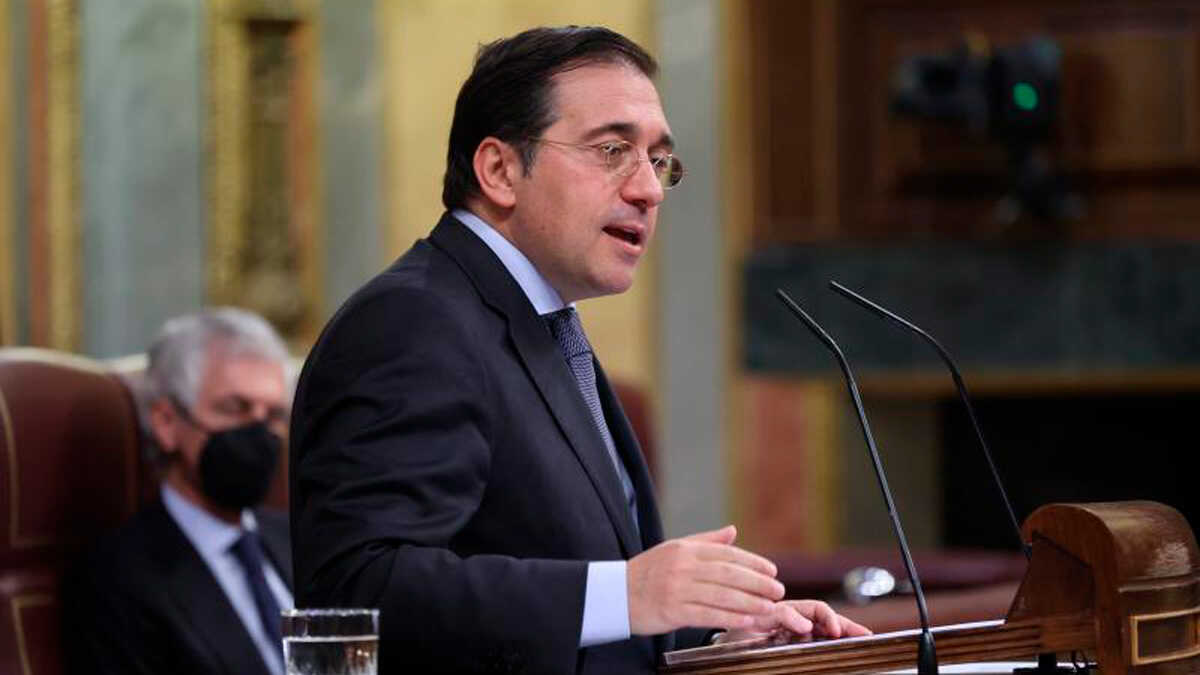
He made the remarks in an interview with Cadena SER, reported by Servimedia, in which he once again stressed that relations with Rabat are "positive," insisting that, thanks to Morocco's cooperation, most of the migrants who entered at the end of July returned within the first few hours and that the neighboring country has accepted the return of people who have no right to remain in Spain.
SOCIAL MEDIA CAMPAIGN
Speaking from New York, where he is attending the United Nations General Assembly, Albares said the Foreign Ministry had carried out a social media campaign, supported by the entire consular network, to tell migrants that "entering Ceuta and Melilla will not allow them to reach the European mainland or stay indefinitely in Ceuta and Melilla," urging them "not to risk their money, their future or even their lives."
The minister wanted to stress that Spain's border with Morocco is the "most unequal" in the world, meaning that many citizens try to reach Europe. He therefore highlighted the importance of "cooperating with migrants' countries of origin and transit."
Albares also referred to Sánchez's comments on Tuesday, when he said he had demanded "responses and action" from Rabat, considering that its border management had failed. According to the foreign minister, the head of government said the same thing he had already stated in his appearance before Congress, reiterating the good relations and cooperation between the two countries. "With Morocco, we are not seeking to be tough or lenient; we are seeking to be effective in defending the interests of Spain, the Spanish people, the people of Ceuta and those of Melilla," he said, while insisting that he wants "a good relationship with Morocco based on respect" for sovereignty and territorial integrity.
In this regard, he again noted that talks with his Moroccan counterpart are constant and that on July 30 he contacted him to say that "all the necessary means had to be mobilized to stop and reverse that flow, to tell him that those who entered would return, and to tell him that this could never happen again."
RETURN CASES
Regarding the first return cases involving migrants who will not be legally allowed to remain in Spain after the relevant screening procedures, he declined to set a timetable for their transfer to Morocco, although he stressed that Moroccan authorities had consistently told him that "they will not obstruct repatriation." The same is true today of those who "have already returned without any opposition and with Morocco's cooperation," he added.