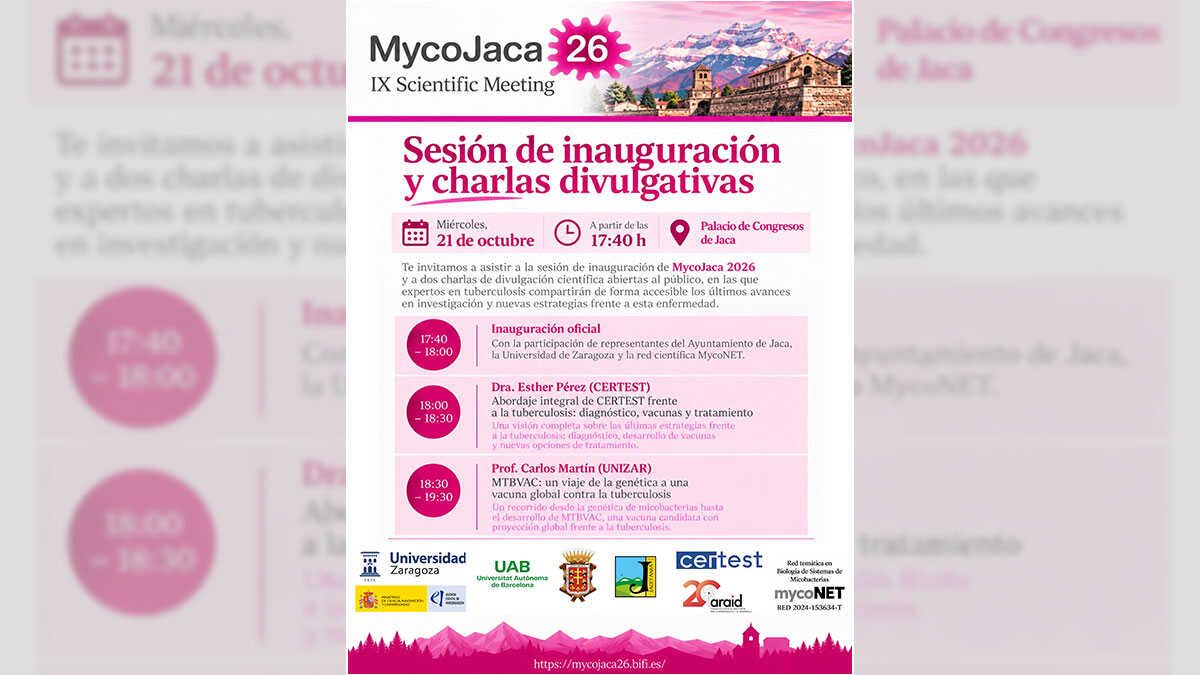
The meeting will bring together established researchers and young scientists beginning their doctoral careers over three days. Talks, oral presentations and poster sessions will showcase new research into the biology of mycobacteria and explore strategies to prevent and combat infections that continue to pose a major challenge to global public health.
The opening address will be given by Carlos Martín Montañés, a professor of microbiology at the University of Zaragoza and one of the researchers involved in the development of the MTBVAC vaccine. His lecture will take place on Wednesday, October 21, at 6:30 p.m. at the Jaca Congress Centre and will be open to the public until the venue reaches capacity.
TUBERCULOSIS, A DISEASE THAT STILL CAUSES MORE THAN ONE MILLION DEATHS
Tuberculosis remains one of the deadliest infectious diseases in the world, despite the existence of treatment and an available vaccine. According to the latest data from the World Health Organization cited by the conference organizers, more than 10.7 million new cases and over 1.2 million deaths related to the disease were recorded in 2024.
One of the main scientific challenges remains improving prevention. The BCG vaccine currently used against tuberculosis provides limited protection against certain forms of the disease. Among the new candidates is MTBVAC, a live attenuated vaccine developed from research conducted at the University of Zaragoza that is currently in various stages of development and clinical trials.
Another major problem is Mycobacterium tuberculosis’s ability to adapt to the body, evade its defenses and develop resistance to drugs. The emergence of resistant strains makes treatment more difficult and requires the search for new therapies. This is compounded by the rise in infections caused by other mycobacterial species, generally known as mycobacterioses.
FROM MOLECULAR BIOLOGY TO ARTIFICIAL INTELLIGENCE
Myco Jaca 2026 will address issues including antibiotic resistance mechanisms, the evolution of mycobacteria, their interaction with humans and other animals, and the immune system’s response. New vaccination strategies and treatments that could improve the healthcare response to tuberculosis and other diseases caused by these microorganisms will also be analyzed.
Technology will also play a prominent role at this year’s event. Researchers will study the incorporation of computational tools, mathematical models and artificial intelligence to analyze large volumes of biological information. Combining experimental and digital methods aims to open new avenues of research and promote collaboration among the participating scientific groups.
The meeting marks the ninth scientific gathering of the MycoNET network, created in 2016 to coordinate mycobacterial research in Spain. The Jaca edition will bring together universities and centers belonging to the CSIC, Ciberes and Ciberesp, among other institutions. Holding the event in the Pyrenees also aims to bring scientific activity closer to other parts of Aragon and strengthen the University of Zaragoza’s ties with the region.