THE HOUSES THAT STOOD ABOVE THE WATER
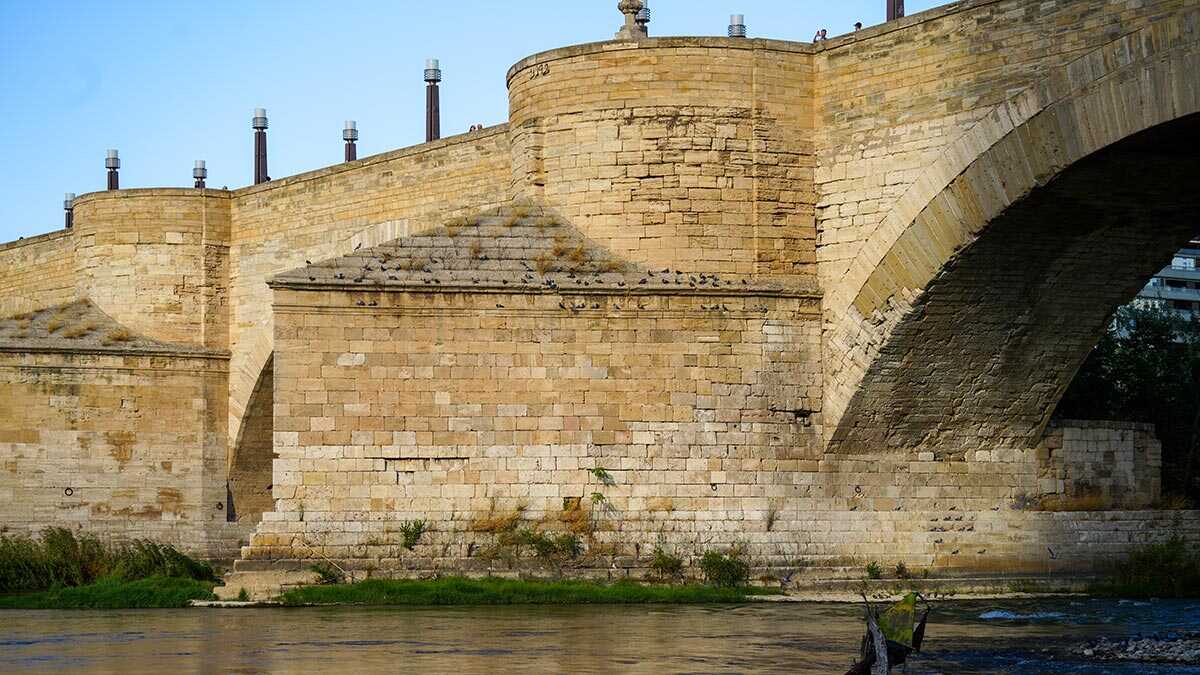
Two of the bridge’s cutwaters (the triangular structures that project into the current to break the flow) were not merely examples of hydraulic engineering. They formed the base of genuine residential towers, with people living inside them, built over the Ebro riverbed. This is documented by the academic project that subjected the bridge to a complete structural analysis: “The downstream cutwaters 4 and 6 (Drums) were residential towers, of which only the square sections of their floor plans can currently be seen.”
Those homes no longer exist. But their imprint remains at bridge level, visible to anyone who knows where to look: the square outline of their floor plans, marked in the stone at the base of those two cutwaters. No one lives in them anymore, but evidence that someone once did remains on display for everyone who crosses each day without knowing it.
THE BRIDGE THAT WAS ALSO A FACTORY
Housing was not the bridge’s only “non-obvious” use. According to historian María Teresa Iranzo Muñío, flour mills were built on the bridge’s massive piers around 1468, harnessing the Ebro’s current to grind grain. The famous drawing of the city made by Flemish painter Anton van den Wyngaerde in 1563—the most frequently cited image of medieval Zaragoza—shows the bridge with those mills already operating, and one of its piers even features an elegant relieving arch designed to accommodate the machinery.
Housing, industry and pedestrian traffic coexisted within the same structure. The Stone Bridge did not merely connect the city’s two banks: it was itself another part of Zaragoza.
Stone Bridge, 1813. Photo: GAZA/Eduard Hanke Locker, 1813. Published in Views in Spain
A BRIDGE PAID FOR BY THE CITY’S THREE RELIGIONS
Funding the project was a citywide undertaking, regardless of faith. In 1407, the City Council distributed the cost of quarrying among Zaragoza’s nearly 4,000 households—around 20,000 people—whether they were Christian, Jewish or Mudéjar. Households were grouped in tens to pay for the work of one quarry laborer. A monument that today is almost automatically associated with the city’s Christian tradition was actually built with contributions from the three religious communities living together in medieval Zaragoza.
And when work had to resume in 1409 after an initial funding crisis, the City Council commissioned two Muslim craftsmen, Zalema Navarro and Mahoma de Omar, to build the crane that would lift the stone brought from the quarries of Mallén. The machinery that raised the city’s most symbolic bridge, stone by stone, was built by Muslim hands under the direct orders of the Christian government.
AN EIGHTH ARCH THAT NO ONE CAN SEE
The bridge we know today as having seven arches actually has eight. The first, closest to the Pilar riverbank, was completely buried beneath the retaining wall of the present-day Paseo Echegaray y Caballero as a result of 20th-century urban infilling. The same engineering study that documents the residential towers confirms this with plans: “the first of them (Number 1) is completely hidden behind the retaining wall.”
The bridge we know today as having seven arches actually has eight. Photo: Jerome Esteban
And here is a detail that surprises even those who believe they know the bridge well: the City Council officially lists it as an Asset of Cultural Interest “of Roman origin,” and it is true that some kind of bridge crossed the river at this same location during the time of Augustus—Strabo even mentions it. But not a single stone from that original structure has been found. In 1610, after visiting it, Portuguese geographer J.B. Labaña wrote that it “does not appear to contain any remains of Roman antiquity.” The most recent technical studies agree: the structure you walk on today, the one you see and touch, is medieval and contains no remains of that Roman construction.
The location is Roman; the stone is not. The current bridge took 39 years to build, between 1401 and 1440. On August 5, 1435, with construction nearly complete, the main arch collapsed, killing five people.
That Zaragoza did build stone bridges during the Roman period was also confirmed just a few months ago. In March 2026, work in Plaza de San Miguel and along the Coso brought to light the remains of a Roman concrete bridge-aqueduct, four meters underground—the first structure of this type documented in the city. It is not beneath the Stone Bridge and does not cross the Ebro, but it confirms that this kind of civil engineering did exist in Roman Caesaraugusta. For now, however, it was located elsewhere in the city.
THE OTHER COUNCIL BUILDING THAT BURNED BESIDE THE BRIDGE
There is one final detail linking this bridge to another building that has disappeared from the city’s memory. The bridge itself was planned in 1407 as the gateway to the city’s complex of government buildings, including “the Council of the Kingdom and that of the City Council, properly known as the Houses of the Bridge,” according to Iranzo Muñío’s research based on direct archival references. The bridge and the Council were not two parallel stories: they were conceived and built as part of the same urban development project.
That Gothic palace, with its striking roof of German tiles arranged in black-and-white diamonds, portrayed in Martínez del Mazo’s famous 1647 painting of Zaragoza, burned for three consecutive days in January 1809 after being hit by French bombs during the Sieges of Zaragoza. Only two stone coats of arms survived from the entire palace; they are now housed in the courtyard of the Zaragoza Museum and are the oldest surviving arms of the Kingdom of Aragon.
The bridge, by contrast, survived everything: floods, sieges and centuries. It still stands, with its eighth arch buried, the square imprint of the homes it once carried above it, and thousands of people crossing every day without knowing that, for generations, it was not merely a bridge. It was a place to live.


