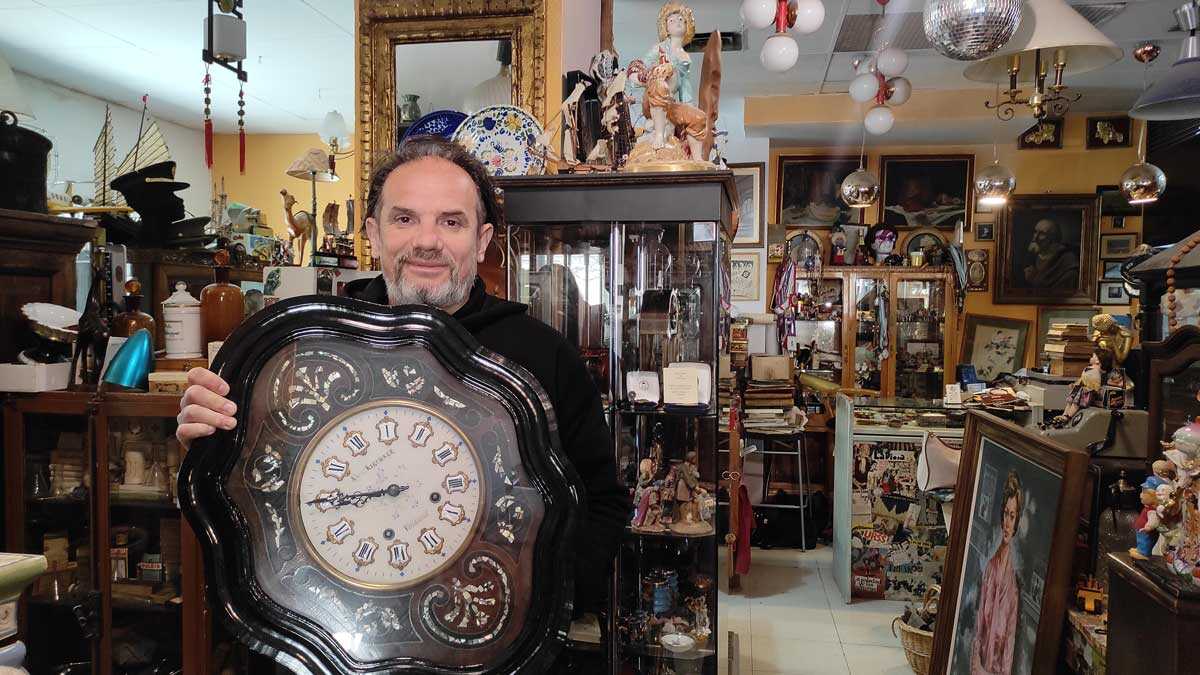
Among its items are also pieces that particularly resonate with those who grew up in the 1970s and 1980s and now want to reclaim a small part of their childhood. Toys, trading cards, records, watches and old everyday objects share space with much older pieces in a shop where you can spend a good while simply looking around and rummaging.
At the heart of this universe is Zaragoza native Luis Izquierdo, who opened the shop in 2018 after a lifetime connected to this world: “I started out personally, as a hobby, and little by little it became a way of making a living,” the antiques dealer tells ARAGÓN DIGITAL.
“I STARTED COLLECTING COINS AND I WAS FASCINATED”
His relationship with antiques began when he was just a child. “I liked everything related to antiquity. I started collecting coins and then moved on to other kinds of objects. I liked reading about and learning the history of each object and learning a little about everything,” Luis recalls.
That curiosity grew over the years until it became a way of life, now taking shape at El Desván de Indi. “I’ve had the shop for eight years now and it has been tough, but it’s very rewarding because many of your customers, when they share your hobby and passion, become friends,” the antiques dealer explains. He also devotes a large part of his work to buying and selling objects and antiques in Zaragoza and clearing out homes.
At El Desván de Indi, you can find objects such as grandmother’s tableware, antique watches and lamps, and furniture from other eras. Photo: E.F / Actualidad Media
FROM ANTIQUE WATCHES TO TOYS FOR THOSE WHO “WENT TO EGB”
El Desván de Indi is a place where you can walk in and lose yourself for hours among piles of objects that, despite the apparent chaos, seem to be arranged according to an invisible order. “I have a huge number of items,” Luis says, although he does not dare give an exact figure. “We like to work with items priced between 5 and 30 euros. We don’t usually deal in very expensive items,” he notes.
This philosophy allows centuries-old objects to coexist with more recent ones that awaken the nostalgia of several generations, especially those who grew up between the 1970s and 1990s. Toys, trading cards and records that connect directly with people who might say “I went to EGB” and who, on seeing them, return to their childhood for a moment. That emotion is precisely what drives many purchases: “Many, many customers buy things that remind them of their childhood, their parents or their grandparents.”
The shop has a section dedicated to vintage toys. Photo: E.F. / Actualidad Media
WHEN AN OBJECT’S VALUE IS DETERMINED BY WHO IS LOOKING FOR IT
One of the lesser-known aspects of this world is how the value of each piece is determined. It does not always depend on its age or historical importance, but on the interest it generates. “There are items with a great deal of history that are not highly priced, while objects from the 1980s or 1990s can have much higher prices,” explains the owner of El Desván de Indi.
For Luis, valuing an object is a matter of experience. “I’ve been in the antiques business for more than 30 years, and you learn to value things through practice, by seeing objects and reading a lot,” he says. Over time, he adds, you end up having “some knowledge of almost everything.” For anything beyond his expertise, the antiques dealer has several resources: catalogues, websites for research, and the experience of other collectors and colleagues in the sector.
El Desván de Indi has objects for all kinds of customers and budgets. Photo: E. F / Actualidad Media
Even so, not everything can be measured in financial terms. There is also emotional value, which in many cases weighs as much as or more than the price. “When something has emotional value for me, I like to keep it,” Luis says, acknowledging that some pieces are difficult to let go.
“EARLIER GENERATIONS KEPT MORE THINGS”
According to the owner of El Desván de Indi, Zaragoza’s antiques sector is competitive and quite active, but it is also undergoing a change that becomes more noticeable over time: fewer and fewer objects are appearing. Not because of a lack of interest, but because people’s way of preserving memories has changed.
“Earlier generations kept more things. As we move closer to the present day, apartments are emptier, cleaner and have fewer things,” Luis explains. It is a reality he sees firsthand in his work outside the shop, when he clears apartments in Zaragoza and towns across Aragón. “When you open drawers and sort through things, you get an idea of that family’s history,” he says. But those stories are becoming increasingly shorter in material terms.
Luis says fewer antique objects are appearing. Photo: E.F. / Actualidad Media
Even so, there are still surprises. “People aren’t really aware of what they have. Some think they have treasures, but they don’t, while others think they have nothing and you find wonders,” he explains. Despite the changes in the sector, Luis does not give up. He continues searching, learning and surrounding himself with objects that, beyond their value, preserve stories that deserve to be told. Because, ultimately, the work of El Desván de Indi is not just about buying and selling antiques in Zaragoza, but about preventing those memories from disappearing altogether.


