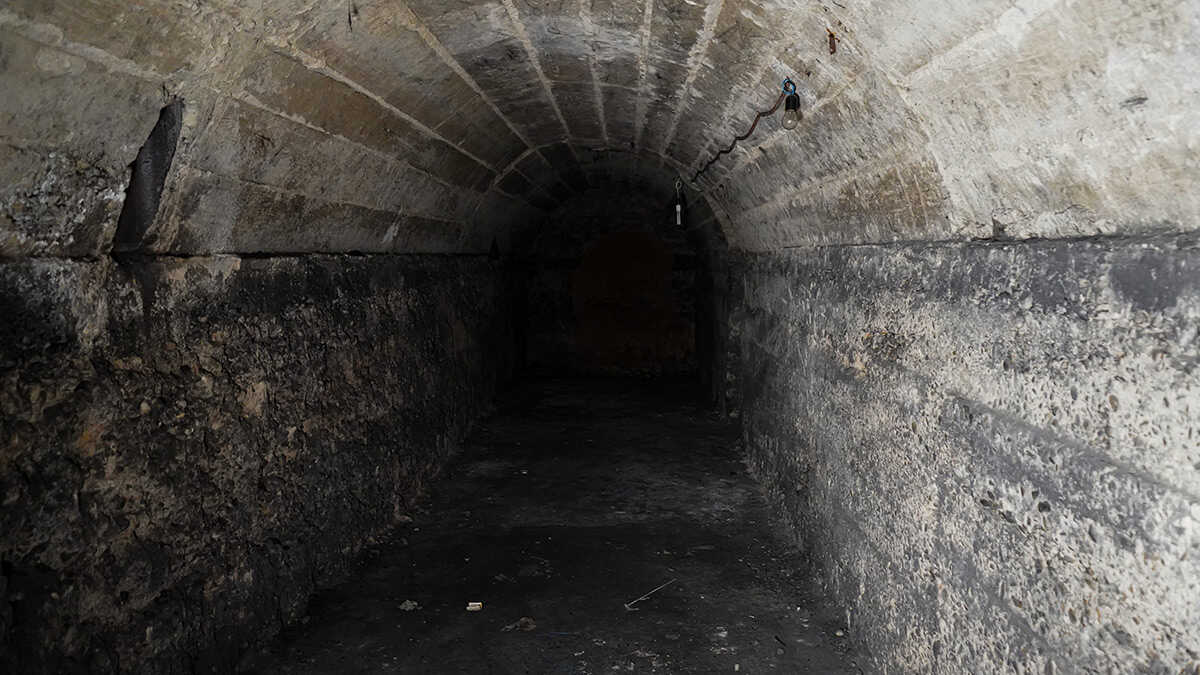
What is now a curiosity that surprises anyone who discovers it was, in reality, a precautionary measure. As Europe headed toward the Second World War and Spain had just emerged from the Civil War, the architect responsible for constructing the building decided to build a shelter beneath it between 1938 and 1940. Its purpose was to protect residents from possible bombing, collapses or any scenario arising from a military escalation that could reach the country.
More than eight decades later, the shelter is still there. It has never had to be used in a real emergency, but it has allowed the building's residents to boast of a story that is difficult to match. Not every day can you say that beneath your entrance hall there is a bunker built to withstand a war.
"WE ARE 16 RESIDENTS AND THE BUNKER BELONGS TO EVERYONE"
One of the residents who knows the place best is Santiago Gonzalo. As he explains, the shelter has been part of the community's life for generations. "We are 16 residents and the bunker belongs to everyone. Every owner has a key to access it because it is a communal space," he says.
For Santiago, the shelter has never been merely an abandoned room underground. For years it was part of the daily lives of those who grew up in the building: children would go down to explore it, walk along its corridors and play among galleries that still retained part of their original facilities. In addition, until 1986 the community used a coal-fired boiler as its heating system, so the bunker was used as a coal store, holding nearly 10,000 kilograms of fuel to ensure the system operated continuously. Traces of that period are still visible, such as the black dust covering the floor, a reminder of the intense use this space received for years.
The bunker was designed to protect residents from possible wartime bombing. Photo: David Graner
Access begins on the storage-room floor. From there, a staircase descends one more level to reach the shelter. "It is two levels below street level. First come the storage rooms and then you go directly down to the bunker," he explains. Once through the door, it feels like entering another era. The sound of traffic disappears, replaced by a silent space built to withstand damage.
But if anything continues to spark the imagination of those who visit, it is its possible extent. According to the residents, the shelter did not end at the building's boundaries. "The most curious thing is that it seems to have occupied the entire block," Gonzalo says.
Adobe partitions can still be seen separating the shelter from the entrances of adjoining buildings. The prevailing theory is that those spaces were connected and that the galleries allowed people to move from one building to another in an emergency. It was a kind of underground network that provided alternative evacuation routes if any of the entrances became unusable after a bombing.
WHAT THE BUNKER IS LIKE TODAY
Although the passage of time has left its mark, the shelter retains much of the original structure with which it was designed more than 80 years ago. It is built with sturdy concrete beams and reinforced walls capable of supporting significant loads. It has no water outlets, but it does have vents that ensured ventilation during long periods of occupation.
The bunker is now completely dark. The electrical system it once had no longer exists, and any visit requires a flashlight or the light from a mobile phone. The lack of lighting reinforces the feeling of being in a place frozen in time.
The bunker is now completely dark. Photo: David Graner
Some of the former connections with other buildings have been sealed for safety reasons, although evidence that they existed is still preserved. The adobe partitions and certain structures make it possible to imagine the scale the original complex may have had, much larger than it appears from outside.
And although it may seem like a unique oddity, the truth is that it is not the only shelter of its kind in Zaragoza. The best-known is the bunker beneath Zaragoza City Hall, accessed from the main hall of the municipal building. In fact, architect Ramón Betrán, who was responsible for managing this municipal air-raid shelter, has said on several occasions that thousands of shelters could exist throughout the city.
Meanwhile, beneath Paseo de la Constitución, this shelter continues to serve a function very different from the one for which it was built. It no longer protects anyone from bombs or the fear of war. Now it preserves something else: a small part of Zaragoza's underground memory, hidden just a few meters from the bustle of one of the city's most iconic avenues.


