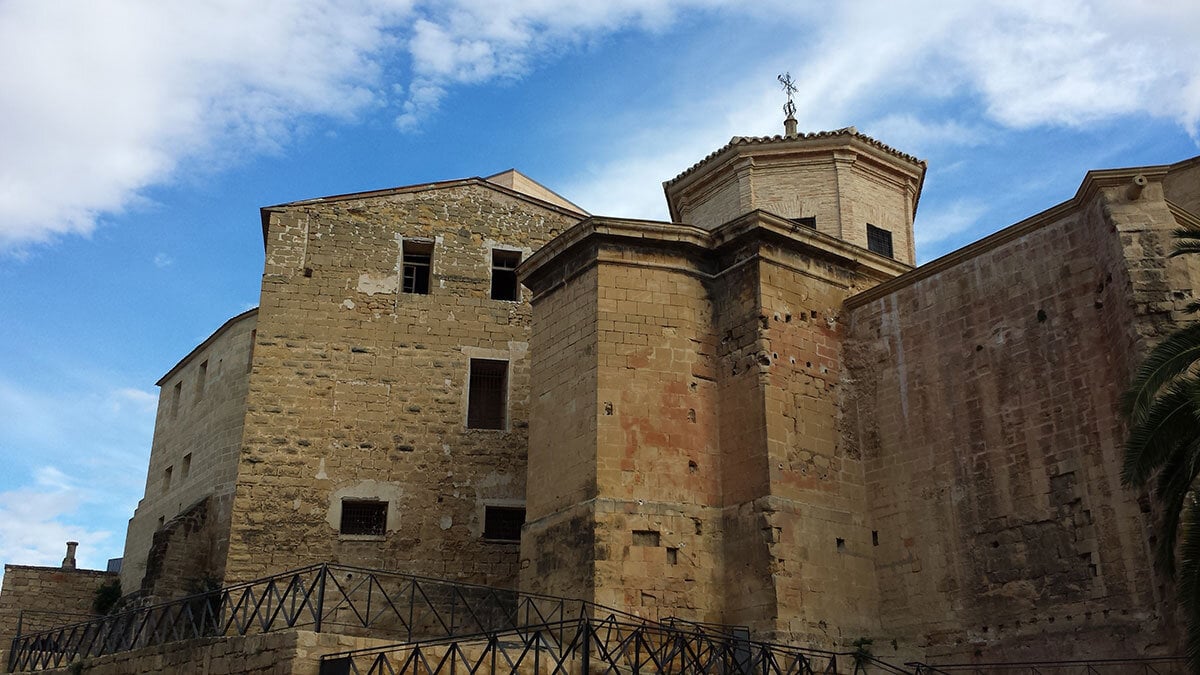
Zaragoza province is also home to fortresses closely linked to the history of Aragon. One of the most significant stands in Caspe: the Castle of the Compromise, a building whose importance goes far beyond its architecture. Its walls witnessed one of the most important political events in the Crown of Aragon and still recall the historic episode that gave the fortress its name.
Among other things, this castle was the setting for the Compromise of Caspe in 1412, an event that resolved a succession crisis through dialogue and negotiation, marking a milestone in medieval European politics. For this reason, in this article we travel back to Zaragoza province’s medieval past. Let us discover the history of Caspe Castle.
The Castle of the Compromise is also known as Bailiff’s Castle. Photo: Turismo de Aragon
ORIGIN OF CASPE CASTLE
The Castle of the Compromise, also known as Bailiff’s Castle, dates from between the 13th and 15th centuries and was built over an ancient Muslim fortification. The castle was erected by order of Juan Fernandez de Heredia, grand master of the Order of Saint John of Jerusalem, who wanted it to serve as a meeting place for the representatives who would choose the successor to the Crown of Aragon. This all took place within the framework of the Compromise of Caspe.
And so it did. Caspe Castle fulfilled its purpose and reached its greatest importance in 1412, when the event known as the Compromise was held. Following the death of King Martin I of Aragon without an heir, an assembly was convened and Ferdinand of Antequera was chosen as the new monarch, thus avoiding a civil war.
Over the centuries, the castle suffered significant damage, particularly during the Peninsular War and the Carlist Wars. In 2012, on the sixth centenary of the Compromise of Caspe, major restoration work was completed, helping to recover part of its former splendor.
ARCHITECTURAL DESIGN
The Castle of the Compromise stands at the highest point of a promontory overlooking the entire Guadalope plain. It has a rectangular ashlar-stone layout measuring approximately 55 by 27 meters, with buttresses reinforcing its structure. Notable features include a cylindrical tower at the southern end and a grand hall with a two-arched semicircular bifora window. The castle also forms part of the medieval acropolis, alongside the Collegiate Church and the former Convent of the Knights of Saint John, all located in Plaza del Compromiso.
Although much of the original complex has been lost, restoration work has preserved significant elements of its Gothic architecture. In fact, these restorations have given rise to several legends. The most widespread claims that secret passageways once connected the castle with various points around Caspe, serving as escape routes during possible enemy invasions. However, there has never been concrete evidence of this.
Collegiate Church of Santa Maria la Mayor
Today, the northern section of the palace survives, along with a tower featuring a trapezoidal floor plan. Next to the castle stands the Collegiate Church of Santa Maria la Mayor, built in the Gothic style during three construction periods between the 14th and 15th centuries. Ferdinand of Antequera was proclaimed king of the Crown of Aragon on its steps.
Next to the castle stands the Collegiate Church of Santa Maria la Mayor
Its interior houses the relic of the True Cross and the chalice used to celebrate the oath-taking and proclamation mass during the Compromise of Caspe.
CASPE CASTLE OPENING HOURS AND PRICES
The Castle of the Compromise has fairly limited opening hours. It is open from Tuesday to Sunday, from 12:30 to 1:15 p.m. Tuesday to Saturday and from 11:30 a.m. to 12:15 p.m. on Sundays. The castle can be visited independently or as part of a guided tour.
Guided tours cost 2.20 euros. They last approximately 45 minutes and include a tour of the entire castle. These tickets are also available for visits to the Church of Santa Maria la Mayor. Booking in advance through the official Caspe Town Council website is recommended.
HOW TO GET TO CASPE
If the magic of Caspe Castle has completely captivated you, you can start planning your trip as soon as possible to enjoy the experience in person. To help you with everything we can, here are the routes you can take to Caspe from the three main cities in Aragon.
From Zaragoza
From the Aragonese capital, you can choose from several options:
• You can travel by car or motorcycle along the AP-2 to Bujaraloz, then take the A-230 to Caspe. The journey takes approximately one hour and 20 minutes.
• You can take a bus operated by HIFE S.A. from Zaragoza Central Bus Station and reach Caspe in approximately one and a half hours.
• Alternatively, you can take a Renfe train from Zaragoza-Goya station and reach Caspe in approximately one hour and 20 minutes.
For buses and trains, we recommend checking the companies’ official websites to confirm schedules and ticket prices and plan your trip in the best possible way.
From Huesca
From the Huesca provincial capital, we recommend traveling by car or motorcycle, as this will be the fastest and most accessible option. Take the A-131 to Sariñena, then continue along the A-230 to Caspe. The journey takes approximately one hour and 40 minutes, making it the longest and most demanding route.
From Teruel
Finally, from the provincial capital of Teruel, we also recommend traveling to Caspe by car or motorcycle. In this case, take the N-211 to Caspe; the journey takes approximately one hour and 20 minutes.
In conclusion, the Castle of the Compromise in Caspe is more than a fortress: it is a symbol of dialogue and consensus in the history of Aragon. Its architecture and the legends surrounding it make it an essential destination for lovers of history and culture. Visiting it means stepping into a fascinating chapter of the past that remains alive in every stone of its walls.


