A MATHEMATICAL TREATISE THAT PUT EUROPE SIX CENTURIES AHEAD
Yusuf ibn Ahmad al-Mutamán ruled the taifa of Zaragoza between 1081 and 1085. He belonged to the Hudid dynasty, the lineage that turned the Saraqusta court into one of the most dazzling intellectual centers of the Iberian Peninsula. He inherited from his father, Al-Muqtádir, a palace that protected poetry and philosophy, although his true devotion was to the sciences.
His great legacy was the Kitab al-Istikmal, the Book of Perfection, a monumental encyclopedia intended to encompass all the mathematics known in his time. In its first volume, across more than 400 propositions on arithmetic and Euclidean geometry, he formulated and proved for the first time in history a major result concerning the cevians of a triangle.
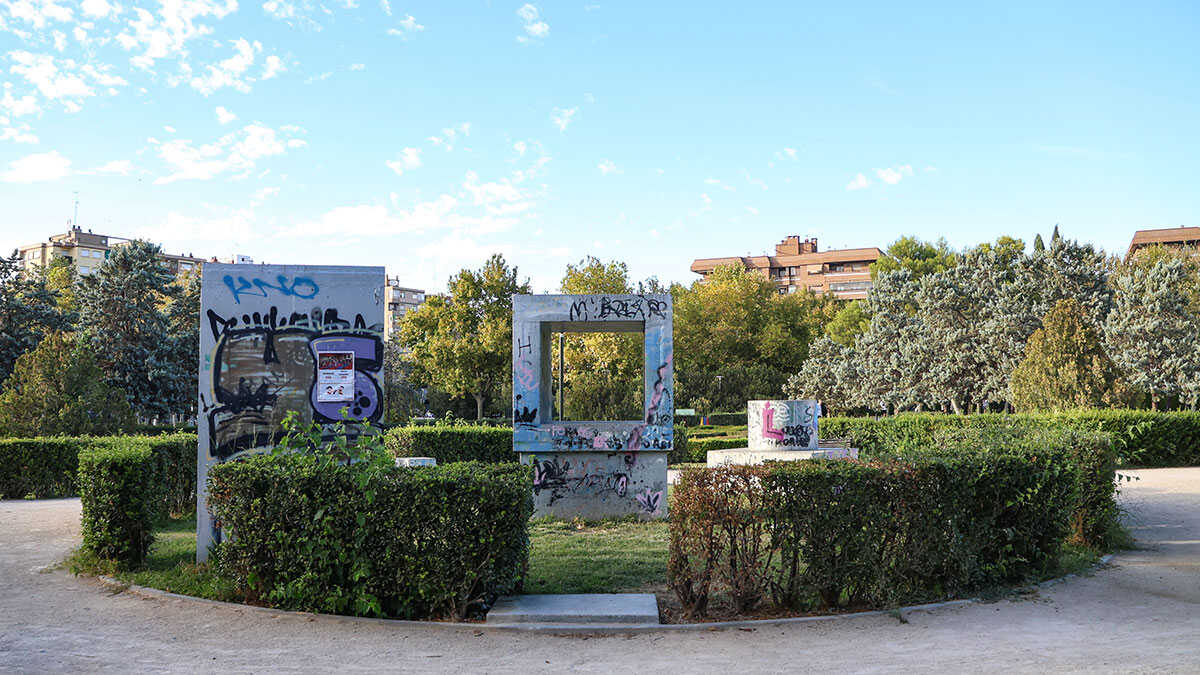
A few meters from the Aljafería, the tribute to Al-Mutamán remains without a plaque identifying it. Photo: Pilar Álvarez
European science knows that formulation today as Ceva's theorem, attributed to the Milanese mathematician Giovanni Ceva after he published it in 1678 in his work De lineis rectis se invicem secantibus statica constructio. Almost six centuries separate the calculation made in Zaragoza from the Italian publication. Ceva may have reached the solution independently in the 17th century, but the proof was already lying in Al-Mutamán's texts when medieval Europe had not even dreamed of modern geometry.
THE ENIGMA OF A KING WHO NEVER CITED HIS SOURCES
The history of the manuscript is almost as extraordinary as the figure himself. For centuries, the work was considered lost. It was in the 1980s that Arabists and historians of science such as Ahmed Djebbar and Dutch professor Jan P. Hogendijk of Utrecht University began tracing the fragments scattered among libraries in Cairo and Leiden.
As they delved into the text, the researchers encountered a singular obstacle. Al-Mutamán never said where he obtained his results; he did not note whether an argument came from Euclid, Archimedes, Apollonius of Perga or his own work, and he wrote for the elite of his court, taking the entire preceding tradition for granted.
Graffiti have taken over a tribute whose history was never explained to the people of Zaragoza. Photo: Pilar Álvarez
That absence of citations forced specialists to compare the propositions line by line for years in order to untangle the text. As Hogendijk himself has noted, historical rigor prevents anyone from stating with complete certainty whether the monarch discovered the theorem entirely on his own or reworked an earlier postulate that has since disappeared. The documentary fact, however, is indisputable: the oldest surviving record of that geometric proof was written in Zaragoza.
UNESCO'S TRIBUTE IN HIS HOMETOWN
The scholarly rescue of the learned king reached its high point in August 1993. Zaragoza hosted the 19th International Congress of the History of Science, a UNESCO-backed gathering that brought specialists from around the world to the Aragonese capital.
Al-Mutamán was one of the central figures of those proceedings. Hogendijk presented the findings on the Kitab al-Istikmal at the Aljafería, and the congress's official reception was held in the Patio of Santa Isabel, at the heart of the palace itself. Nine hundred years later, the international scientific community paid tribute to the monarch in the very rooms where he had been born and composed his theorems.
The work was designed to face the Aljafería, the palace where the mathematical king lived. Photo: Pilar Álvarez
THE SCULPTURE THAT LOST ITS NAME ALONG THE WAY
In the wake of that congress, the city council decided that the palace surroundings should reflect the memory of its mathematical king, and in 1995 commissioned the monument from Zaragoza artist Sergio Abraín. He rejected the classic figurative style of 19th-century statues and chose instead to translate Al-Mutamán's legacy into a study in pure geometry, with structures conceived as viewfinders framing the landscape and oriented toward the Aljafería's Troubadour Tower.
The initial project soon collided with the reality of the municipal budget. The city council's public art record documents how a cut forced changes to Abraín's original proposal; the pieces were supposed to be painted, with one of the viewfinders in red and blue, evoking earth and water, but they all ended up in silver, the color the artist himself called his non-color.
But the most unusual problem affected the explanatory texts. Abraín had drafted two plaques to be fixed to the base. The first contained a simple dedication: “The city in memory of Al-Mutaman Ibn Hud, King and Mathematician of the Taifa of Zaragoza, 1085. Zaragoza 1995.” The second was meant to feature Andalusian verses associated with the Hudid court. Neither was ever cast or installed, and the monument was never officially inaugurated.
Al-Mutamán remains today in La Almozara, silent and camouflaged among the trees. Zaragoza financed a sculpture, commissioned a great artist and found it a place beside the palace where he had been born. It fulfilled every part of the protocol except the most basic one: telling its own residents whom they were looking at. Sometimes, to bury a thousand-year-old memory in oblivion, there is no need to tear down monuments; it is enough to save the cost of a bronze plaque.


