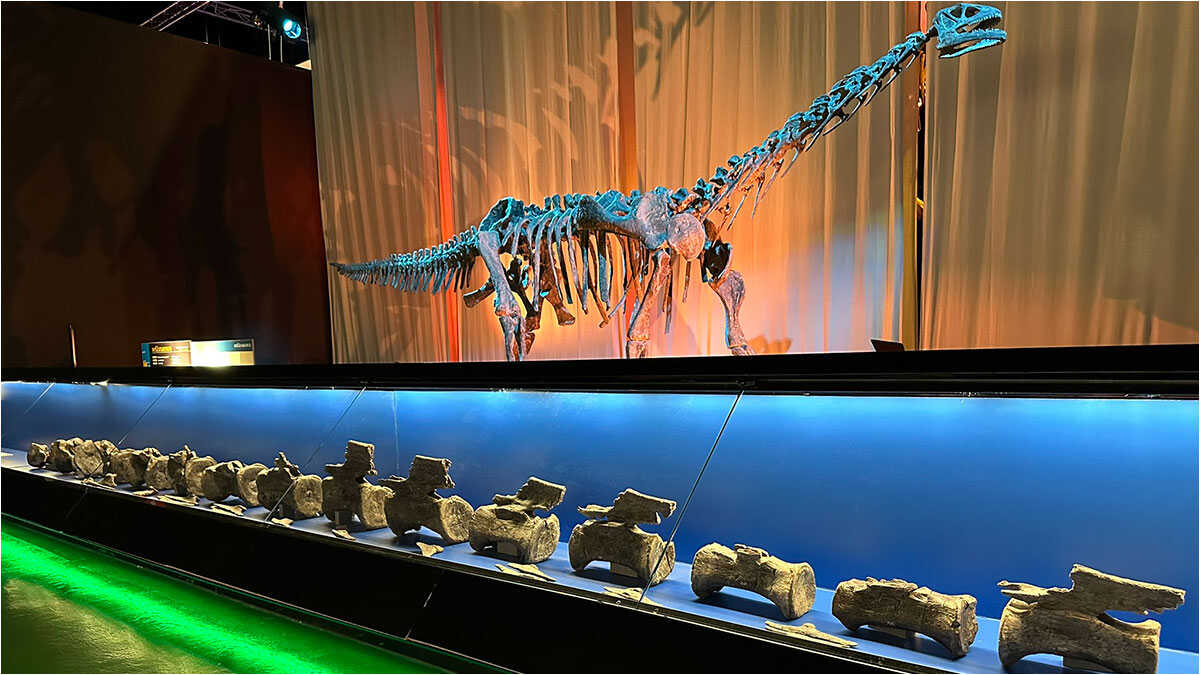
Paleontologists from the Teruel-Dinópolis Paleontological Complex Foundation have identified fossils belonging to the Diplodocus genus at the La Tejería site in El Castellar. It is the first time this dinosaur has been scientifically identified outside North America, where it had remained confined since its discovery in the United States in 1878. The study has just been published in the international journal Journal of Vertebrate Paleontology.
Fourteen vertebrae from the middle and final sections of the tail have been preserved, along with several chevrons, bones located beneath the vertebrae. Analysis of these remains has enabled researchers to assign the fossils to the Diplodocus genus.
CHARACTERISTICS OF A TRUE DIPLODOCUS
The key lay in several highly distinctive features of these dinosaurs, including the elongated shape of the vertebrae, the presence of large internal cavities, deep grooves on their underside and bifurcated chevrons. The combination of all these characteristics has confirmed that the specimen found in Teruel belongs to the same Diplodocus genus previously known only from North America.
“This is one of the most complete diplodocids discovered to date in Europe and constitutes the first evidence of this genus outside North America,” explains Sergio Sánchez Fenollosa, a researcher at the Dinópolis Foundation and the study’s lead author. The discovery, he adds, also provides some of the strongest paleontological evidence that episodes of faunal dispersal and exchange took place between the two continents during the Late Jurassic.
The discovery is about more than identifying a new dinosaur in Teruel. The presence of Diplodocus on the Iberian Peninsula helps explain how these animals may have moved between Europe and North America when the proto-Atlantic Ocean was still forming and the planet’s geography was very different from today’s.
The El Castellar Diplodocus fossils are currently on display in the dinosaur hall of the Aragonese Museum of Paleontology at Dinópolis, in Teruel. More than a century after becoming a worldwide symbol of paleontology, one of the planet’s best-known dinosaurs is now forcing researchers to look toward Aragón to complete its story.


