The story began a few years after the death of her husband, Pedro Fernández de Híjar, the illegitimate son of King James I. Marquesa wanted to join an order that until then had been reserved for men and, according to Vicente Gómez, heritage curator at the Monastery of the Canonesses of the Holy Sepulchre, "thanks to Marquesa's relationship with the canons of Calatayud, the female branch of the order was officially recognized between 1304 and 1306,"
The first nuns occupied houses owned by the founder beside Zaragoza's walls. The community's growth made it necessary to build a monastery, which was developed throughout the 14th century. The chapel, cloister, refectory and other rooms gradually took shape, while mural paintings, altarpieces and other artistic elements were added. "It preserves one of the best-preserved 14th-century medieval complexes in Aragon," explains Vicente Gómez.
A MONASTERY DESIGNED TO LIVE ALONGSIDE THE CITY
Its location breaks with the usual image of medieval monasteries. Whereas communities often sought isolation in remote places, the Holy Sepulchre was built inside Zaragoza, beside the city wall. The reason lay in the nature of its inhabitants. The religious women were canonesses and shared the same charism as the order's canons, centered on the celebration of the liturgy.
The canonesses' daily routine was divided between prayer, work and community life. Photo: Javier Miranda
This mission meant that the church and cloister remained open to local residents, who could take part in the Liturgy of the Hours throughout the day. The monastery thus maintained a constant relationship with the population, a reality very different from that of other cloistered convents, where contact with the outside world was practically nonexistent.
The canonesses' daily routine was divided between prayer, work and community life. There was also time for reading, music, poetry, embroidery, and cultivating the garden and medicinal plants. "For many women of the period, joining the community meant gaining access to an environment offering greater opportunities for autonomy and escaping arranged marriages," Vicente notes.
FROM AN OPEN COMMUNITY TO A CLOISTERED MONASTERY
"The balance changed with the profound transformations Europe experienced during the 16th century," Gómez says. The arrival of the Renaissance coincided with the Protestant Reformation and the birth of the Anglican Church. In response, the Catholic Church promoted the Counter-Reformation and encouraged religious communities to adopt enclosure.
The Monastery of the Holy Sepulchre holds a unique place in Aragonese heritage. Photo: Javier Miranda
The canonesses of the Holy Sepulchre maintained their traditional open way of life for decades, although at the beginning of the 17th century they received an order from Rome requiring new religious members to accept enclosure. The measure sought to ensure the community's continuity at a time when the number of religious women had fallen considerably. This model remained in force until the mid-20th century.
A BUILDING THAT HAS SURVIVED ALMOST INTACT TO THE PRESENT DAY
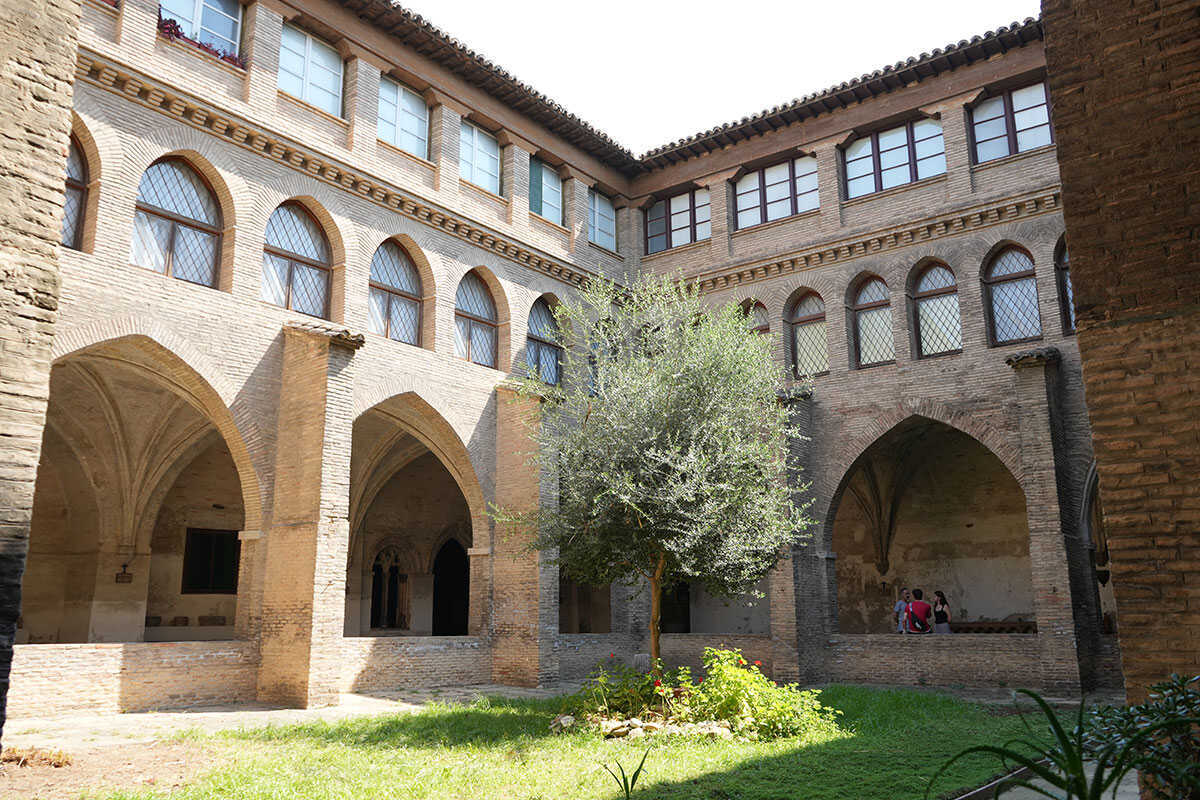
The Monastery of the Holy Sepulchre holds a unique place in Aragonese heritage. It is the only monastery of canonesses of this order in Spain and the only complete surviving Mudéjar monastery in Aragon. "Its architecture combines the Gothic structure of the 14th century with the Islamic influences characteristic of Mudéjar art," Vicente explains. Brick, plaster and wood dominate the construction, while the sgraffito work, decorated wooden roofs and rich ornamentation reflect the Islamic principle of horror vacui.
The tour provides access to the former convent turnstile, the chapter house covered by a large ribbed vault and decorated with medieval paintings, the practically intact rectangular cloister, and the remains of the Roman wall alongside the extensions built during the Islamic period, which were incorporated into the building itself.
This architectural heritage is complemented by a wide collection of altarpieces, paintings, gold and silverwork, furniture, textiles, ceramics, tableware, tools and everyday objects preserved over the centuries, as well as a historical archive open to researchers. Among the oldest rooms is the cellar, whose existence has been documented since the 14th century through a parchment stating that the refectory was built above it. Its construction was financed by Friar Martín de Alpartir, a canon of the Order of the Holy Sepulchre, secretary and treasurer to Archbishop López Fernández de Luna, who obtained permission to allocate part of his personal wealth to the monastery's construction and requested to be buried in the chapter house, where his tombstone is still preserved.
This architectural heritage is complemented by a wide collection of altarpieces, gold and silverwork, textiles, ceramics, tableware... Photo: Javier Miranda
VISITS TO DISCOVER THE MONASTERY
The monastery can be visited through two guided tours. 'The Mudéjar Monastery' offers the chance to discover the Church of the Holy Sepulchre, the chapter house with its Mudéjar paintings, the cloister and the refectory, while also learning about the history of the canonesses. Meanwhile, 'Through the Kitchen Along the Monastery Walls' introduces visitors to the community's daily life, with access to both refectories, the wall passages known as the "pasetes" and the old kitchen.


