Its significance also extends beyond the local sphere, as it forms part of Aragonese Mudéjar, recognized as World Heritage by UNESCO. Just a few meters from the church, on Calle San Pablo, one of the neighborhood’s best-known historic establishments still stands. Casa Perdiguer, an emblematic wine shop founded in 1907, according to documents and accounts preserved by the family, retains the essence of Zaragoza’s traditional commerce.
The business stands out for its historic sign, its window filled with bottles and its status as a landmark for both residents and visitors seeking authenticity and tradition in Zaragoza’s historic center. However, one of its greatest treasures remains hidden beneath the premises: an underground cellar made up of several rooms and passageways that are still preserved, although no public documentation exists to date their origin precisely.
One of the establishment’s greatest treasures remains hidden beneath the premises
THE UNDERGROUND PASSAGEWAYS OF SAN PABLO
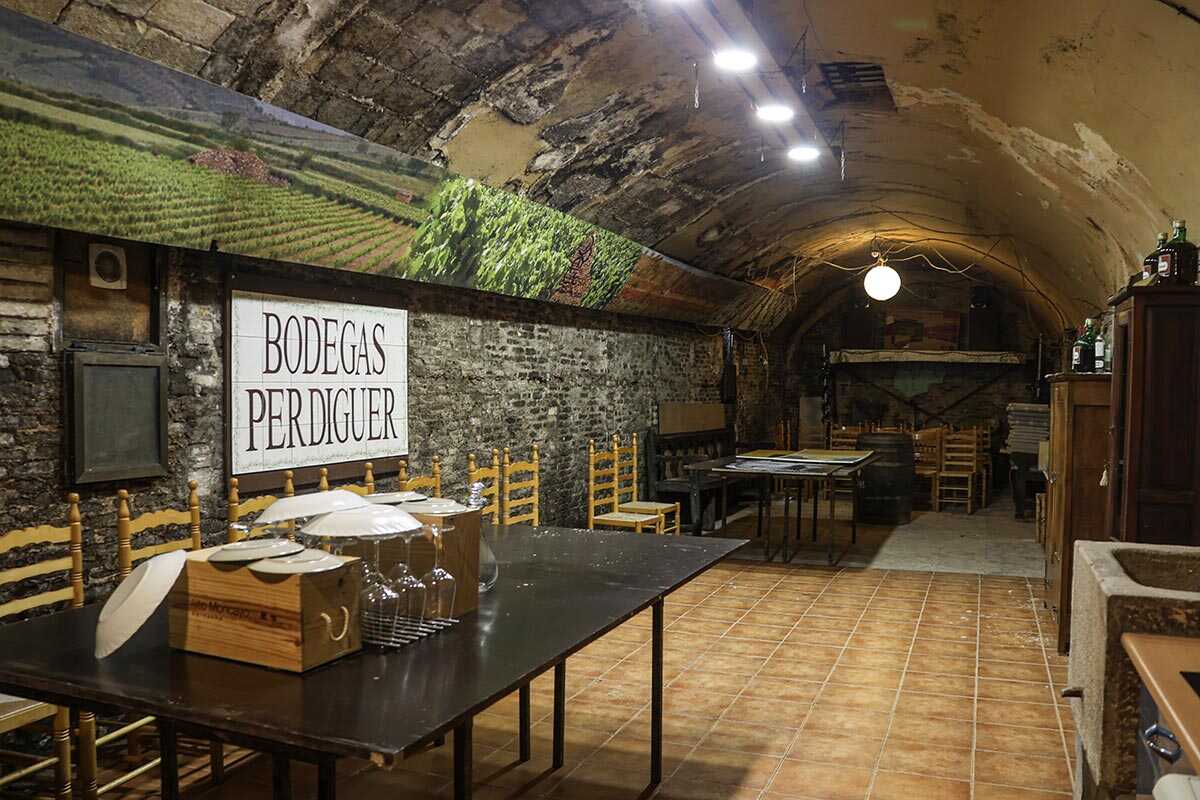
The basement of Casa Perdiguer houses a large space made up of vaulted brick and stone galleries that retain much of their original appearance. Several rooms still contain enormous wooden vats, old barrels and metal cages filled with bottles, elements that evoke the intense wine-making activity that took place beneath the establishment for decades. The dim lighting, walls and long corridors create an atmosphere that seems frozen in time and reinforce the historic character of the complex.
The space is also a unique testament to the industrial and artisanal past associated with wine
The underground route reveals different rooms connected to one another. Some retain a more rudimentary appearance and are practically untouched. The vaulted ceilings, stone floors and old wine tanks reflect the importance these cellars once held in the commercial life of the San Pablo neighborhood. Beyond their ethnographic value, the space is also a unique testament to the industrial and artisanal past linked to wine in Zaragoza’s historic center.
The existence of historic cellars around San Pablo is consistent with the urban and commercial layout the neighborhood traditionally had. Even so, no published archaeological documentation confirms the existence of a fully connected underground network linking different properties in the area.
For this reason, references to possible connections between nearby cellars or to their use during historic episodes, such as the Sieges of Zaragoza, belong mainly to oral tradition passed down by residents and owners from generation to generation.
FOUR GENERATIONS LINKED TO THE BUSINESS
The history of Casa Perdiguer has passed through four generations of the same family. The family business dates back to 1893, when Ramón Perdiguer founded a spirits and alcohol factory.
Later, Longinos and Francisco Perdiguer continued the activity in 1922. Agustín Perdiguer took over in 1940, followed by Fernando Perdiguer in 1947. Today, Juan Carlos Perdiguer runs the four stores the company has operated in Zaragoza since 1985.


