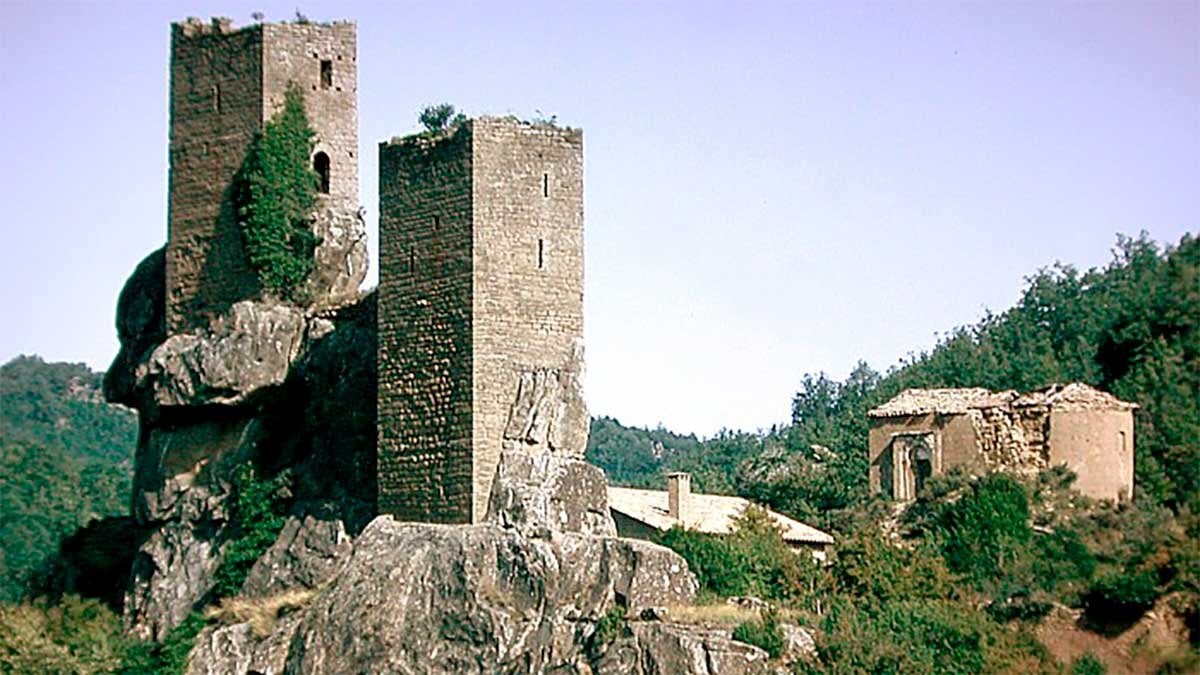
What now appears to be a landscape frozen in time was once a strategic settlement. The castle ruins and remains of a church endure as the last echoes of an ancient medieval stronghold.
But what history does this place in Zaragoza, where no one lives anymore, hold? How does its castle still cling to the cliffs? What remains of the Romanesque chapel? To find out, you have to look up.
SIBIRANA, THE ARAGÓN VILLAGE WHERE ONLY A CASTLE AND CHURCH REMAIN
Perched atop a rocky ridge about 12 kilometers from Luesia, Sibirana—also known as Sibrana or Siverana—played a key role in monitoring the territory during the Middle Ages. Some experts identify it with the “Castrum Silbanianus,” already mentioned in medieval writings as a defensive stronghold.
In the ninth century, it fell into the hands of the Banu Qasi, but was soon recaptured by Sancho Garcés I and incorporated into the defenses of the Kingdom of Pamplona. From the 12th century onward, it began to decline, although remains of its military and religious past still survive.
Today, the settlement has almost entirely disappeared, with the exception of the Romanesque church of Santa Quiteria. All of it lies among dirt tracks, scrubland and a horizon that has barely changed in centuries.
SIBIRANA CASTLE: A STONE GUARDIAN ABOVE THE VOID
Built with a clear defensive purpose, the castle stands on a narrow rock barely 25 meters long and 4 meters wide. From there, it overlooked the former route linking Luesia with Lobera de Onsella. Its Romanesque layout remains recognizable: two rectangular towers connected by walls that follow the contours of the cliff.
Fragments of walls and a cistern carved into the rock survive between the two towers. Farther down, beside the path, the ruins of former homes can be made out. The site was declared a Site of Cultural Interest in 2006 and forms part of Aragón’s heritage inventory, although it remains outside the tourist spotlight.
THE HERMITAGE OF SANTA QUITERIA: ROMANESQUE RUINS
A short distance from the castle, on the same summit, stand the remains of the Romanesque hermitage of Santa Quiteria. Although damaged by time, it retains architectural elements that make it possible to imagine its original splendor: a single nave, a presbytery and a semicircular apse built with finely cut stone blocks.
Its most notable feature is the south portal, where a semicircular arch with moldings remains, along with columns topped by capitals that are almost intact. The inscription “MCX,” probably dating from 1110, can still be made out at the entrance. Although the vaults have disappeared, a small window in the eastern wall offers a glimpse of the faint light that once illuminated this religious building.
HOW TO REACH SIBIRANA
Getting there is not easy, but that is part of its charm. From Luesia, take the road toward Uncastillo until reaching the Pígalo well, where a turnoff marks the route. A well-maintained forest track leads to the site’s surroundings.
Another option is a hiking route from Petilla de Aragón, part of a long-distance trail connecting several historic sites. Whichever route you choose, the destination is the same: a solitary summit where time stood still, and where the castle and church endure as silent witnesses to a forgotten history.


