Although some of Aragon's most iconic castles are found in Teruel, such as Mora de Rubielos Castle (the largest in Aragon) and Alcañiz Castle (now a National Tourism Parador), this time we turn in a different direction: Huesca.
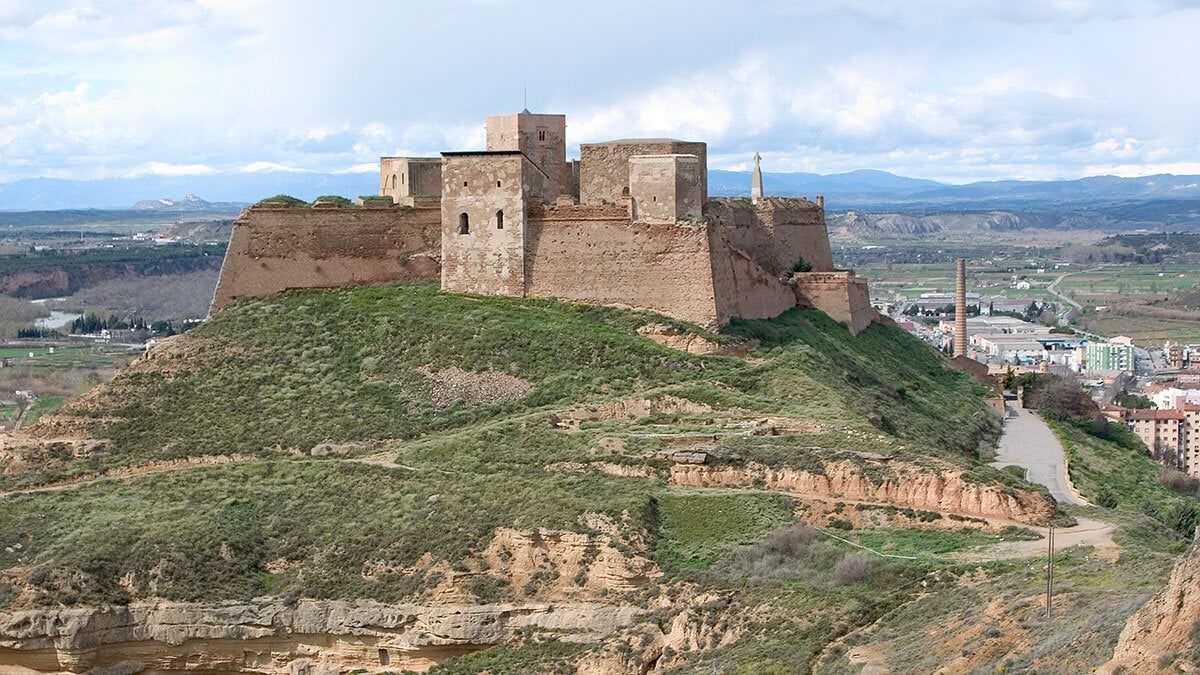
Monzón Castle has been the setting for battles, a refuge for military orders and a school for knights. Photo: Turismo de Aragón
Another of the most imposing and symbolic castles is Monzón Castle, a site that has served as the setting for battles, a refuge for military orders and a school for knights. Strategically located on a hill overlooking the Cinca Valley, Monzón Castle stands out not only for its imposing silhouette, but also for its Templar legacy.
Although that legacy belongs to the past, it is still preserved in the castle's walls and possessions, allowing visitors to embark on a journey into history. Let us explore the story of this Templar gem.
THE ORIGINS OF MONZÓN CASTLE
The castle's origins date back to the ninth century, when Muslims built a defensive fortress on the hill and the settlement they controlled in Monzón. Historical records describe Monzón Castle as a fortress marked by conflict: Ismail Banu Qasi of Zaragoza was held prisoner there in 872, it was occupied by El Cid in 1083, and it was conquered by Sancho Ramírez and his son Pedro in 1089. Soon afterward, the Kingdom of Monzón was founded with the castle as its seat, and Pedro inherited his father's crown to become Peter I.
At the same time, the castle began to be transformed into a key part of Aragon's defensive system against Al-Andalus. As a result, Monzón Castle became one of the most important strongholds in Upper Aragon.
Throughout the 12th century, the fortress was reinforced and expanded once again, adapting to new military and political needs. Its privileged location made it possible to control routes to the south and also served as a refuge for troops and authorities. Thanks to its strategic importance and renovations carried out over the previous two centuries, the fortress attracted the attention of the Knights Templar, who received the castle in 1143, thus beginning its most legendary period.
MONZÓN'S TEMPLAR PAST
With the arrival of the Templars, Monzón Castle underwent another transformation, both in its structure and its purpose. It became a conventual castle, meaning it was not only defensive but also a place of education and religious life. The infante James I the Conqueror was educated here under the tutelage of the Templar master Guillem de Montrodón, following the death of his father, Peter II, at the Battle of Muret.
With the arrival of the Templars, Monzón Castle underwent another transformation, both in its structure and its purpose
This connection with the future king added even greater weight to the legend surrounding the castle. It is said that the Templars hid part of their treasure here, although it has never been found. It is also said that, during the siege of 1309, when the Templars were disbanded, the defenders held out for months thanks to secret passageways and almost superhuman resistance, enhancing the site's mystical aura.
A SOBER AND EFFECTIVE DESIGN
The architectural design of Monzón Castle reflects the evolution of medieval military engineering, as well as a combination of different cultural influences. As a stronghold of Islamic origin, its earliest phases feature square towers and rammed-earth walls. However, under the Christians and later the Templars, improvements were introduced, including semicircular towers, barrel vaults, cisterns, stables and a terraced defensive system.
Monzón Castle also hosts theatrical activities, night visits and events throughout the year
The complex is divided into three main enclosures: the upper castle or noble area, with the keep and main rooms; the middle enclosure, with the Romanesque church and defensive structures; and the lower area, with stables and warehouses. The entire complex fits perfectly into the shape of the hill, creating a fortress that was practically impregnable for its time.
Indeed, both its architectural beauty and its multicultural heritage, together with its key role in the history of the Kingdom of Aragon, led to Monzón Castle being declared a National Monument in 1949. Today, its restored and well-preserved walls are open to the public, allowing visitors to journey into the past among battlements, passageways and legends.
MONZÓN CASTLE PRICES AND OPENING HOURS
Monzón Castle has different opening hours depending on the time of year. During the summer season, from March to October, it is open from Wednesday to Sunday from 10:00 a.m. to 2:00 p.m. and from 4:30 p.m. to 7:30 p.m. On Tuesdays, it can only be visited in the afternoon, from 4:30 p.m. to 7:30 p.m., while it remains closed on Mondays.
During the winter season, from mid-October to mid-March, the usual hours are from 10:00 a.m. to 2:00 p.m. and from 3:00 p.m. to 5:30 p.m., with opening from Tuesday afternoon through Sunday.
General admission costs 3.50 euros, while the reduced rate is 2.50 euros for retirees, large families, unemployed people and students under 25. Admission with historical reenactment costs 4.50 euros.
For groups of 15 or more, the price is 2.50 euros per visitor, while school groups pay a rate of 1.25 euros per student.
Admission is free for children under 9, people with disabilities, tour guides and students enrolled in Monzón who visit as part of a group.
HOW TO GET TO MONZÓN
If the castle's history and legends have completely captivated you, do not hesitate to visit Monzón and immerse yourself in the Templar past of its fortress.
To help you plan your trip as effectively as possible, especially if you are traveling with a sizable group, here are the easiest routes to the town from Aragon's three main cities.
From Huesca
From the provincial capital of Huesca, you can take three different routes:
• You can drive a car or ride a motorcycle along the A-22 and reach Monzón in approximately one hour.
• You can take a Grupo Avanza bus from Huesca Bus Station and reach the town in approximately one hour and 15 minutes.
• Or you can take a Renfe train from Huesca Station and reach Monzón in approximately one hour and 20 minutes.
From Zaragoza
If you plan to travel to Monzón from Zaragoza, you can also choose from three options:
• Drive a car or ride a motorcycle along the A-23 and A-22 and reach Monzón in approximately one and a half hours.
• Take a Grupo Avanza bus from the Central Bus Station and arrive in Monzón in approximately one hour and 40 minutes.
• Take a Renfe train and reach the town in approximately one hour and 20 minutes.
From Teruel
Finally, if you are traveling from Teruel, we recommend choosing the option of driving a car or riding a motorcycle. If you plan to travel with a large group, organize yourselves properly to make the journey efficiently.
This is because this is the longest and most demanding of these routes, so we recommend this option alone because it is the most accessible and fastest. To do so, you will have to take the A-23 to Zaragoza and then the A-22 to Monzón, a journey that takes approximately three hours.
Visiting Monzón Castle means stepping into the living history of Aragon. Its walls tell of the passage of cultures, kings and Templar knights, while its silhouette, visible from miles away, continues to remind us that there was a time when these stones determined the fate of a kingdom. That era has passed, but to this day its legacy continues to spark the imagination of those who dare to cross its gates.


