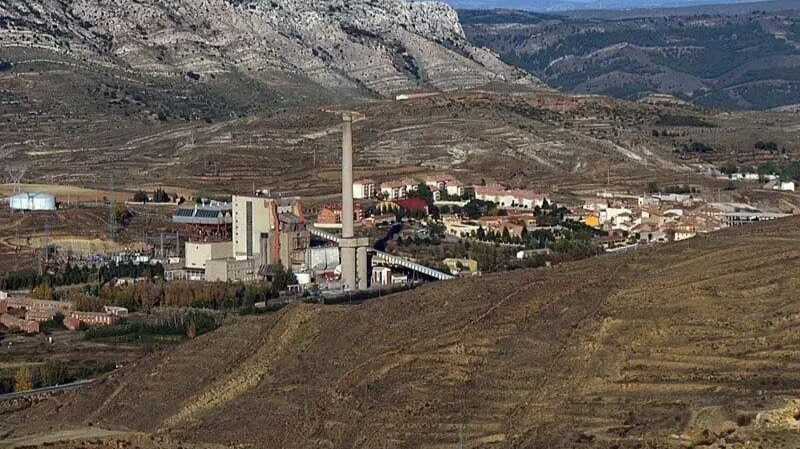
The Directorate-General for Culture and Cultural Heritage has proposed as an alternative that Escucha Town Council, in agreement with the owner, preserve the movable and immovable elements it considers most significant and incorporate them into the mining heritage it already promotes. The resolution also proposes creating a digital twin of the complex to preserve its memory without having to physically maintain the entire facility.
THE PLANT HAS A DEMOLITION PERMIT
Repsol Generación Ciclos Combinados S.L.U., the plant’s owner, applied to Escucha Town Council on September 8, 2025, for a major works permit to completely dismantle the complex. The project was referred to the Provincial Commission for Cultural Heritage of Teruel, which raised no objections, considering that the property lacked regional cultural protection.
After receiving the request to protect the plant, the Culture Department consulted Escucha Town Council about the complex’s planning status. The council reported on July 1 that the General Urban Development Plan provided for its complete demolition and that the permit had been granted on June 4. Five days later, on July 6, the Directorate-General for Culture and Cultural Heritage temporarily suspended any works or activity at the facilities while it assessed whether protection proceedings should be opened.
Subsequently, the Cuencas Mineras District and Utrillas Town Council requested to participate in decisions and discussions concerning the plant and the recovery of mining heritage. In addition, Repsol filed an administrative appeal on July 30 against the temporary resolution that had halted the work.
THE GOVERNMENT QUESTIONS THE FEASIBILITY OF PRESERVING THE COMPLEX
Among the reasons for rejecting protection, the Directorate-General points out that no request for a declaration has been submitted by Escucha Town Council, the district or the Provincial Council of Teruel. The resolution also considers that maintaining the entire complex “could mortgage the municipality’s own development,” limiting its expansion in several parts of its municipal area, and adds that “the opinion of the municipality itself is essential, and it has made its position clear by granting the permit to demolish the complex.”
The Aragon Government also warns that the building requires urgent structural work and contains polluting elements that must be removed by specialized companies. According to the resolution, this is compounded by the absence of a specific plan to secure its future: “The fundamental problem is that the proposed declaration is not accompanied by any feasibility project for the complex drawn up, supported and coordinated by any public administration.”
The Directorate-General maintains that a protection declaration would not, by itself, guarantee the preservation of the property. Without an action plan, it says, “the declaration could lead to a period of inactivity at the complex that would accelerate its deterioration” in the future while the project is drafted and funding—currently not guaranteed—is secured.
PRESERVING THE MOST SIGNIFICANT ELEMENTS
The resolution acknowledges the historical and social value of the Escucha Thermal Power Plant, although it considers that “its architectural values are less evident, as they are subject to subjective opinion and there is no broad technical consensus on them.”
For this reason, the Culture Department advocates preserving only those movable and immovable elements that Escucha Town Council and the owner consider to be of particular interest and adding them to the cultural and heritage initiatives already centered on mining heritage. It also proposes digitally documenting the complex through a digital twin.
The Directorate-General concludes that protecting all the facilities without a viable project would be “irresponsible,” since “far from solving the problem, the only thing it would do would be to pass the problem on to the medium and long term, jeopardizing the future development of the municipality of Escucha.”


