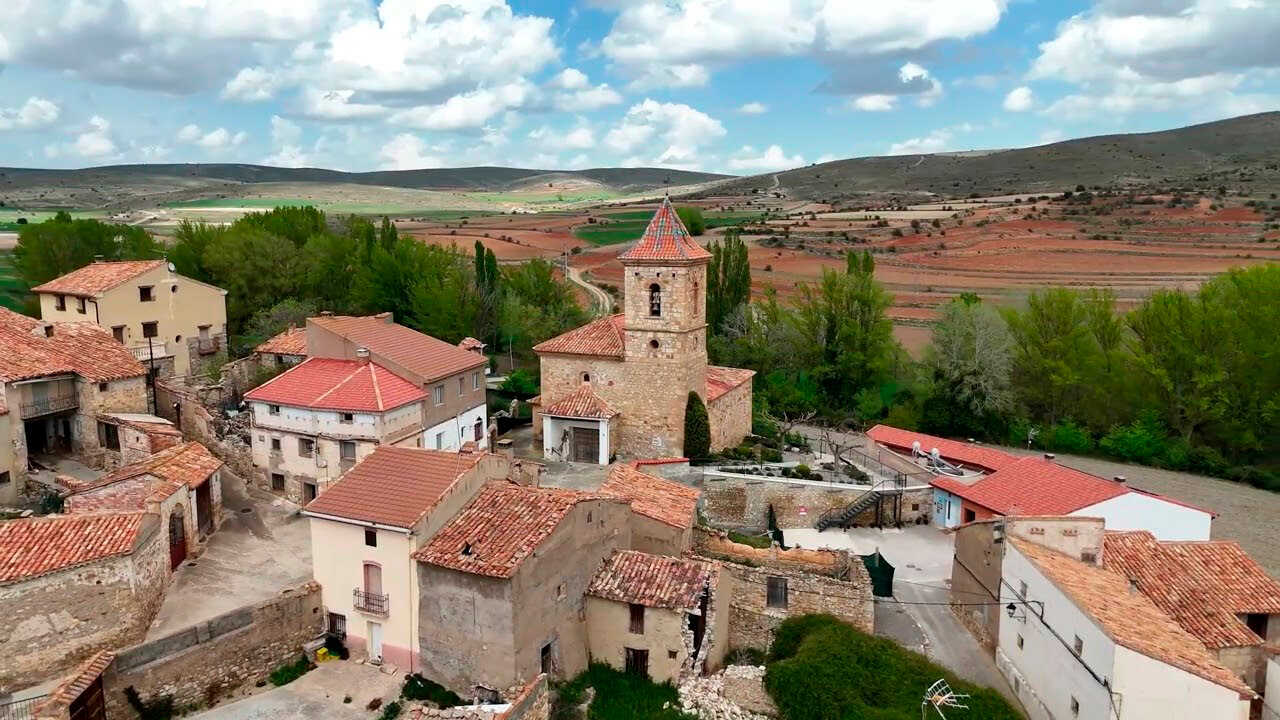
Located in Aguatón, one of Aragon's least-populated municipalities, the village has barely 18 registered residents. Beyond its small urban centre, its true appeal lies in the surrounding landscape and the network of trails that start in the village itself—an invitation to discover on foot one of the least-known areas of inland Teruel.
ROUTES AND TRAILS STARTING IN THE VILLAGE ITSELF
Aguatón is an unexpected destination for those who enjoy walking. Several well-defined and signposted local trails begin in the village and can be explored on foot or by mountain bike. One of the most demanding is the Vaqueriza route, a circular trail that climbs quickly to elevations close to 1,400 metres and offers open views across the entire municipality and the Jiloca Valley.
Another of the most striking routes is the trail through the Hoz ravine, which enters a narrow gorge with pools of water and rocky walls. The path runs alongside an area classified as a unique woodland and allows visitors to observe up close the intense geological activity that characterises this part of the Sierra Palomera.
The network is completed by the Virgen del Castillo route, which connects the urban centre with the chapel located several kilometres from the village. The trail crosses the valley floor and passes by the remains of industrial heritage, now turned into resting spots for walkers.
WHAT TO SEE IN AGUATÓN BEYOND THE ROUTES
Although small, the urban centre preserves several features that reveal its rural past. The 17th-century Church of El Salvador dominates the village and defines the skyline of its buildings. Next to it stands the town hall, with an arcade on the ground floor, along with other traditional features such as the washhouse.
In the surrounding area, the Chapel of the Virgen del Castillo stands out. Built in the 17th century, it is located in peaceful surroundings beside a picnic area frequently used by hikers. Remains of old ovens and features linked to the more recent history of the 20th century have also been preserved, integrated into the landscape without altering the character of the place.
HOW TO REACH ONE OF TERUEL'S LEAST-KNOWN VILLAGES
From Zaragoza, the usual route follows the A-23 to Teruel and then continues north along the regional road network. The final stretch crosses an increasingly open landscape, with ravines and landforms that anticipate the area's natural character.
Travellers coming from Huesca should take the A-23 towards Zaragoza and then join the same motorway in the direction of Teruel. From there, the journey continues along the regional road network towards the north of the province. Although it is a long trip, the final section offers an increasingly open landscape, with ravines and pine woodland.
From Teruel, access is straightforward and short. Simply take the road towards Argente and continue along the road connecting with Torrelacárcel. Aguatón appears after several kilometres of rural landscape, in an elevated area surrounded by ravines that reinforce the feeling of isolation and tranquillity.


