Although the Virgin of the Pillar and Saint Valerius are the figures most closely linked to Zaragoza’s traditions, Saint Engracia played a prominent role in local devotion until the Virgin of the Pillar was proclaimed the city’s patron saint in 1642. Her feast day is celebrated every April 16.
THE HISTORY OF SAINT ENGRACIA
But who was Engracia? Tradition holds that she was a young Christian woman from Braga (Portugal) who, at the beginning of the fourth century, was tortured and killed in Zaragoza during the persecutions of Diocletian. The nail with which she was martyred in the forehead eventually became her most recognizable symbol.
Centuries later, in 1480, her importance grew even further when King John II attributed the recovery from a serious eye ailment to the saint. After entrusting himself to her, he promoted the construction of the Monastery of Santa Engracia, a project later completed by Ferdinand the Catholic. Today, little remains of that monastery apart from its entrance and crypt, following the destruction it suffered during the Sieges of Zaragoza.
The crypt houses relics attributed to Saint Engracia, including a skull traditionally identified as belonging to the martyr.
A TREASURE BENEATH ZARAGOZA
The site dates back to the early centuries of Christianity. It is accessed from inside the Basilica of Santa Engracia, down a staircase leading to one of the most distinctive corners of Zaragoza’s heritage.
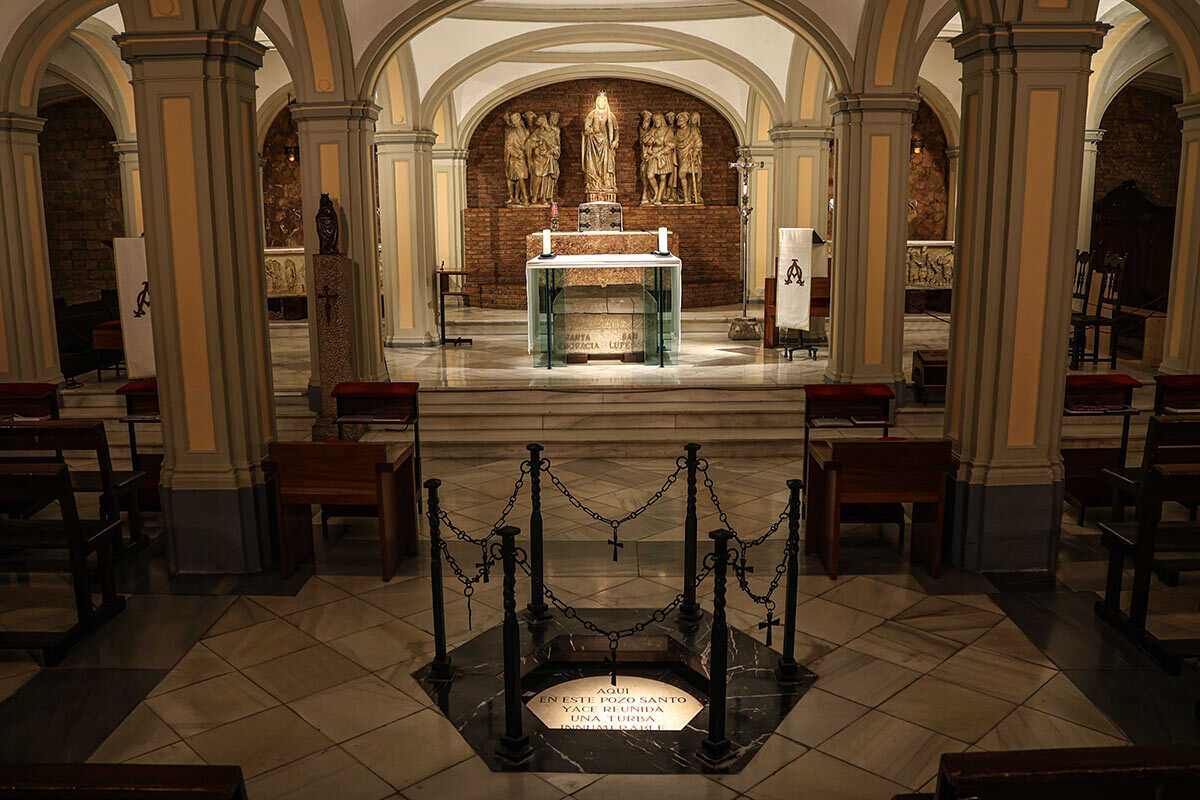
The crypt can be visited freely as long as no religious services are taking place. Photo: Pilar Álvarez
Immediately upon entering the crypt, visitors will notice a stone sculpture of the saint and, beneath it, several archaeological remains discovered in 2008, including a hexagonal baptistery and a baptismal font.
The present-day crypt is the result of reconstruction work begun in 1814 thanks to a public fundraising campaign launched after the damage caused by the Peninsular War. The work was completed in 1819, creating the space that can be visited today: an underground church with five naves, low-vaulted ceilings and quadrangular pillars.
During the work, tombs and human remains traditionally associated with the martyrs were discovered, reinforcing the site’s historical importance. Years later, damp caused by the nearby Huerva River led to another restoration in 1991.
The crypt houses relics attributed to Saint Engracia, including a skull traditionally identified as belonging to the martyr
Today, the Crypt of Santa Engracia remains one of the great hidden treasures beneath Zaragoza’s central, bustling streets.
WHEN IT CAN BE VISITED
The crypt can be visited freely as long as no religious services are taking place. In addition, the Alma Mater Museum organizes guided tours to explore this historic and religious underground site in depth.
• Free visit: access is permitted as long as no religious services are taking place. • Guided tour: more information and bookings are available on the Alma Mater Museum website.